
15 Learners, One Shared Experience: Smith College Alumnae Study the Civil Rights Movement

- For a class reunion, 15 members of the Smith College Class of 1969 embarked on a private group learning adventure to study the Civil Rights Movement.
- As they traveled across Georgia and Alabama, Smith alumnae and Road Scholars Susan, Linda and Janet each found moments that stayed with them, including the Equal Justice Initiative and the National Memorial for Peace and Justice.
- For these classmates, it was fascinating to gain a new perspective on some of the events that took place during their college days through expert insight and discussions with one another.
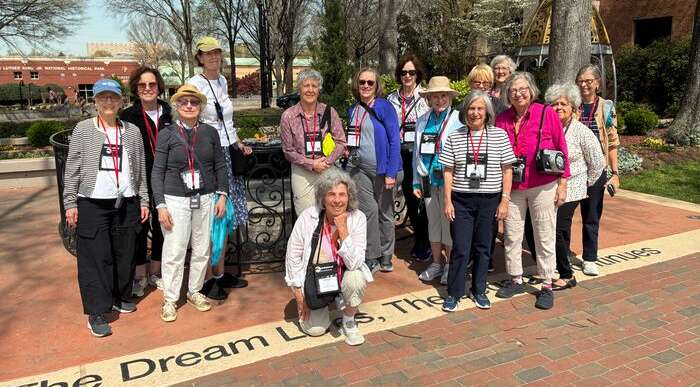
Almost 60 years ago, 15 students from Smith College’s Class of 1969 were looking forward to graduation, aware of — and yet isolated from — the events of the Civil Rights Movement that were taking place across the country. This past March, they were able to gain a new perspective on these events together. Three members of this group — Smith alumnae Susan M., Janet H. and Linda S. — shared their Road Scholar experience.
As members of a private group program with Road Scholar, these “Smithies” were drawn to the opportunity to gather with classmates in a setting outside of campus. But they were also intrigued by the learning opportunities and its relevancies to their lives.
“When our classmate recommended this Road Scholar program as a reunion option, I think it really struck a chord with us because we would have lived together, at the same age, when the Civil Rights Movement was taking place,” Janet explained. “I think that appealed to us as a way to revisit this experience that we had gone through together, but at a very different age and time. And some of us had grown up with very different backgrounds, and it was important for us to go through it again.”
How It All Began
Though this learning adventure took place across Georgia and Alabama, the seeds of the reunion were planted on Zoom. “We have regular Zoom meetings organized for our class, and one of the people that started that Zoom gathering had gone on this Road Scholar program,” Susan explained. “And she just thought it was a fantastic experience, and maybe we could do something like that as a class. She spoke to Road Scholar, and that’s how the idea all started. We just threw it open, and people started signing up!”
Even though they had all graduated at the same time, not everyone knew each other prior to the program starting. “It was just easy with a number like 15, but it wasn’t too small either.” Linda said. “You can mix a lot and sit next to different people. I didn’t know many of the people very well, and so being in a small group like that, we could just randomly be sitting next to somebody and get to know them. And that was a real plus to the program too. Of course, we did have a common theme within the group, so that made it easy. We all had a starting point for conversation.”
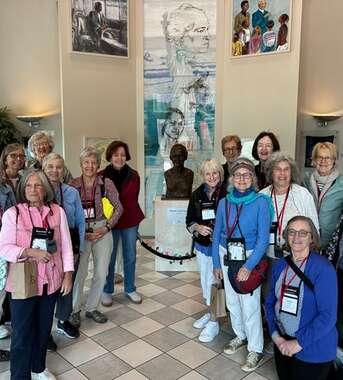
Not everyone in the group had been on a Road Scholar learning adventure previously either. While Susan had recently gone on a cycling program from Vienna to Munich and Janet has taken her grandchildren on Grandparent programs, the experience was new for Linda.
“This was my first Road Scholar program, so I had no background other than having heard people talk about it in the past,” she said. “I really think it was very well organized and presented, and I felt there was no time wasted, that it was really made worth our while.”
An Impactful Learning Experience
“We specifically chose to do this program as a group,” Susan said. “It was the theme that drew us in and made us interested in this program.”
Over eight days, the group traveled from Atlanta, Georgia, to Birmingham, Alabama. Along the way, they stopped at pivotal sites in the Civil Rights Movement, including the Edmund Pettus Bridge and the Dexter Avenue King Memorial Baptist Church. For each woman, different sites made lasting impacts.
“I was really struck by the work of the Equal Justice Initiative in Montgomery,” Janet said. “I had read Bryan Stevenson’s book, but I had no idea how broad their reach was. It’s transformed, in my mind, Montgomery into this flowering center of redemption of so much of the history, in the way that it’s being explained and brought to light.”
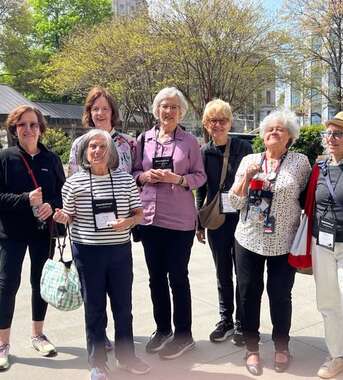
For Linda, it was the National Memorial for Peace and Justice. “Such an overwhelming, overpowering experience to think that this is our country’s history. And to have the monument broken down by county was really what made it so individualized, in a way that a mass monument normally wouldn’t be.”
Memories of the Past, Lessons for the Present
For this group, the events of the Civil Rights Movement were landmarks of their time in college together. Revisiting them was a way to connect with their past while continuing their learning journey.
“We really did live this, watching it unfold,” Linda said. “So it made it extremely personal. We did talk about that along the way — ‘I remember seeing this on television,’ or ‘I discussed this with my parents.’ And seeing it now brings it back in a totally different way from what we saw as young women. The program as a whole has really stayed with each of us in an important way.”
Janet agreed. “I feel like I was very far away from it in a lot of ways, being in Massachusetts for college. I was the only one in the group who had grown up in the South, specifically Atlanta, and my parents were both from the South. A moment that stood out to me was at the National Center for Civil and Human Rights — the first thing was an exhibit about ‘50s and ‘60s Atlanta and a visual display of segregation. And I was so struck by that — that the people in the pictures looked like they could be my parents, and the swimming pool looked like one I could have visited.”
The group’s experiences with the people they met along the way also made a huge impact. “Our Group Leader was such an asset in many ways,” said Linda. “That Road Scholar has a person like her with her connections to run this program is a great plus. She had Bill Baxley come in to talk to us, the former Alabama Attorney General who had prosecuted one of the men convicted of the 16th Street Baptist Church bombing. He spoke to us over dinner about his pursuit of the murderers of the young girls, and I think that made it even more real in many ways. For all of us to hear his quest to do justice was a very meaningful experience.”
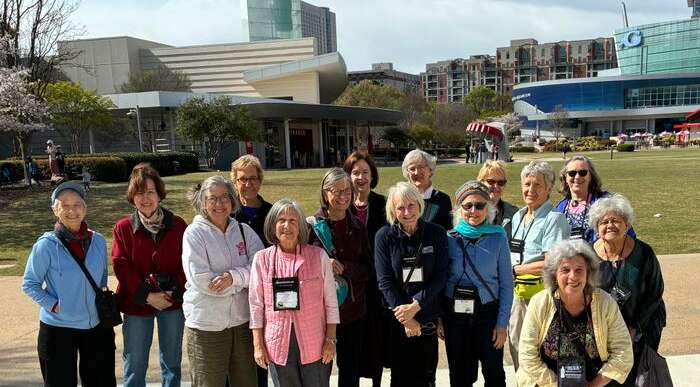
Fifteen Learners, One Shared Experience
The fifteen members of Smith College’s Class of ’69 may not have all started the program knowing each other, but they found connection in their shared learning journey.
“What was wonderful about this was that many of us had seen each other from time to time, but we’re dispersed in different places,” said Janet. “So, to explore things from your past and your present and have concentrated time to sit together and talk about your experiences and what things meant to you — that was really special. This was a way to bring us together over a meaningful subject and to have the time to discuss the topic with other people — that’s special at our ages.”
Interested in learning more about the Civil Rights Movement? Join us on The Civil Rights Movement: Atlanta, Montgomery, Selma, Birmingham, or explore our additional civil rights programs: Rhythm of Resistance: Civil Rights & Jazz in New Orleans and The Civil Rights Movement in Jackson, Memphis & Nashville.
Lauren Briggs first discovered Road Scholar at the age of ten, when she embarked on a Grandparent Adventure with her grandfather. In 2022, she reconnected with the
organization and began writing for Road Scholar full-time. Lauren is especially passionate about sharing participant stories, including her own Road Scholar experiences in South Dakota and Grand Teton National Park. She lives in Massachusetts and enjoys spending summers exploring New England in her campervan.