
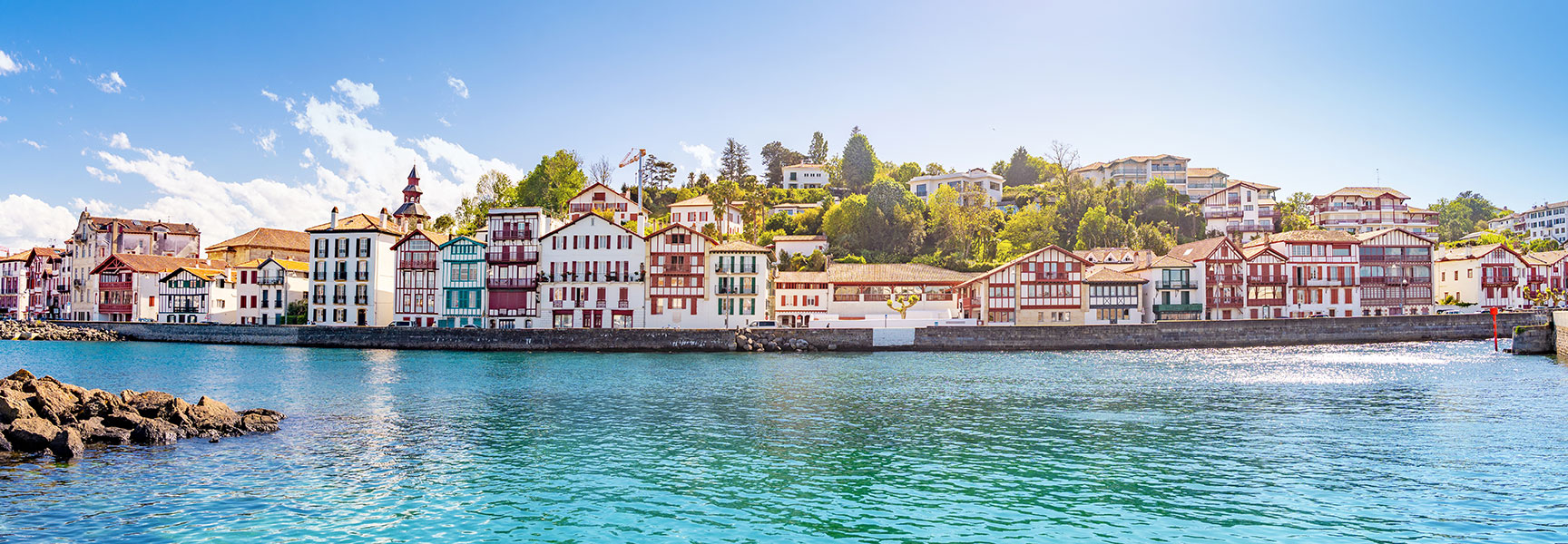

Spain/France
Bordeaux & Basque Country: A Tale of Two Cultures
Program No. 25666RJ
See More Photos
Bordeaux & Basque Country: A Tale of Two Cultures
Bordeaux & Basque Country: A Tale of Two Cultures
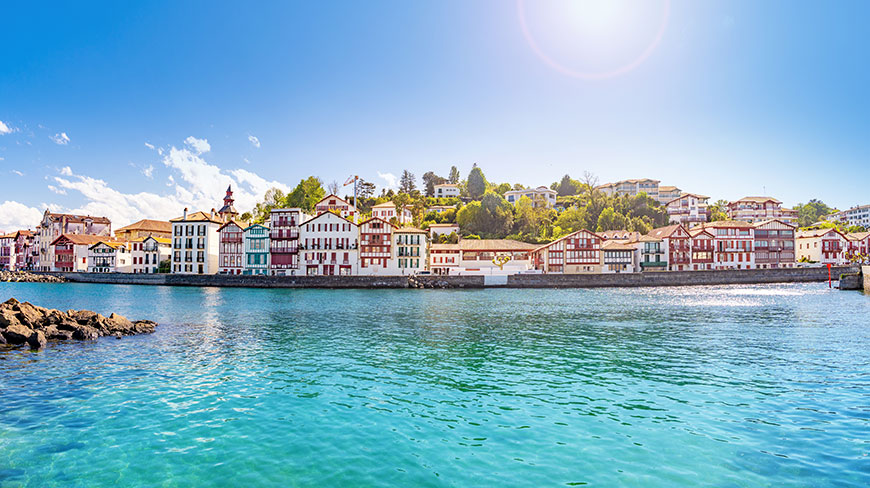
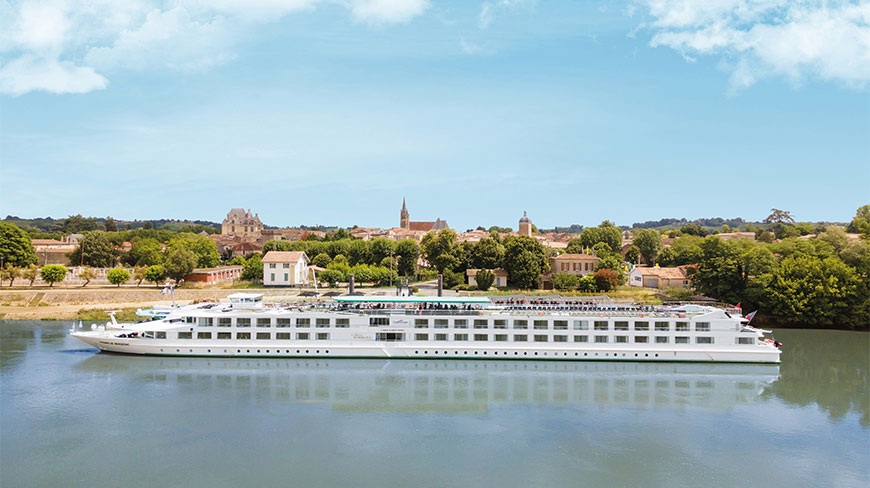
1 of 10
Itinerary
While we make every effort to ensure the accuracy of our published materials, programs are typically advertised more than a year prior to their start date.
Read More.
All itineraries and excursions are subject to change. Weather and water conditions may affect the progress of the ship, and we may miss ports if it is not safe to dock. The operators reserve the right to change the content and duration of excursions without prior notice and so the cruise itinerary should always be regarded as provisional. Whenever possible, Road Scholar’s published daily schedule will indicate port arrival and departure times. Prior to departure, if there is a major change, we will make every effort to alert you. For less significant changes, we will update you during orientation. Thank you for your understanding.
Duration
13 days
12 nights
What's Included
Included
26 meals (
11B, 7L, 8D
)
7 expert-led lectures
17 expert-led field trips
An experienced Group Leader
Taxes and customary gratuity
Road Scholar Assurance Plan
Bordeaux
Bordeaux & Basque Country: A Tale of Two Cultures
Sep 15 - Sep 27, 2027
Program Number
25666
Day
1
In Transit to Program
Location:
In Flight
Day
2
Arrive Bordeaux, Check-in, Orientation, Welcome Dinner
Location:
Bordeaux
Meals:
D
Stay:
Quality Hotel Bordeaux Centre
Activity Note
Activity Notes Hotel check-in from 3:00 p.m. NOTE: The large group will be split into smaller groups of approximately 25/30 participants. In order to ensure you will be placed in the same small group as your traveling companions, please make sure to include their names on your Participant Information Form.
Afternoon:
Orientation: The Group Leader will greet everyone and lead introductions. We will review the up-to-date program schedule, discuss roles and responsibilities, logistics, safety guidelines, emergency procedures, and answer questions.
This is a Chartered Exclusively for Road Scholar Adventures Afloat program. Port stops and field trips are subject to change as weather and river conditions could affect the progress of the vessel, making it run late and possibly miss ports if it is not safe to dock. The cruise itinerary should therefore be regarded as provisional. The time available in each port is set by the cruise line, which may mean free time in port is limited. The cruise line reserves the right change the itinerary without prior notice. When possible, the Road Scholar daily schedule indicates port arrival and departure times.
Our knowledgeable Group Leader will also serve as our Study Leader, giving lectures and providing expert commentary throughout the program.
Periods in the schedule designated as “Free time” and “At leisure” offer opportunities to do what you like and make your experience even more meaningful and memorable according to your personal preferences. The Group Leader will be happy to offer suggestions.
Program activities, schedules, personnel, and indicated distances or times may change due to local circumstances/conditions. In the event of changes, we will alert you as quickly as possible. Thank you for your understanding.
This is a Chartered Exclusively for Road Scholar Adventures Afloat program. Port stops and field trips are subject to change as weather and river conditions could affect the progress of the vessel, making it run late and possibly miss ports if it is not safe to dock. The cruise itinerary should therefore be regarded as provisional. The time available in each port is set by the cruise line, which may mean free time in port is limited. The cruise line reserves the right change the itinerary without prior notice. When possible, the Road Scholar daily schedule indicates port arrival and departure times.
Our knowledgeable Group Leader will also serve as our Study Leader, giving lectures and providing expert commentary throughout the program.
Periods in the schedule designated as “Free time” and “At leisure” offer opportunities to do what you like and make your experience even more meaningful and memorable according to your personal preferences. The Group Leader will be happy to offer suggestions.
Program activities, schedules, personnel, and indicated distances or times may change due to local circumstances/conditions. In the event of changes, we will alert you as quickly as possible. Thank you for your understanding.
Dinner:
We’ll walk to a local restaurant near the hotel. We’ll have a plated meal with a beverage choice of water, wine, soft drink; other beverages available for purchase. French restaurants take pride in creating a relaxed atmosphere where patrons expect to take their time, savor every bite, and set the pace of the meal, requesting “l’addition” — the check — only when they are ready. Meals are accompanied by complimentary “pain” (bread) and “eau” or “l’eau” (water), so you need not ask for them. When wine is offered, it is customary to fill your glass only half way so the wine can breathe and to be sure everyone has a share. Servers wait until everyone at the table has finished their dish before clearing and bringing the next course. To indicate that you have finished your meal, place your utensils together on the right hand side of your plate.
Evening:
At leisure.
Day
3
Bordeaux, Museum of Aquitaine
Location:
Bordeaux
Meals:
B,L
Stay:
Quality Hotel Bordeaux Centre
Activity Note
Walking up to 3 miles over the course of the day; cobblestone streets, uneven terrain, flat ground. Standing up to 2 hours at a time during field trips. When sampling wines during a tasting, participants have the option to swallow or spit.
Breakfast:
At the hotel, we’ll have a breakfast buffet with a variety of foods and beverage choices of coffee, tea, water, juice, milk.
Morning:
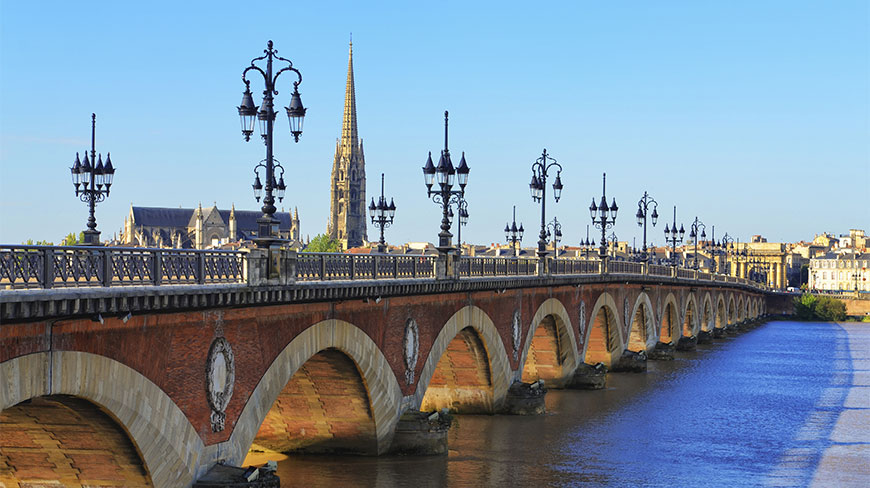
We will then head out on foot with a local expert to explore historic Bordeaux, a UNESCO world heritage site. We’ll hear the story of Bordeaux and learn of its importance with special emphasis on its UNESCO-listed World Heritage architecture. From the UNESCO inscription: “The port city of Bordeaux in south-west France, is inscribed as an inhabited historic city, an outstanding urban and architectural ensemble, created in the age of the Enlightenment, whose values continued up to the first half of the 20th century, with more protected buildings than any other French city except Paris. It is also recognized for its historic role as a place of exchange of cultural values over more than 2,000 years, particularly since the 12th century due to commercial links with Britain and the Low Lands.” One of the sights we will see is the cathédrale Saint-André. Eleanor of Aquitaine and French king Louis VII were married at this cathedral in 1137. With its freestanding belltower, this is one of the most beautiful cathedrals in Bordeux. This cathedral is also a stop on the Routes of Santiago de Compostela. These routes pass through several regions of France and Spain and are also a UNESCO world heritage site.
Lunch:
At a local restaurant, we'll learn about the importance of the wine trade from a local expert while enjoying a wine tasting and plated meal featuring local products. There will be water served with the meal; other beverages available for purchase.
Afternoon:
We will walk to the Museum of Aquitaine where a local expert will take us on an exploration of the museum and give us an overview on the history of the region, from prehistoric times, through the Middle Ages and the slave trade era, to today. As we explore the exhibits, we’ll learn more about the significant role trade played in the development of Bordeaux.
Dinner:
On your own
Evening:
At leisure.
Day
4
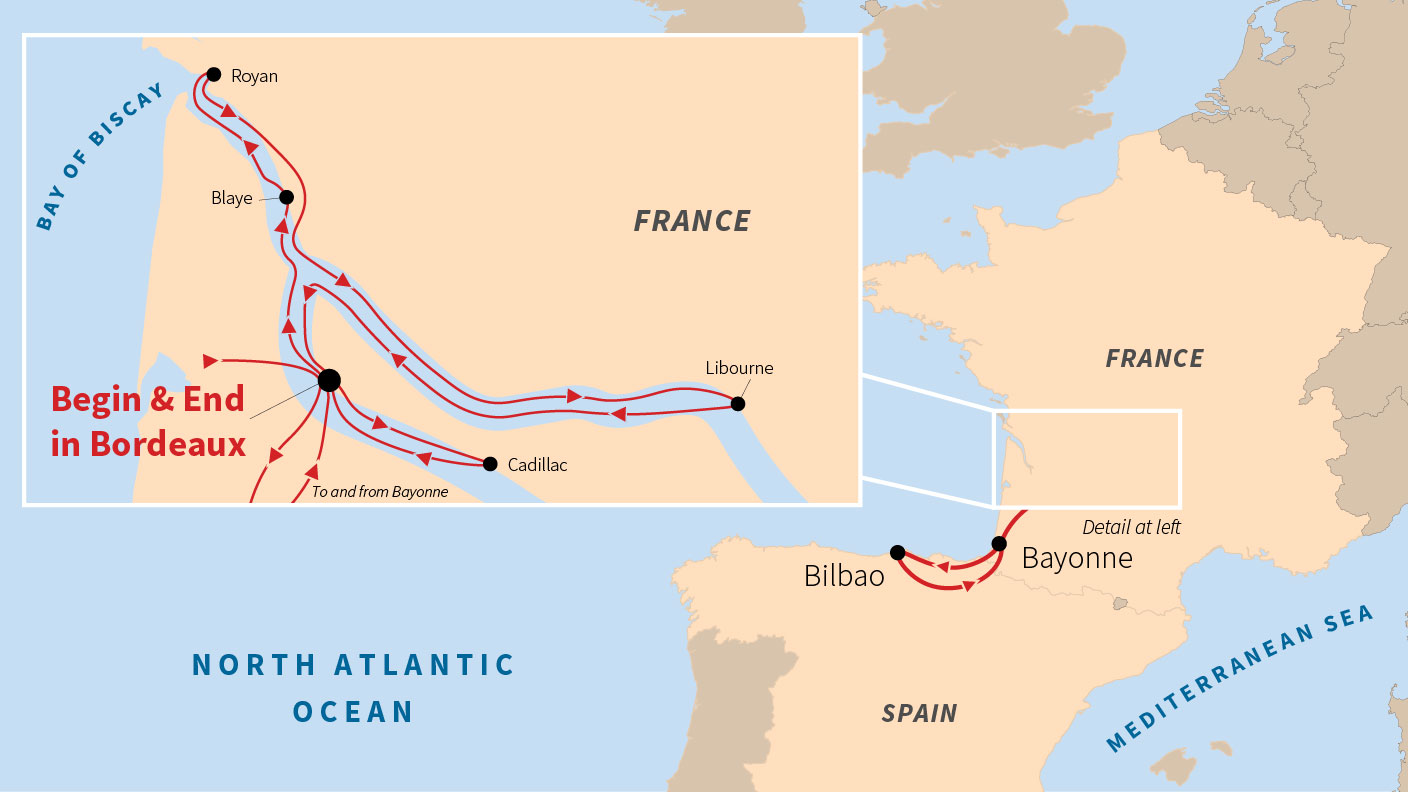
Arcachon and Biarritz
Location:
Bayonne
Meals:
B,D
Stay:
Mercure Bayonne Centre Le Grand Hotel
Activity Note
Getting on/off motorcoach; driving approximately 230 miles (370 km); about 4 hours, with a stop in Arcachon. Walking up to 2 miles total throughout the day; periods of standing up to 1 hour at a time; cobblestone streets.
Breakfast:
At the hotel.
Morning:
We will gather with our Group Leader and head out by motorcoach to to the Arcachon Basin, a sheltered tidal lagoon separated from the Atlantic by a long sandbar. This is one of France's great oyster-producing regions. You will explore the town on foot and taste freshly harvested Arcachon oysters, flat-cupped and delicate, with a flavor shaped by the cold, clean Atlantic water flowing in and out of the Basin with every tide. Upon arrival in town, we will discover Arcachon on foot and we will have an opportunity to taste fresh Arcachon oysters.
Lunch:
On your own
Afternoon:
We will return from our field trip and continue south along the Atlantic coast to Biarritz. Before the 19th century, the ocean was something to fear, not enjoy. The Romantic movement changed that and then Empress Eugénie, the Spanish-born wife of Napoleon III, sealed the transformation when she chose Biarritz as her summer residence in the 1850s. Royalty from across Europe followed, and the town blossomed with grand hotels, villas, and a promenade.
Dinner:
At a local restaurant near the hotel, we’ll have a plated meal with coffee, tea, water; other beverages available for purchase.
Evening:
At leisure.
Day
5
St Jean de Luz, Espellette
Location:
Bayonne
Meals:
B,D
Stay:
Mercure Bayonne Centre Le Grand Hotel
Activity Note
Getting on/off motorcoach; driving approximately 47 miles (76 km) roundtrip; 1.5 hours throughout the day, with stops for field trips. Walking up to 3 miles throughout the day; even and uneven terrain, certain steps unavoidable in old towns and buildings; periods of standing for up to 2 hours at a time.
Breakfast:
At the hotel.
Morning:
We will set out from the hotel via motorcoach and head to Saint Jean de Luz, a seaside resort on the Atlantic Coast, where we will visit the St Jean-Baptiste church where Louis XIV and the Spanish Crown Princess, Marie Thérèse, were married in 1660. Our Group Leader will provide expert commentary throughout our exploration on the history of this location.
Next, we will indulge in macaroons at Masion Adam where this iconic dessert was made for the first time in the 17th century to celebrate Louis XIV’s marriage to Marie Thérèse of Spain.
Next, we will indulge in macaroons at Masion Adam where this iconic dessert was made for the first time in the 17th century to celebrate Louis XIV’s marriage to Marie Thérèse of Spain.
Lunch:
on your own
Afternoon:
The motorcoach takes us deeper into the Basque interior, passing through some of the most unspoiled villages in all of France. Our Group Leader brings Basque culture to life along the way, explaining the etxe — the traditional ancestral farmhouse at the heart of Basque society. More than a building, it is a legal and cultural institution: family name, inheritance, and identity are all tied to the house itself, passing intact through generations. The farmhouses dotting the hillsides represent a way of life that has resisted every empire and every reform for centuries.
We pass through Aïnhoa, one of the most beautiful villages in France, its main street lined with 17th-century half-timbered houses, each with its name and date carved in stone, then on to Sare, nestled at the foot of the Pyrenees.
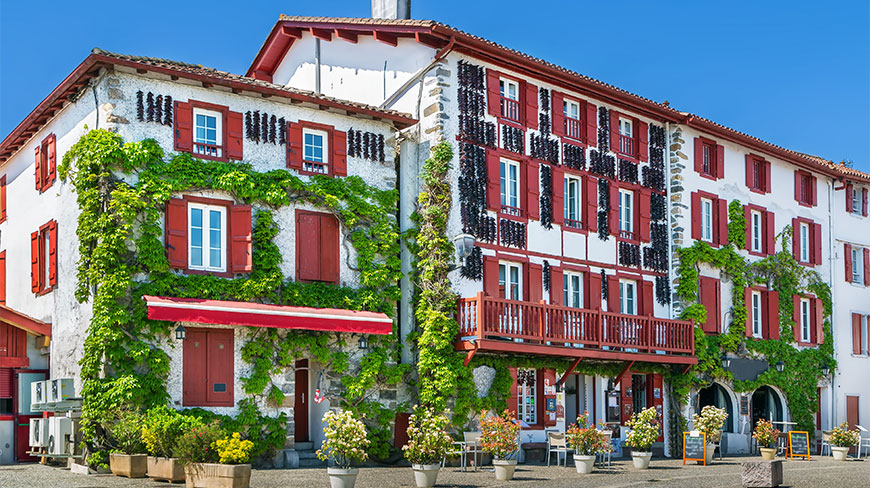
We arrive in Espelette, famous for its piment d'Espelette — bright red peppers hanging in great strings from the village's white-and-red houses. Brought from Mexico by Basque sailors in the 16th century, this pepper now holds its own AOC designation. Free time to explore at our own pace.
On the return to Biarritz, our Group Leader speaks about the Camino de Santiago — the pilgrimage network that brought hundreds of thousands of medieval travellers through these very villages, shaping their architecture and identity, and that still draws over 300,000 walkers every year.
We pass through Aïnhoa, one of the most beautiful villages in France, its main street lined with 17th-century half-timbered houses, each with its name and date carved in stone, then on to Sare, nestled at the foot of the Pyrenees.
We arrive in Espelette, famous for its piment d'Espelette — bright red peppers hanging in great strings from the village's white-and-red houses. Brought from Mexico by Basque sailors in the 16th century, this pepper now holds its own AOC designation. Free time to explore at our own pace.
On the return to Biarritz, our Group Leader speaks about the Camino de Santiago — the pilgrimage network that brought hundreds of thousands of medieval travellers through these very villages, shaping their architecture and identity, and that still draws over 300,000 walkers every year.
Dinner:
We will walk to a traditional Basque Cider House. A copious meal, served family style, includes traditional fare such as: Omelet, beef ribs, fish, French fries and salad. There is also a selection of cider from the barrels – all you can drink! Locals come here for a casual and fun evening. Wine and beer and other beverages available for purchase.
Evening:
At leisure.
Day
6
Bilbao & the Guggenheim Museum
Location:
Bayonne
Meals:
B,L
Stay:
Mercure Bayonne Centre Le Grand Hotel
Activity Note
Getting on/off motorcoach; driving to Bilbao is approximately 100 miles each way, about 2. 5 hours with rest stop en route. Walking and standing in the museum for 1.5 hours, plus additional time at your leisure. Remember to bring your Passport with you today!
Breakfast:
At the hotel.
Morning:
We will depart early by motorcoach to Bilbao, Spain. En route, our Group Leader will discuss the political borders and the Basque regions, comparing and contrasting Basques in Spain versus France during an expert lecture.
We will arrive in Bilbao, and enjoy a docent-led exploration of the Bilbao Guggenheim Museum.
In 1997, Bilbao was a declining post-industrial port city. Then the Guggenheim opened. The titanium-clad building designed by Frank Gehry almost instantly became one of the most recognized structures in the world, drew millions of visitors, and transformed the city's economy and self-image. This has been studied ever since as the 'Bilbao Effect' — the idea that a single great building can revive a city.
We will arrive in Bilbao, and enjoy a docent-led exploration of the Bilbao Guggenheim Museum.
In 1997, Bilbao was a declining post-industrial port city. Then the Guggenheim opened. The titanium-clad building designed by Frank Gehry almost instantly became one of the most recognized structures in the world, drew millions of visitors, and transformed the city's economy and self-image. This has been studied ever since as the 'Bilbao Effect' — the idea that a single great building can revive a city.
Lunch:
Bilbao is famous for its "pintxos"--Tapas--we'll enjoy a light lunch featuring a variety of small plates.
Afternoon:
Free time for self exploration, or visit the city of Bilbao with the Group Leader. Return to Bayonne in the late afternoon or early evening.
Dinner:
on own
Evening:
At leisure.
Day
7
Bayonne and Embark Cyrano de Bergerac Ship in Bordeaux
Location:
Bordeaux
Meals:
B,D
Stay:
CroisiEurope’s Cyrano de Bergerac
Activity Note
Getting on/off motorcoach; driving approximately 115 miles (184 km) total; about 2 hours, with stops for field trips. Walking up to 3 miles throughout the day; uneven and even ground; periods of standing for up to 2 hours at a time.
Breakfast:
At the hotel.
Morning:
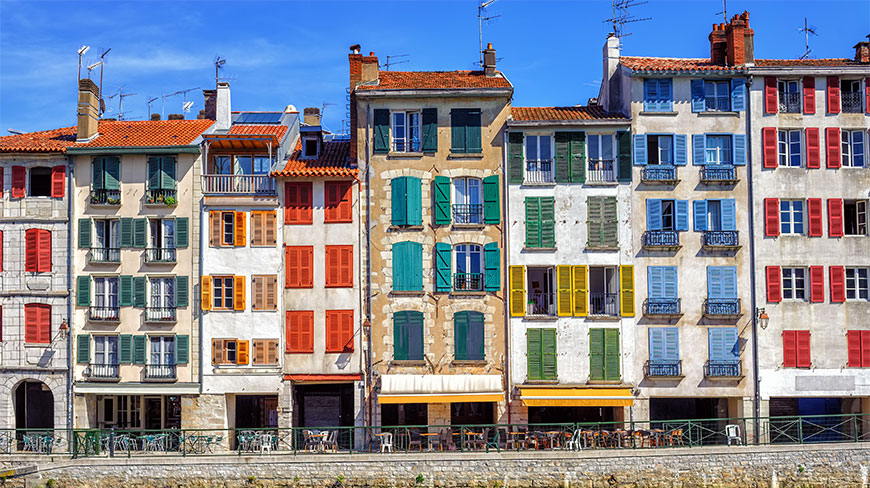
After checking out of our hotel, we will explore the medieval district of Bayonne on foot with our expert Group Leader. We will admire the Cathédrale de Sainte-Marie, a cathedral built during the 13th–16th centuries with two 19th-century towers, and move on to see the city's fortifications and historic timbered houses.
Lunch:
on your own
Afternoon:
We’ll then have free time to explore Bayonne at your own pace. At a predetermined time and place, we will meet to board our motorcoach for our return transfer to Bordeaux.
in the late afternoon we will embark the ship and have a welcome drink before dinner.
in the late afternoon we will embark the ship and have a welcome drink before dinner.
Dinner:
Aboard ship.
Evening:
At leisure.
Day
8
St Emilion
Location:
Libourne
Meals:
B,L,D
Stay:
CroisiEurope’s Cyrano de Bergerac
Activity Note
Getting on/off motorcoach. Walking up to 2.5 miles at a time during excursions. Walking will be on cobbled streets, gravel paths, unpaved lanes and city streets. Ability to stand for up to 1 hour without sitting and climbing stairs is a must.
Breakfast:
Aboard the ship
Morning:
On board, we will hear from an expert a lecture on the background of Alienor d'Aquitaine. She was an extraordinary woman whose presence you have been feeling since Day 2. Born in this very region, she inherited the Duchy of Aquitaine as a teenager, became Queen of France and then Queen of England, participated in a Crusade, was imprisoned for 16 years by her own husband, and lived to the age of 82 — extraordinary for the 12th century.
Lunch:
On board.
Afternoon:
We will go by motorcoach to explore St Emilion and its many historic sites including the Eglise Monolith, the largest underground church in Europe. This structure was carved by Benedictine monks during the 9th-12th centuries.
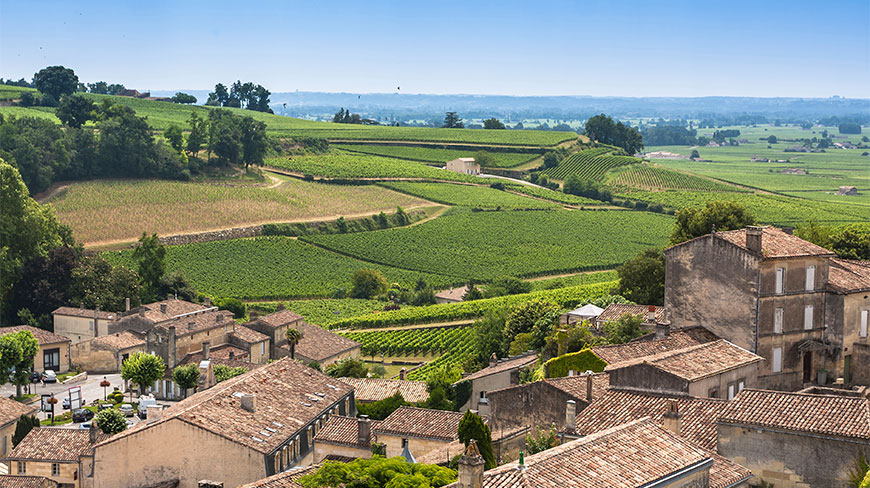
We will also visit a vineyard in St Emilion for a sampling of their wines. Many of the growers in this area still keep up the old tradition of planting roses at the ends of the rows. Together, we will learn about the origins of this practice.
We will also visit a vineyard in St Emilion for a sampling of their wines. Many of the growers in this area still keep up the old tradition of planting roses at the ends of the rows. Together, we will learn about the origins of this practice.
Dinner:
On board.
Evening:
At leisure. Information regarding activities aboard ship will be provided.
Day
9
To Pauillac, Chateau Visit
Location:
Pauillac
Meals:
B,L,D
Stay:
CroisiEurope’s Cyrano de Bergerac
Activity Note
Getting on/off a motorcoach. Walking up to 2.5 miles at a time during excursions. Walking will be on cobbled streets, gravel paths, unpaved lanes and city streets. Ability to stand for up to 1 hour without sitting and climbing stairs is a must.
Breakfast:
On board.
Morning:
On board, we will learn from an expert on the origin of viticulture and the history of winemaking in the region we are currently exploring. We'll discover the appellations (AOC) within Bordeaux and sample some of the wines to develop our palates.
Lunch:
On board.
Afternoon:
We will take a motorcoah to discover the Medoc vineyards produce some of the best wines in the world. This region of the Bordeaux wine AOC is blessed with unique solid and micro climates. We will visit a chateau to see first hand how wine is produced in this region.
Dinner:
On board.
Evening:
At leisure.
Day
10
Royan and Cognac
Location:
Royan
Meals:
B,L,D
Stay:
CroisiEurope’s Cyrano de Bergerac
Activity Note
Getting on/off motorcoach; traveling about 65 miles, approximately 2 hours. Walking up to 3 miles throughout the day; uneven ground;
Breakfast:
On board.
Morning:
The motorcoach takes us to Cognac, a small riverside town whose name is known in every corner of the world. Our first stop is the Château de Cognac — birthplace of François I (1494–1547), the king who brought the Renaissance to France. Standing in his birthplace, our local expert brings this extraordinary reign to life.
We then explore the town, learning how this quiet Charente river town gave its name to one of the world's most prestigious spirits. Cognac must be made within a strictly defined area, double-distilled in copper pot stills from local white grapes, and aged in Limousin oak barrels.
Our morning concludes with a tasting of cognac.
We then explore the town, learning how this quiet Charente river town gave its name to one of the world's most prestigious spirits. Cognac must be made within a strictly defined area, double-distilled in copper pot stills from local white grapes, and aged in Limousin oak barrels.
Our morning concludes with a tasting of cognac.
Lunch:
On board.
Afternoon:
We will enjoy an expert lecture on board about the estuary of Gironde and its very unique ecosystem. We will all spend some time on the deck observing the scenic vistas of the Gironde Estuary and the cliffs of Meschers-sur-Gironde. We will also learn about how this estuary is key to the production of local and regional products.
Dinner:
On board.
Evening:
At leisure.
Day
11
Sauternes and Chateau de Malle
Location:
Cadillac
Meals:
B,L,D
Stay:
CroisiEurope’s Cyrano de Bergerac
Activity Note
Getting on/off a motorcoach. Walking up to 2.5 miles at a time during excursions. Walking will be on cobbled streets, gravel paths, unpaved lanes and city streets. Ability to stand for up to 1 hour without sitting and climbing stairs is a must.
Breakfast:
Aboard the ship
Morning:
We will board our motorcoach to visit Château de Malle — a Classified Historic Monument of France built in the early 17th century, ranked as a Second Growth in the famous 1855 classification, and now entering a remarkable new chapter. In 2024, a young couple, Luc and Clémence Planty, acquired the estate and launched an ambitious restoration after years of neglect. Luc comes from a long line of Bordeaux winemakers; Clémence brings expertise in hospitality and communications. Together they are replanting the vineyards, reviving the gardens, and breathing fresh life into four centuries of history — with the same passion and energy that once made this one of Sauternes's most celebrated estates. Our visit has three parts. We will begin inside the château itself, where we will learn the story of the estate: its origins, its connection to the powerful Lur-Saluces family who also owned Château d'Yquem, its rise and long periods of dormancy, and what it takes to restore a historic property of this scale. We will then step outside into the Florentine-inspired gardens — six hectares decorated with statues of mythological figures and characters from the commedia dell'arte, once compared to Versailles in their splendour, and now being carefully brought back to life. Finally, we will walk the vineyard with your hosts to understand how Sauternes is grown: the remarkable diversity of soils (gravel, clay, stony sand, limestone), the role of the small Ciron river whose cold waters create the morning mists essential to the wine, and what it means to farm organically in one of the world's most prestigious appellations. The visit ends with a tasting of Château de Malle's golden Sauternes.
Lunch:
On Board
Afternoon:
We will hear a lecture about the region today: its,unity, its tension, and pride. The 2016 merger that created Nouvelle-Aquitaine was controversial — Bordelais, Basques, and Limousins do not naturally feel they belong together. Yet the region has emerged as one of France's most dynamic: a leader in aerospace (Airbus is here), in organic agriculture, in wine tourism, and in the kind of gentle rural tourism participants have been enjoying all week. The tension between local identity and national unity, between preservation and modernization, between the deep past and the living present — this is the story of Nouvelle-Aquitaine.
Dinner:
On Board
Evening:
At leisure.
Day
12
Bordeaux and La cité du vin
Location:
Bordeaux
Meals:
B,L
Stay:
CroisiEurope’s Cyrano de Bergerac
Activity Note
Walking up to 2 miles; cobblestone and even terrain. Standing up to 2 hours during field trips.
Breakfast:
On Board
Morning:
Back in Bordeaux, you explore the Chartrons — the quayside district where the wine trade has been conducted for 300 years.
Lunch:
On Board
Afternoon:
We will head to the La Cité du Vin, Bordeaux's spectacular wine museum, which opened in 2016. The building itself , designed to suggest a decanter in motion, or perhaps the swirl of wine in a glass, makes a fitting last stop. Inside, the permanent collection tells the story of wine. Wine is not just a beverage. It has been a form of currency, a religious sacrament, a medium of diplomacy, and a symbol of cultural identity for 8,000 years. The Greeks spread viticulture across the Mediterranean; the Romans carried it to France, Spain, and Germany; the Church preserved it through the Middle Ages; and colonial trade carried it to the New World.
Dinner:
On your own
Evening:
At leisure.
Day
13
Program Concludes, In Transit From Program
Location:
In Flight
Meals:
B
Activity Note
Hotel check-out 12:00 Noon. See your program’s Travel Information regarding transfers.
Breakfast:
Aboard the ship. This concludes our program.
Morning:
If you are returning home, safe travels. If you are staying on independently, have a wonderful time. If you are transferring to another Road Scholar program, detailed instructions are included in your Information Packet for that program. We hope you enjoy Road Scholar learning adventures and look forward to having you on rewarding programs in the future. Don’t forget to join our Facebook page and follow us on Instagram. Best wishes for all your journeys!