
Mexico
The Best of Central Mexico: Magical Towns and Bustling Cities
Program No. 23083RJ
See More Photos
The Best of Central Mexico: Magical Towns and Bustling Cities
The Best of Central Mexico: Magical Towns and Bustling Cities



1 of 9
Itinerary
While we make every effort to ensure the accuracy of our published materials, programs are typically advertised more than a year prior to their start date.
Read More.
While we make every effort to ensure the accuracy of our published materials, programs are typically advertised more than a year prior to their start date. As a result, some program activities, schedules, accommodations, personnel, and other logistics occasionally change due to local conditions or circumstances. Should a major change occur, we will make every effort to alert you. For less significant changes, we will update you during orientation. Thank you for your understanding.
Duration
15 days
14 nights
What's Included
Included
35 meals (
14B, 11L, 10D
)
22 expert-led lectures
27 expert-led field trips
4 hands-on experiences
1 performance
An experienced Group Leader
Taxes and customary gratuity
Road Scholar Assurance Plan
Mexico City
The Best of Central Mexico: Magical Towns and Bustling Cities
Dec 2 - Dec 16, 2027
Program Number
23083
Day
1
In Transit to Program, Orientation, Welcome Dinner
Location:
Mexico City
Meals:
D
Stay:
Zocalo Central Hotel
Activity Note
Hotel check-in from 3:00 p.m. Remember to bring your nametag (sent previously).
Afternoon:
After checking in to the hotel and confirming the meeting room with the front desk, take some time to freshen up and relax. 6:00 p.m. Gather in the hotel lobby to register with the program staff and walk a short distance to a local restaurant. Settle in a private room for orientation and the welcome dinner. The Group Leader will greet everyone and lead introductions. We will receive a welcome packet containing the up-to-date schedule that reflects any changes, and other important information. We will then discuss roles and responsibilities, logistics, safety guidelines, emergency procedures, and answer questions. Our knowledgeable Group Leader will also serve as our Study Leader on field trips and other group activities, presenting important aspects of Mexican history, culture, traditions, and economy during transfers. Transportation will be via private motorcoach unless noted otherwise. Periods in the daily schedule designated as “Free time” and “At leisure” offer opportunities to do what you like and make your experience even more meaningful and memorable according to your personal preferences. The Group Leader will be happy to offer suggestions. For meals designated on your own, you may join the Group Leader at a designated restaurant, if desired. Program activities, schedules, personnel, and indicated distances or times may change due to local circumstances/conditions. In the event of changes, we will alert you as quickly as possible. Thank you for your understanding. If you arrive late, please ask for your packet and instructions from the Group Leader at the hotel front desk when you check in.
Dinner:
In a local restaurant
Evening:
Return to the hotel, settle in, and get a good night’s rest for the day ahead.
Day
2
Chapultepec Park, Anthropology Museum, Zocalo
Location:
Mexico City
Meals:
B,L,D
Stay:
Zocalo Central Hotel
Activity Note
Getting on/off a motorcoach, city driving. Walking up to 3 miles during the day on city sidewalks and museums generally flat. Standing up to 2 hours at museum. Climbing one flight of stairs approximately 40 steps without handrails.
Breakfast:
On the scenic terrace of the hotel.
Morning:
As the ancient center of the Aztec Empire and the first and most important of Spanish colonial marvels in the New World, Mexico City offers culture and history in a vibrant atmosphere. We will begin to explore this fascinating city. We will board our motorcoach and ride along majestic Reforma Boulevard where every roundabout exhibits a monument, to reach the more visited section of Chapultepec Park. Chapultepec Park, one of the largest and most beautiful urban parks in the world, traces its origins to the Aztecs, who planted the first ahuehuete trees—some of which still stand today—near a natural spring and built an aqueduct later destroyed by the Spanish. Beyond its expansive green spaces, the park is home to nine museums, a zoo, an amusement park, lakes, and more. It remains a vital social and cultural hub for both local people and visitors. Among its many highlights is the world-renowned National Museum of Anthropology, where we will enjoy an expert-led exploration.
Lunch:
At the museum restaurant
Afternoon:
Enjoy some free time to explore the lively park, perhaps catching Indigenous groups performing in the plaza. We will then return to the city center to discover the main square, the Zócalo. Led by our Group Leader, we will enter the Metropolitan Cathedral, built using stones from the former Aztec capital of Tenochtitlán. We will also view from atop the Templo Mayor archaeological site, where the base of the city’s main pyramid has been unearthed. Along the way, we will learn about the importance of the imposing National Palace, now the official residence of Mexico’s president. Since Aztec times, the Zócalo has served as a central stage for political, religious, and social life, and it remains lively and bustling today. You may choose to stay longer in the plaza and return to the hotel on your own. In the late afternoon, we will regroup in the hotel lobby and walk to a nearby restaurant for dinner.
Dinner:
In a local restaurant.
Evening:
At leisure.
Day
3
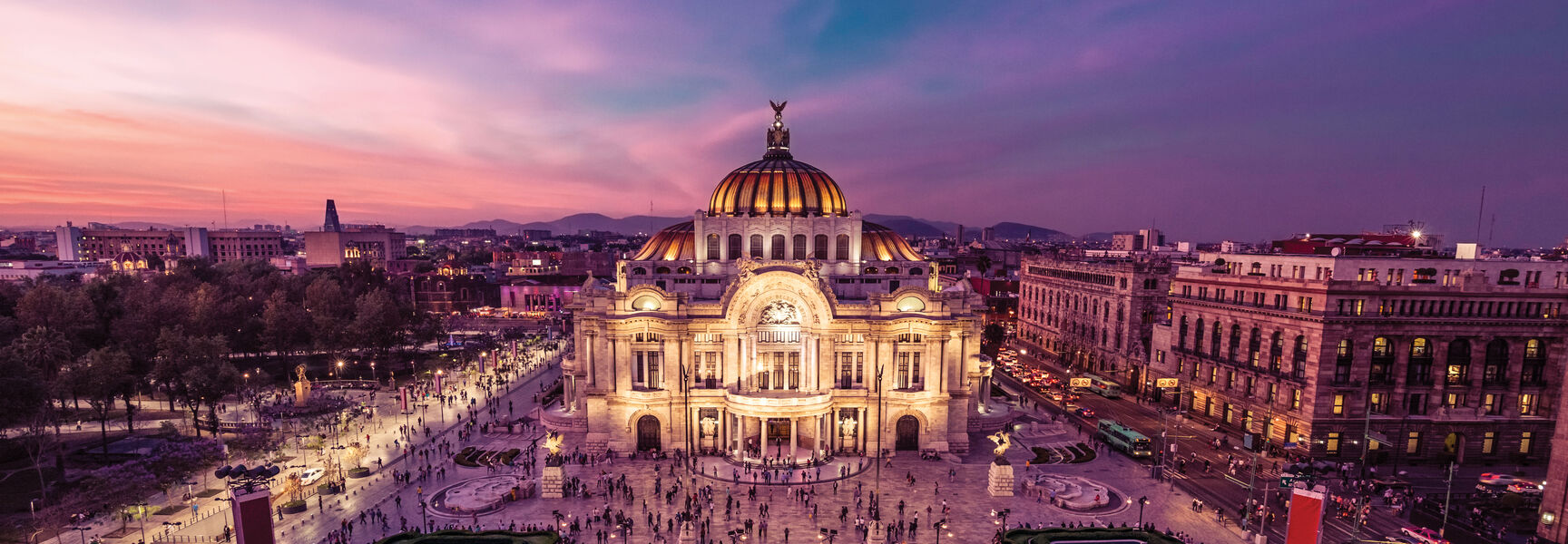
Xochimilco, Coyoacan, Frida Kahlo, Bellas Artes
Location:
Mexico City
Meals:
B,L
Stay:
Zocalo Central Hotel
Activity Note
Activity Notes Getting on/off a motorcoach, 1 hour city driving. Stepping into a flatboat from a cement platform. Walking up to 2.5 miles during the day on city sidewalks, generally flat and uneven. Standing up to 1 hour in museum. Climbing one flight of stairs.
Breakfast:
At the hotel.
Morning:
We will board our motorcoach and ride to Xochimilco. The Aztec capital of Tenochtitlán once stood on a lake, where the Mexica (Aztecs) navigated by canoe and cultivated crops using chinampas—ingenious raised fields built on trellises set in the water. Today, a remnant of this lake system and agricultural tradition survives in Xochimilco, where colorful trajineras—flat-bottomed boats adorned with flowers—glide along canals through the famed “floating gardens.” Boats carrying food vendors, flower sellers, and mariachi musicians pass by along the boats, creating a lively and festive atmosphere. We will board a trajinera to experience this unique setting while gaining a deeper appreciation of the Aztec engineering that once sustained a great city. Together with Mexico City, Xochimilco is part of a UNESCO World Heritage Site. From the UNESCO inscription, “With its network of canals and artificial islands, it testifies to the efforts of the Aztec people to build a habitat in the midst of an unfavorable environment. Its characteristic urban and rural structures, built since the 16th century and during the colonial period have been preserved in an exceptional manner.” We will then continue to Coyoacán, a charming colonial neighborhood known for its narrow streets, leafy plazas, lively markets, and inviting cafés and restaurants. Here, we will enjoy a traditional Mexican taco lunch at a local taqueria, where we can assemble our own tacos with a variety of toppings and salsas.
Lunch:
At a local restaurant
Afternoon:
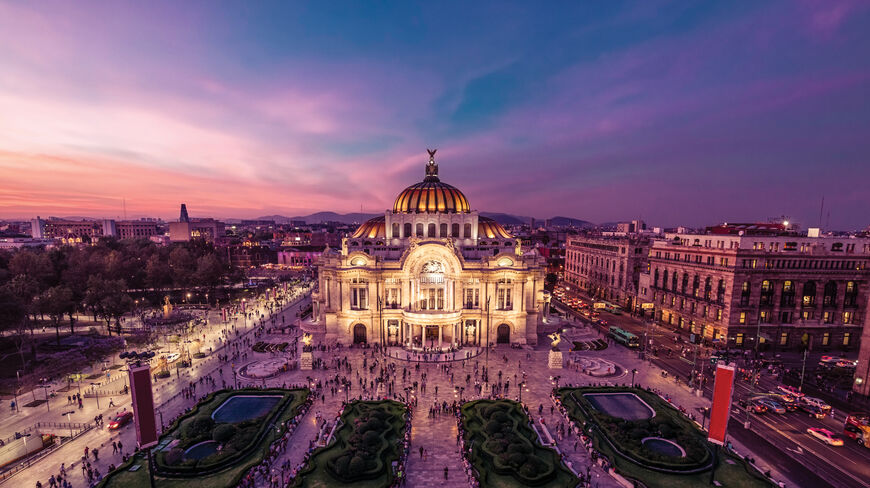
A popular ice cream shop sits just across the plaza, offering both traditional and uniquely Mexican flavors such as corn, avocado, and jalapeño—choose your favorite for dessert. We will then have some time on our own to stroll through the plazas or browse in a local craft market. Frida Kahlo was born and spent much of her life in Coyoacán. Both her childhood and adult homes are now museums, and we will visit one of them to gain insight into the fascinating life of this renowned artist. On our return, we will disembark at Alameda Park and continue on foot to further explore Mexico City’s historic center. Our first stop is the impressive Art Nouveau Palacio de Bellas Artes, where we will admire its architecture and view murals by some of Mexico’s most celebrated artists. As we do, the Group Leader will discuss the significance of muralism in Mexican culture. We will then continue to the Palacio Postal (Correo Mayor), an eclectic architectural gem that once served as the city’s main post office. From there, we will stroll along a booksellers’ alley and a pedestrian street lined with striking colonial and neoclassical buildings before returning to the hotel. The evening is free for you to enjoy at your leisure.
Dinner:
On your own
Evening:
At leisure. Prepare for check-out and transfer in the morning.
Day
4
Transfer to Morelia, City Field Trip
Location:
Morelia
Meals:
B,L
Stay:
Hotel de la Soledad
Activity Note
Getting on/off a motorcoach. Driving 190 miles, approximately 4.5 hours. Walking up to 1.5 miles throughout the day on city sidewalks and cobblestone streets, generally flat but uneven. Standing up to 1 hour at a time during visits. Climbing one flight of stairs.
Breakfast:
At the hotel.
Morning:
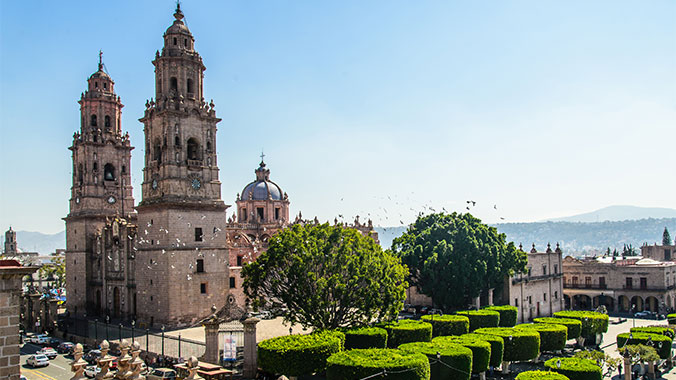
We will check out of the hotel and depart Mexico City, passing the ultra-modern skyscrapers of the Santa Fe district. As we cross forested mountains, we will catch glimpses of the snow-capped peaks that form the Trans-Mexican Volcanic Belt. During the journey, our Group Leader will introduce the rich history of the state of Michoacán, its Indigenous Purépecha culture, and the origins of its renowned crafts. We expect to arrive in Morelia late in the morning. Morelia, the capital of Michoacán, is often called the aristocrat of colonial cities, with a historic center designated a UNESCO World Heritage Site. Known for its harmonious urban design, the city features wide avenues lined with more than 200 elegant stone buildings, including grand palaces, a prominent cathedral, and stately plazas. Constructed primarily from pink quarry stone, these structures give the city a refined and cohesive appearance. Upon arrival, we will check in to our centrally located hotel and enjoy lunch on the hotel’s charming patio.
Lunch:
At the hotel.
Afternoon:
Accompanied by our Group Leader, we will begin exploring the city on a walking field trip. As we stroll along its stately avenues, we will admire the elegant palaces, appreciating their architecture and decorative details with stops to observe the façade of the majestic Cathedral and the Government Palace. Walking through plazas, parks, and fountains, we will come upon one of the former homes of José María Morelos, a key figure in the War of Independence for whom the city is named. During our visit to this house-museum, the Group Leader will provide insight into this pivotal period in Mexico’s history. We will then return to the hotel, with the remainder of the afternoon and evening at leisure.
Dinner:
On your own
Evening:
At leisure. You might like to stroll in the main plaza to see the cathedral beautifully illuminated and mingle with local people at cafés under the arches.
Day
5
Purépecha Villages & Towns
Location:
Morelia
Meals:
B,L,D
Stay:
Hotel de la Soledad
Activity Note
Getting on/off a motorcoach. Driving 90 miles, approximately 2 hours. Walking up to 3.5 miles during the day on city sidewalks and cobblestone streets, generally flat and uneven with uphills. Standing up to 1 hour at a time during field trips. Climbing steps with and without handrails and one flight of stairs.
Breakfast:
At the hotel.
Morning:
The state of Michoacán—often called the “Soul of Mexico”—is home to the Indigenous Purépecha people, called Tarascans by the Spanish. In pre-Hispanic times, they established a powerful kingdom that successfully resisted Aztec domination. Although their realm eventually fell after the Spanish conquest, today a population of more than 100,000 continues to preserve many ancient traditions. Michoacán’s rich artisanal heritage, considered among the finest in Mexico, is attributed to the Purepechas. We will board our motorcoach and travel to villages around Lake Pátzcuaro. Along the way, our Group Leader will further explore Mexican culture and traditions. Our first stop is the picturesque Purépecha village of Santa Fe de la Laguna, where time seems to stand still. In the simple market of the town plaza, we will see these reserved indigenous people trading goods, including freshly caught fish still jumping. We will then visit the home of a potter who has revived ancient ceramic techniques and enjoy freshly made blue corn tortillas prepared on a traditional griddle. We will continue to Pátzcuaro, a charming quaint town founded in the 14th century by the Purépecha. Today, it remains a colonial gem, with red-and-white adobe houses topped by tile roofs, historic churches, and austere convents that reflect its Indigenous, colonial, and mestizo heritage.
Lunch:
At a local restaurant.
Afternoon:
The Purépecha take great pride in their traditions, including music and dance. On the restaurant patio, we will delight on a private presentation of their most noted dances and songs by an Indigenous folkloric group. Our Group Leader will then lead a walking field trip through plazas and along cobblestone streets, including a visit to the House of the Eleven Patios. Afterward, you will have free time to explore at your own pace—perhaps relax at a café or join the Group Leader to view a mural by Juan O’Gorman. We will then return to our hotel in Morelia, with time to freshen up and relax before dinner at a restaurant set beneath the arches facing the Cathedral, a favorite gathering place for locals.
Dinner:
At a local restaurant.
Evening:
At leisure. Tonight or any night when appropriate, enjoy the “sobremesa” — lingering at the table to chat after dinner — as is customary in Mexico. Prepare for check-out and transfer tomorrow.
Day
6
More Morelia, Transfer to Guanajuato, El Pipila Viewpoint
Location:
Guanajuato
Meals:
B,L,D
Stay:
Edelmira Hotel Boutique
Activity Note
Getting on/off a motorcoach and in/out of Sprinters. Driving 120 miles, approximately 3 hours. Walking up to 3 miles during the day on city sidewalks and cobblestone streets, generally flat and uneven with steps. Slow walking and standing up to 1 hour during field trips. Climbing one flight of stairs and uneven steps without handrail.
Breakfast:
At the hotel.
Morning:
We’ll continue exploring Morelia by bus and on foot with our Group Leader. The city features a magnificent aqueduct, one of the best preserved in the world. Built of pink quarry stone, this one-mile structure is supported by 253 arches. Near its end, we’ll pause for some free time to admire the aqueduct up close and, if you wish, enter the vividly decorated Santuario de Guadalupe, renowned for its brilliantly colored interior. As our Group Leader will explain, the Virgin of Guadalupe holds a central place in Mexican identity. From there, we’ll stroll to the charming Callejón del Romance (Romance Alley) and the Fuente de las Tarascas, one of Morelia’s most iconic fountains. Then we’ll reboard the bus for a short ride back to the main plaza, where you’ll have time for independent exploration or to relax before checking out of the hotel and regrouping for lunch.
Lunch:
In a local restaurant.
Afternoon:
Next, we travel to Guanajuato, often called the queen city of Mexico’s colonial cities and a UNESCO World Heritage Site. En route, our Group Leader will discuss the vital role of mining in Mexico’s history. In the 18th century, the discovery of some of the richest silver deposits in the world promoted the construction of this remarkable city. Set amid the mountains, Guanajuato is celebrated for its charm and distinctive layout: narrow, winding, and often steep streets (callejones), stairways, intimate plazas (plazuelas), underground streets and vividly colored buildings. Because buses cannot navigate the historic center, we will transfer to private vans and continue along a panoramic road. We’ll stop at the El Pípila monument for one of the city’s finest viewpoints, where Guanajuato unfolds before us on a steep hillside across from us, colorful and imposing as if it were a painting. We’ll then take a funicular down to our hotel, tucked into a quiet corner of the pedestrian-friendly Jardín Unión, the city’s main plaza. After checking in, we’ll have time to freshen up and relax before dinner. You may wish to sit for a while in the tree-shaded plaza and admire the ornate façade of the Teatro Juárez. We’ll re-gather for dinner in the plaza.
Dinner:
At an elegant local restaurant.
Evening:
You may want to explore Guanajuato’s serpentine streets by night on your own or stay in the plaza where music and merriment are always part of the atmosphere.
Day
7
Guanajuato Highlights, Free Time
Location:
Guanajuato
Meals:
B,D
Stay:
Edelmira Hotel Boutique
Activity Note
Walking up to 4 miles during the day on generally narrow sidewalks, uneven cobblestones, many up-hills, many steps without handrails. Standing up to 1 hour at a time during field trips. Climbing one flight of stairs. Teatro Juarez opens to the public on a day-to-day basis; visits cannot be guaranteed.
Breakfast:
At the hotel.
Morning:
We’ll set out with our Group Leader on a walking field trip to discover some of Guanajuato’s highlights. Brightly colored homes and buildings line the city’s streets, alleys, and plazas. Some alleys are so narrow that, according to a popular tale of forbidden love, a young couple would meet late at night to share a kiss from their opposing balconies. We’ll pause to admire the imposing white stone edifice of the University of Guanajuato, fronted by a dramatic staircase of 133 steps—viewed from below! We’ll also visit the striking deep-yellow Basilica of Guanajuato, one of the city’s most important architectural, historical, and religious landmarks. Overlooking a large plaza, it is impressive by day and beautifully illuminated at night. Funded by local silver miners, construction began in 1671 and was completed in just 25 years. Inside, the principal object of devotion is a jewel-adorned image of Our Lady of Guanajuato. According to tradition, this wooden statue of the Virgin and Child was carved in Andalusia before the Moorish invasion of Spain and hidden in a cave for safekeeping, where it remained for eight centuries. It was later presented to the basilica by the King of Spain in gratitude for the wealth generated by the region’s silver mines. We’ll also explore the city’s turbulent past at the Alhóndiga de Granaditas, a former granary now housing a regional museum. In 1810, it was the site of the first major battle of the Mexican War of Independence.
Lunch:
On your own
Afternoon:
Free time. Take this opportunity for personal independent exploration to see and do what interests you most. The Group Leader will be happy to offer suggestions. You might choose to wander through the maze of alleys, plazas, and markets—getting lost in Guanajuato can be a magical experience. Options include visiting the former home and museum of world-renowned artist Diego Rivera, exploring the Modern Art Museum or the Cervantes Museum, or simply settling into a café to sip a drink and take in the city’s vibrant atmosphere. In the late afternoon, gather at the stately entrance of Teatro Juarez, with its magnificent, neo-classical exterior that faces the central plaza. If permitted, we will enter the theater with our Group Leader to appreciate its richly ornate, flamboyant decoration that follows the horseshoe design of most European opera houses. For dinner, take a break from Mexican specialties to delight on Italian cuisine in a first-floor restaurant that overlooks the plaza.
Dinner:
At a local restaurant.
Evening:
One of Guanajuato’s most popular traditions is the “callejoneada” in which groups of musicians in period dress sing, dance, and retell local legends (in Spanish) as they weave through old cobbled streets, steep alleys, and plazas. Elective: Those with energy, stamina, and enthusiasm are welcome to follow the callejoneada. Prepare for check-out and transfer in the morning.
Day
8
San Miguel Allende, Queretaro
Location:
Queretaro
Meals:
B,L,D
Stay:
Doña Urraca
Activity Note
Getting in/out of Sprinters and on/off a motorcoach. Driving 90 miles, approximately 2.5 hours. Walking up to 3 miles during the day on narrow sidewalks, uneven cobblestones with up-hills and steps. Standing up to 1 hour at a time during field trips.
Breakfast:
At the hotel.
Morning:
Due to the narrow streets, we will take private Sprinters to reach our motorcoach. Picturesque back sides of homes are visible through the openings of the underground tunnels and narrow passageways. On our motorcoach, we continue our journey to Queretaro stopping in San Miguel Allende on the way. The drive crosses the region known as the Cradle of National Independence. On September 16, 1810, Father Hidalgo, a priest who became “the Father of Mexico”, gave the famous cry for freedom, now called the “Grito de Dolores”, in a Dolores Hidalgo church. He then marched to a Sanctuary outside of San Miguel Allende where he took the banner depicting the Virgin of Guadalupe as a symbol of the nascent insurgent army. These two emblematic events sparked the beginning of the War of Independence from Spain. September 16 is celebrated as Mexico’s Independence Day. During the drive, the Group Leader will discuss the war and the economic, social, and religious structure of the Spanish colonial period leading to it. Named in honor of General Ignacio Allende, one of the fathers of Mexican Independence who was born here, San Miguel Allende gained international fame thanks to the establishment of Instituto Allende in the 1950s attracting foreigners to its art and Spanish courses. We will take a walking field trip with our Group Leader to see the town center and appreciate the variety of architectural styles represented in its buildings, especially La Parroquia de San Miguel Arcángel, the Parish of Saint Michael the Archangel, that can be seen from everywhere. Founded in the mid-1500s, it was rebuilt several times over the centuries. Though ancient in appearance, the soaring towers and neo-Gothic façade we see today are from the late 19th century.
Lunch:
At a local restaurant.
Afternoon:
Free time to explore on your own. We’ll then move on to Querétaro. During the drive, our Group Leader will narrate the eventful years following the independence discussing Benito Juarez, the French Invasion, the Revolutionary War, and the eventual signing of Mexico’s Constitution. Santiago de Querétaro is a designated UNESCO World Heritage Site. From the UNESCO inscription: “The old colonial town of Querétaro is unusual in having retained the geometric street plan of the Spanish conquerors side by side with the twisting alleys of the Indian quarters. The Otomi, the Tarasco, the Chichimeca and the Spanish lived together peacefully in the town, which is notable for the many ornate civil and religious Baroque monuments from its golden age in the 17th and 18th centuries.” We will check in to our hotel set in an 18th century villa, then walk to a lively Mexican restaurant for dinner.
Dinner:
At a local restaurant.
Evening:
At leisure. You are welcome to walk back to the hotel with our Group Leader or stay in the plaza to enjoy the nightlife, mingle with local people, and return to the hotel on your own.
Day
9
Exploring Querétaro, Aqueduct
Location:
Queretaro
Meals:
B,L
Stay:
Doña Urraca
Activity Note
Walking up to 3 miles throughout the day on cobblestones, generally flat and uneven. Slow walking and standing up to 1 hour during field trips. Climbing one flight of stairs and uneven steps without handrails.
Breakfast:
At the hotel.
Morning:
Away from the main flow of tourism, Santiago de Querétaro’s dynamic historic center offers a rewarding surprise. We’ll explore on a walking field trip with our Group Leader. A monumental aqueduct, one of the city’s defining symbols, features 75 arches rising to nearly 100 feet, an imposing sight. We’ll trace Querétaro’s pivotal role in Mexican history—from its founding in 1531 to its involvement in the planning of Independence, the execution of Emperor Maximilian, the drafting of the Mexican Constitution, and the signing of the Treaty of Guadalupe Hidalgo. An expert-led visit to a 16th-century Franciscan monastery will bring much of this history to life, offering insight into monastic life and the many significant events that unfolded here. Highlights include Maximilian’s former prison cell and a quarry cross tied to an Otomí legend. Strolling through charming streets and lively plazas, our Group Leader will discuss the elegant blend of Baroque and Neoclassical architecture. We’ll enter the courtyard of the Government Palace, once known as the Casa de la Corregidora—the home of Josefa Ortiz de Domínguez, a heroine of the independence movement. We’ll also visit Querétaro’s Museum of Modern Art, housed in the former San Agustín monastery (founded in 1728) to admire its ornate courtyard, considered among the most beautiful in Latin America. On our way to lunch, we’ll pause to admire the richly decorated Baroque façade of the Casa de la Marquesa.
Lunch:
At a local restaurant.
Afternoon:
Elective: The Otomi Indigenous people of Queretaro are responsible for the creation of Lele dolls, the colorful rag dolls with ribbon-decked hair considered a cultural heritage. You may join our Group Leader to a local Otomi Indian craft center where the women will guide us through the steps of making our own rag doll. This relaxing fun activity offers the opportunity to interact with and get to know the lifestyle of these indigenous people who come to the city from remote villages in the surrounding mountains. The remainder of the afternoon and evening are free to rest and relax or explore independently. The Group Leader will be happy to offer suggestions. You may choose to join the Group Leader on a walking excursion to Santa Rosa de Viterbo Church to admire the stunning unique exterior and the contrasting Baroque Neo-classical interior.
Dinner:
On your own to enjoy what you like.
Evening:
At leisure. Prepare for check-out and early transfer in the morning.
Day
10
Transfer to Puebla, Teotihuacan Complex
Location:
Puebla
Meals:
B,L,D
Stay:
Quinta Real Puebla
Activity Note
Getting on/off a motorcoach. Driving 230 miles, approximately 5 hours. Walking up to 3 miles during the day on gravel paths and cobblestones, generally flat and uneven and climbing high uneven stone steps with and without handrail at the archeological site. Standing up to 2 hrs.
Breakfast:
At the hotel.
Morning:
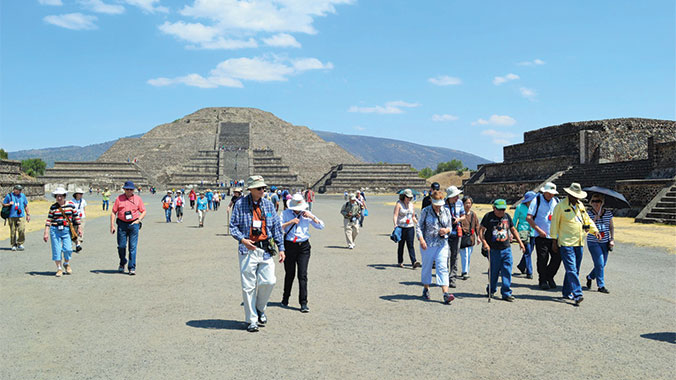
Today is an early departure. After checking out of the hotel, we’ll board our motorcoach for the journey to Puebla, with a visit to the archaeological site of Teotihuacan en route. Our drive takes us past agricultural fields neatly divided by stone walls and the rolling hills that surround Mexico City. Along the way, our Group Leader will introduce the region’s pre-Columbian cultures. Teotihuacan, one of Mexico’s most renowned archaeological sites and a UNESCO World Heritage Site, is often called the “City of the Gods.” From the 1st century BCE to the 5th century CE, it was home to a powerful civilization whose influence shaped later Mesoamerican cultures; at its height, its population exceeded that of ancient Rome. As noted in its UNESCO inscription, the site—located about 50 kilometers northeast of Mexico City—was built between the 1st and 7th centuries CE and is distinguished by the monumental scale of its structures, including the Temple of Quetzalcoatl and the Pyramids of the Sun and Moon, all laid out according to precise geometric and symbolic principles. With our Group Leader, we’ll explore the site, walk along the Avenue of the Dead, enter select palace complexes, and admire from below the imposing Pyramid of the Sun, rising to nearly 200 feet, as well as the slightly smaller Pyramid of the Moon.
Lunch:
At a restaurant by the archeological site.
Afternoon:
Continuing our journey, our Group Leader will discuss Mexico’s renowned cuisine while completing the historical overview, bringing us to the present day. We arrive in Puebla—Mexico’s fourth-largest city—known for its rich history, culture, and economic importance. Our first stop is the monumental fountain in the fort area, site of the Battle of Puebla on May 5, 1862. There, the outnumbered Mexican forces led by General Ignacio Zaragoza defeated a superior French army, securing a symbolic victory in the broader struggle against foreign intervention. We’ll then check in to our hotel, a former 16th-century convent, and have time to freshen up. Originally named Ciudad de los Ángeles (City of the Angels), Puebla is a UNESCO World Heritage Site celebrated for its remarkable architectural heritage. Its Spanish colonial treasures include more than 360 churches, palaces, a historic library, and private homes—many adorned with colorful Talavera-style ceramic tiles known as azulejos. With our Group Leader, we’ll head to the impressive Zócalo to view the façade of Puebla’s monumental cathedral. Begun in 1575 and completed in 1649, it is the second-largest cathedral in Mexico, with the tallest twin bell towers in the country. You’ll then have free time to enjoy the lively atmosphere of the Zócalo before we re-gather for dinner at a rooftop restaurant overlooking the cathedral, beautifully illuminated at night.
Dinner:
At a local restaurant
Evening:
At leisure.
Day
11
Exploring Puebla
Location:
Puebla
Meals:
B,L
Stay:
Quinta Real Puebla
Activity Note
Getting on/off a motorcoach. Driving 25 miles, 1 hour total. Walking up to 3 miles throughout the day on cobblestone sidewalks generally flat some uneven. Slow walking and standing up to 2 hours in museum. Climbing one flight of stairs.
Breakfast:
At the hotel.
Morning:
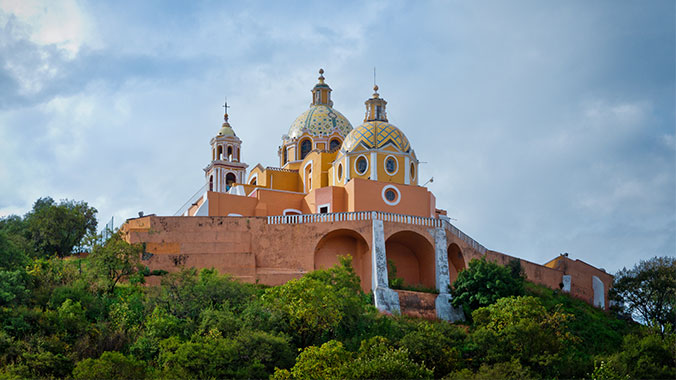
We’ll board our motorcoach to explore highlights beyond the city center. In nearby San Andrés Cholula, we’ll visit the remarkable Church of Santa María Tonantzintla, famed for its extraordinary interior. Nearly every inch of its ornate plasterwork is covered in what is often called “indigenous Baroque” decoration—vivid, colorful forms depicting flowers and fruits, human and animal figures with indigenous headdresses, and intricate abstract designs that reflect a blending of pre-Hispanic and Christian traditions. We then continue to the Museo Internacional del Barroco, inaugurated in 2016. Its sleek, avant-garde exterior stands in striking contrast to the richly expressive Baroque art within. As we explore the museum’s galleries—featuring paintings, sculpture, and interactive exhibits—we’ll gain deeper insight into the many dimensions of the Baroque style and the important role Mexico, and Puebla in particular, played in its development. We’ll return to the city center for a traditional Puebla lunch featuring mole (pronounced “MOH-leh”), a signature dish that originated here. This rich, velvety sauce—often served over chicken, turkey, or other meats—is complex and labor-intensive to prepare. It combines ground chiles with ingredients such as stock, tortillas, nuts, seeds, spices, garlic, onion, and tomatoes, along with chocolate, plantains, and raisins for subtle sweetness, among many other elements.
Lunch:
In a local restaurant
Afternoon:
After lunch, we’ll visit the Biblioteca Palafoxiana with our Group Leader. Founded in 1646 and listed on UNESCO’s Memory of the World Register, it is considered the first public library in the Americas. The remainder of the afternoon is free for independent exploration. Our Group Leader will be happy to offer suggestions. If you wish, you may also join an optional walking visit to the Church of Santo Domingo to admire the richly ornamented Capilla del Rosario, famed for its lavish Baroque decoration and extensive gold leaf.
Dinner:
On your own
Evening:
At leisure. Prepare for check-out and transfer in the morning.
Day
12
Transfer to Oaxaca, Exploring the City
Location:
Oaxaca
Meals:
B,L,D
Stay:
Quinta Real Oaxaca
Activity Note
Getting on/off a motorcoach. Driving 210 miles, approximately 5 hours. Walking up to 2 miles during the day on cobblestones, generally flat and uneven. Slow walking and standing up to 1.5 hours during field trip. Climbing one flight of stairs with high steps.
Breakfast:
At the hotel.
Morning:
After checking out of the hotel, we’ll travel to Oaxaca, the final destination of our journey. Our route crosses mountainous terrain with striking changes in altitude and ecosystems: from pine forests to towering cacti and arid desert landscapes. Along the way, we may even glimpse distant volcanoes. During the drive, our Group Leader will discuss Mexico’s “Pueblos Mágicos” and the protected areas that preserve the country’s rich natural and cultural heritage. We arrive in Oaxaca, one of Mexico’s most captivating cities, whose Centro Histórico is a UNESCO World Heritage Site. Oaxaca is renowned for its rich indigenous traditions, magnificent Baroque colonial architecture, exceptional crafts, vibrant markets, archaeological sites, and distinctive mestizo cuisine. It is also the birthplace of Benito Juárez, a national hero and one of Mexico’s most respected presidents. Upon arrival, lunch awaits at a local restaurant.
Lunch:
In a local restaurant.
Afternoon:
We’ll then transfer to our centrally located hotel, housed in a former monastery, for check-in and some free time to freshen up. In the late afternoon, we’ll set out with our Group Leader on a walking field trip to get acquainted with Oaxaca. Near the hotel stands the magnificent Church of Santo Domingo and its adjacent plaza. From there, a pedestrian street leads to the spacious and lively Zócalo, dominated by the Baroque Metropolitan Cathedral. We’ll then visit the city’s famed market, where an array of local specialties is on display, including heaps of fried grasshoppers, a memorable sight! A stop at a chocolate workshop offers a look at the traditional process of making Mexican chocolate. We’ll return to the Zócalo, where folkloric music often fills the square and locals gather to dance. Dinner will be at a restaurant overlooking the plaza, where the festive atmosphere continues into the evening.
Dinner:
At a local restaurant.
Evening:
At leisure. You may remain in the plaza, mingle with local people and enjoy the music or return to the hotel with your Group Leader.
Day
13
Monte Alban, Santo Domingo Cultural Center, Cooking Class
Location:
Oaxaca
Meals:
B,D
Stay:
Quinta Real Oaxaca
Activity Note
Getting on/off a motorcoach, minimum driving. Walking up to 4 miles during the day on cobblestones, generally flat and uneven and on gravel paths and climbing some high stone steps with no handrails at the archeological site. Slow walking and standing up to 2 hours during field trips. Climbing one flight of stairs with high steps.
Breakfast:
At the hotel.
Morning:
We’ll board our motorcoach for a field trip to Monte Albán with our Group Leader. Once the social, political, and economic center of the Zapotec civilization from 500 BCE to 800 CE, it ranks among the earliest and most significant sites in Mesoamerica. Perched atop a mountain with sweeping views of the Oaxaca Valley, this expansive archaeological site, part of the UNESCO World Heritage listing shared with Oaxaca, is truly impressive. Excavations here uncovered remarkable artifacts, including finely crafted gold jewelry and other treasures from the famed Tomb #7. Of particular note are Los Danzantes (“The Dancers”), a series of more than 300 carved stone figures, often depicted in dynamic or enigmatic poses. We’ll then return to Oaxaca to visit the Santo Domingo Cultural Center. Founded as a Dominican monastery in the 16th century, it now houses a museum where the treasures of Tomb #7, considered among the most important archaeological discoveries in Mesoamerica, are on display.
Lunch:
On your own
Afternoon:
Enjoy some free time for independent exploration or relaxation before this evening’s cooking class and dinner experience. A short motorcoach ride takes us to a local cooking school, where we’ll be welcomed by the chef. Aprons on, we’ll roll up our sleeves and begin preparing a range of traditional dishes such as mole, salsas, guacamole, tortillas, and other Oaxacan specialties. During the experience, we’ll also have the opportunity to sample mezcal. While tequila is technically a type of mezcal produced exclusively from blue agave in five designated regions of Mexico, mezcal more broadly can be made from various agave species across different regions. The production methods for each differ significantly, contributing to their distinct flavors and character.
Dinner:
At the Cocking Class
Evening:
Return to the hotel. You may wish to take an evening stroll in the attractive streets and plazas surrounding the hotel.
Day
14
Santa María del Tule, Teotitlan del Valle, Alebrijes
Location:
Oaxaca
Meals:
B,L,D
Stay:
Quinta Real Oaxaca
Activity Note
Getting on/off a motorcoach. Driving about 20 miles approximately 1 hour. Walking up to 1.5 miles during the day on cobblestones, generally flat and uneven. Slow walking and standing up to 1 hour during field trips. Climbing one flight of stairs with high steps.
Breakfast:
At the hotel.
Morning:
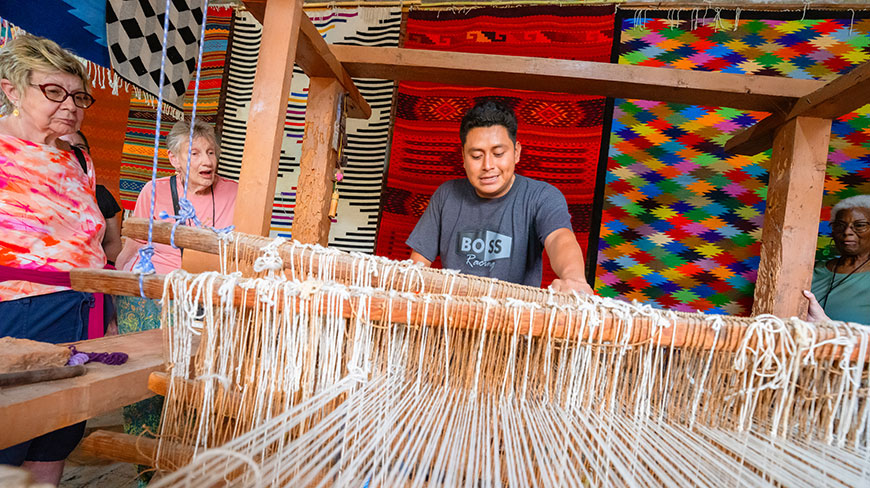
On our final day, we’ll set out by motorcoach for a morning exploration of the Oaxaca Valley with our Group Leader, making several stops along the way. In Santa María del Tule, we’ll see the famed Montezuma cypress, believed to be over 2,000 years old. With a diameter of about 46 feet and a circumference of roughly 190 feet, it is considered the widest tree in the world. In Teotitlán del Valle, a village renowned for its handwoven rugs, we’ll see skilled artisans at work. We’ll visit a family home and workshop to learn about the traditional process: from carding and spinning the wool to dyeing it with natural pigments and weaving it on pedal looms. The resulting rugs represent pre-Columbian motifs, interpretations of famous artworks, and original designs. On our return drive to Oaxaca, we’ll stop for lunch at a countryside restaurant featuring regional Oaxacan specialties.
Lunch:
At a local restaurant.
Afternoon:
The early afternoon is yours to enjoy at leisure, relax at the hotel or pool or continue exploring the city center. You might choose to visit the Temple of Santo Domingo, the most ornate of Oaxaca’s churches, stroll through galleries, or explore one of the city’s museums. In the late afternoon, join a pleasant hands-on activity. We’ll meet at the hotel for a short walk to a gallery showcasing alebrijes—brightly painted wooden carvings of imaginative, often fantastical creatures that originated in Oaxaca and are now celebrated worldwide. As you admire these finely crafted pieces, you’ll learn about their origins and artistry. Guided by a local craftsman and assisted by our Group Leader, you’ll also have the chance to try your hand at painting your own alebrije. We’ll then return to the hotel to prepare for our farewell dinner in the hotel’s elegant dining room.
Dinner:
At the hotel. Toast farewell to Mexico and to travel companions, until we meet again
Evening:
Prepare for check-out and departure in the morning.
Day
15
Program Concludes
Location:
Oaxaca
Meals:
B
Activity Note
Hotel check-out 12:00 Noon. See your program travel details regarding transfers. If you are returning home keep passports on hand. Personal travel permits must be returned upon leaving Mexico, the airline will collect them during check-in.
Breakfast:
At the hotel.
Morning:
If you are returning home, safe travels. If you are staying on independently, have a wonderful time. If you are transferring to another Road Scholar program, detailed instructions are included in your Information Packet for that program. We hope you enjoy Road Scholar learning adventures and look forward to having you on rewarding programs in the future. Please join our Facebook page and share photos of your program. Visit us at www.facebook.com/rsadventures. Best wishes for all your journeys!
Please select a day to update the map
Map details are not available for this location.
Please Note:
This program has itinerary variations on certain dates.