Brains vs. Brawn: The Myth of Athena & Poseidon

- The myth of Athena vs. Poseidon is the story not only of which god would rule a city, but which values and principles the ancient Greeks held most dear.
- The gods offered gifts to the city of Cecrops in order to earn its patronage, each gift reflecting that god’s strengths.
- The importance of Athena and Poseidon to the ancient Greeks is evident today in magnificent ancient temples and sanctuaries that can be explored throughout Greece.
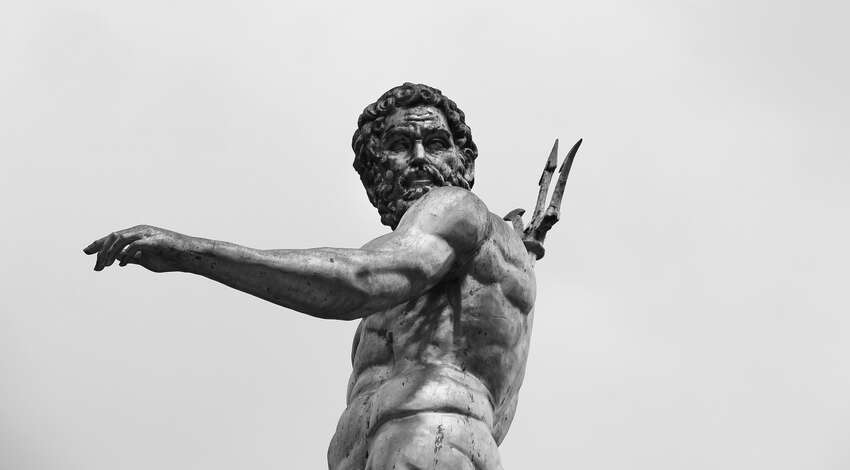
Is it better to be wise, or strong? That’s the question at the core of a classic tale from Greek mythology, pitting a god and a goddess against one another.
The legend goes that when humans were first beginning to populate Greece and create cities, one such city was Cecropia. The city was ruled by Cecrops, who had married Agraulos, the daughter of Actaeus, the first king of Attica. Actaeus gave his son-in-law the land for the city. (Cecrops, incidentally, was a man from the waist up, with a serpent’s tail in place of legs. There’s no record of the reaction when Agraulos brought him home to meet dad for the first time.)
Athena and Poseidon were among the more prominent gods of the era. Athena was the goddess of wisdom and strategic warfare, daughter of Zeus, born fully grown from his forehead. On her résumé were the defeat of the giant Enceladus — she threw Sicily on him — and helping to create Pandora, the first woman. Athena gifted Pandora skills in weaving and craftsmanship.
Poseidon was the god of the sea, the son of the Titan Cronus and the brother of Zeus, Hera and other gods, all of whom — except for Zeus — Cronus swallowed at birth, fearing one would overthrow him. Zeus was later able to free them all.
During his tenure as the sea god, Poseidon was noted for causing earthquakes and storms, as he did after Odysseus blinded Poseidon’s son, the cyclops Polyphemus. In addition, upset at being shortchanged on a sacrifice, Poseidon also set in motion the chain of events that led to the creation of the Minotaur.
Sacrifices were quite important to the gods, and they were the impetus for the Athena-Poseidon conflict. At the time, the gods were still claiming lands in which they would have patronage, be worshipped and be sacrificed to — sort of like an Aegean gold rush — and both Athena and Poseidon had their eyes on Cecropia.
It was determined that they would vie for the city by bestowing gifts upon it. Poseidon made his bid, striking his trident into the ground and creating a spring to indicate his power over water. Other versions hold that Poseidon gifted the city its first horse, to show the power and speed that promised to transform Cecropia in areas ranging from warfare to agriculture.
Not to be outdone, Athena calmly planted an olive tree. It would provide food and wood, and oil for both cooking and lighting. It would also serve as a symbol for peace, reflecting Athena’s wisdom and values.
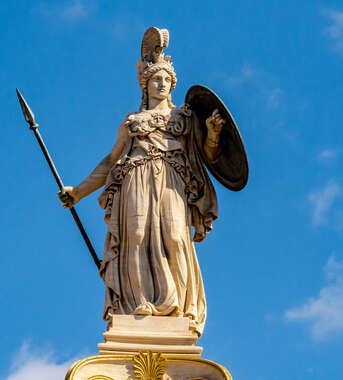
Athena
The other gods on Mount Olympus were charged with deciding the winner. It was a close call, but after much debate, it was determined that Athena’s gift would be more valuable in the long run as a sustainable resource and a reminder of the ideals of civilization.
Thus, Athena was declared the winner and the patroness of Cecropia, which was promptly renamed Athens in her honor.
Poseidon did not take the loss well. He sent numerous floods Athens’ way and also assigned his son Halirrhothius to cut down Athena’s olive tree. Attempting to do so, Hal accidentally killed himself with his own axe, much to Poseidon’s chagrin.
So, in the debate over whether it’s better to be wise or strong, the ancient Greeks came down on the side of wisdom. The moral was that a civilization’s greatest strength lay in its ideals.
Among Greece’s myriad monuments of antiquity, some of the most impressive have ties to Poseidon and Athena. Among them:
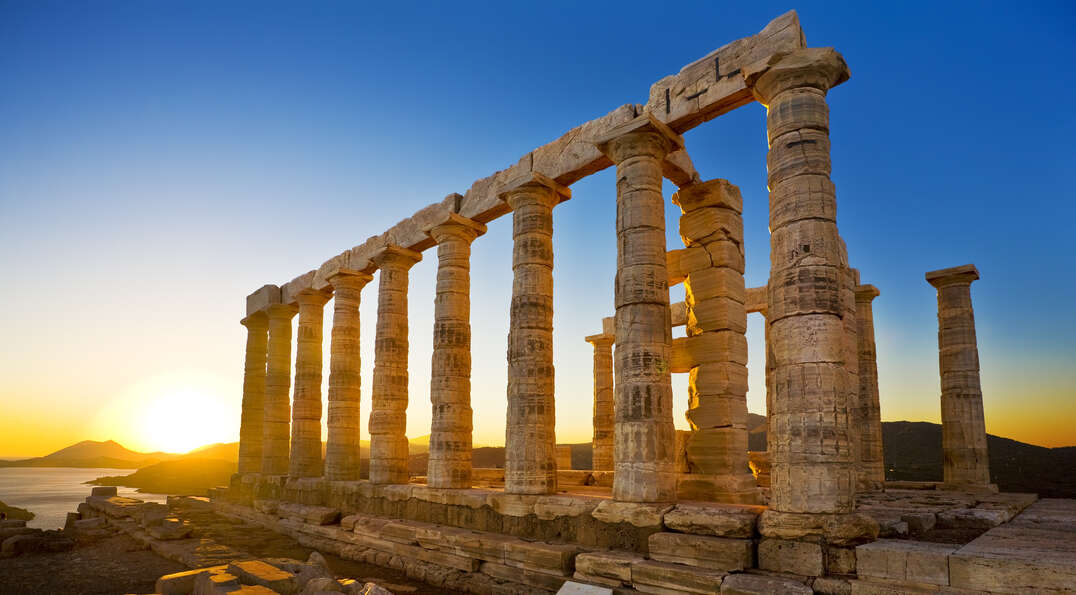
The Temple of Poseidon at Sounion
The Temple of Athena Nike
One of best-preserved among the temples on the Acropolis, the Temple of Athena Nike is also among the smallest, measuring roughly 18 feet x 26 feet. You can inspect it on any of several Road Scholar programs, including Classical Greece: Islands of the Aegean.
Sanctuary of Athena Cynthia
The sanctuary is located on the highest point of now-uninhabited Delos, an ancient pilgrimage site and an island Road Scholar explores on programs including The Best of Greece: Island Hopping in the Aegean.
The Temple of Poseidon at Sounion
Dating to around 440 BCE and situated sixty miles south of Athens on cliffs overlooking the Aegean, the temple is built of white marble. It is said to have also served as a lighthouse and offers stunning, panoramic views of the sea. It’s one of the highlights of the Road Scholar program, The Greek Isles & Ephesus: A Small Ship Voyage.
The Sanctuary at Isthmia
The Sanctuary at Isthmia
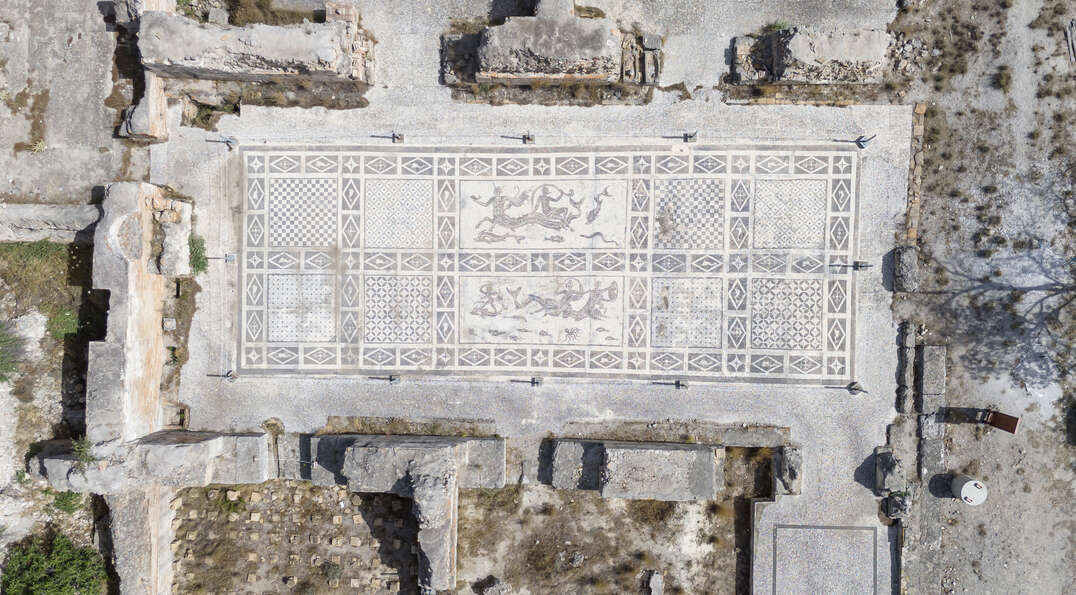
Located on the narrow strip connecting the Peloponnese to the mainland, the sanctuary includes several temples, the most significant being the Temple of Poseidon. Artifacts show that worshippers here beseeched Poseidon for safe travels at sea. The site was also home to the Isthmian Games, a major athletic festival in honor of Poseidon that drew athletes from all over Greece.
It’s no myth — Greece is one of the most fascinating places on Earth to learn about ancient civilizations. That’s why we made it our Campus of the Year for 2026!