2026 Multigenerational Travel Survey: How Families are Planning Shared Adventures Across Generations

Planning Multigenerational Travel
- Quality time matters more than simple sightseeing.
- All-inclusive programs reduce the stress of planning.
- Look for educational trips that prioritize accessibility.
Top International Destinations
- Italy: 39%
- UK: 25%
- Japan: 15.1%
- Costa Rica: 12.3%
- Greece: 8.6%
Tips for Traveling with Grandkids
- Choose national park and wildlife adventures.
- Plan a trip of about a week to keep everyone energized.
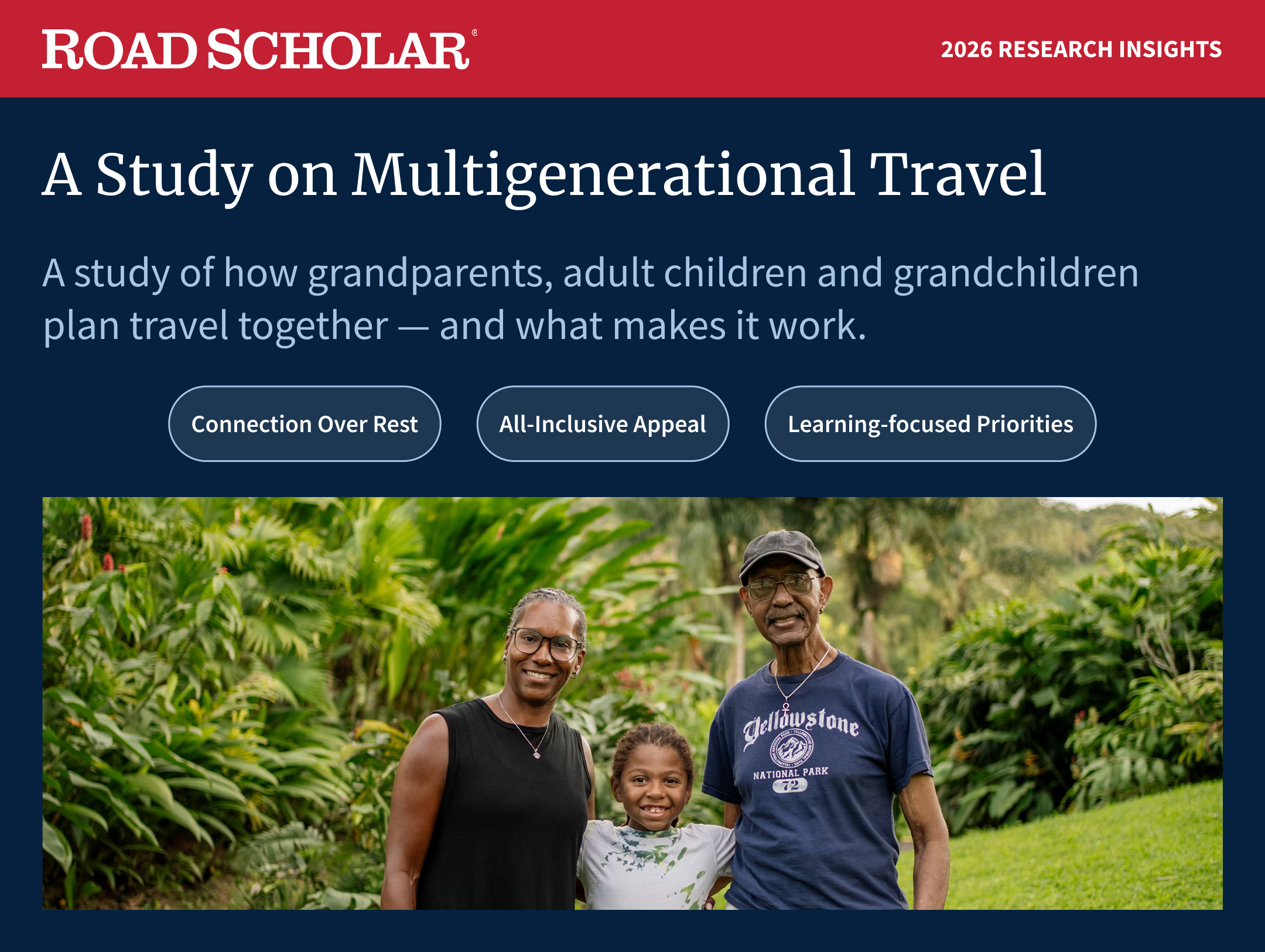
from survey"Over 57% of our survey respondents have taken a multi-gen trip, and even more would do it again."
Gathering your loved ones for an adventure is one of life’s greatest joys and a deeply meaningful way to explore the world. Multigenerational travel offers retirees, adult children, and grandchildren a chance to make discoveries and share real experiences that they’ll cherish for years to come.
Our recent Thought Leader survey revealed that traveling as a family remains a popular and growing trend in 2026. The results show that adult generations are actively preparing for shared, intergenerational adventures over the coming year. But rather than escaping to the nearest beach, they’re focusing on spending quality time and creating lifelong memories together.
Together, families are pursuing hands-on, expert-led journeys that provide a deeply enriching experience for adults and children alike. Today, we’ll explore what the study reveals about multigenerational travel trends and how families are pulling off an educational adventure that every generation will remember.
Multigenerational Travel Is Driven by Quality Time and Shared Memories
Have you heard the phrase “Faster alone, further together?” It’s entirely true. While traveling solo or with a peer lets you move quickly, sharing those experiences with your adult children or grandchildren turns every moment into a treasured memory.
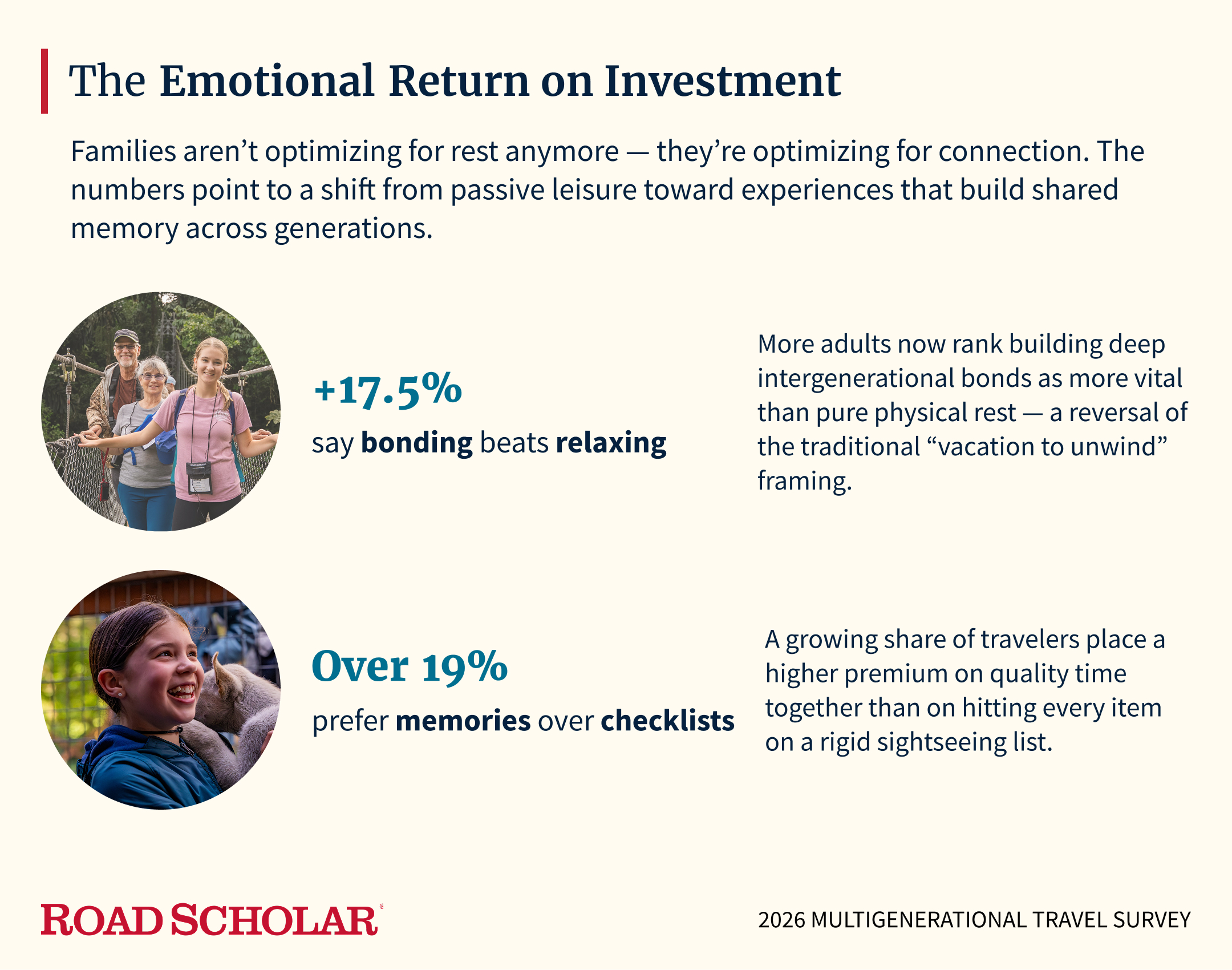
Our study showed that when planning multigenerational family travel, emotional “return on investment” matters much more than catching rays. In fact, 17.5% more adults said building an emotional connection was more important than relaxation when traveling.
The survey also revealed that over 19% of adults value sharing memories and quality time over visiting bucket-list destinations (although they aren’t mutually exclusive!). Whether exploring the jungles and wildlife of Costa Rica or taking a grandchild to their first Broadway show, shared learning experiences make the best souvenirs.
Educational and Cultural Experiences Matter Most in Intergenerational Travel
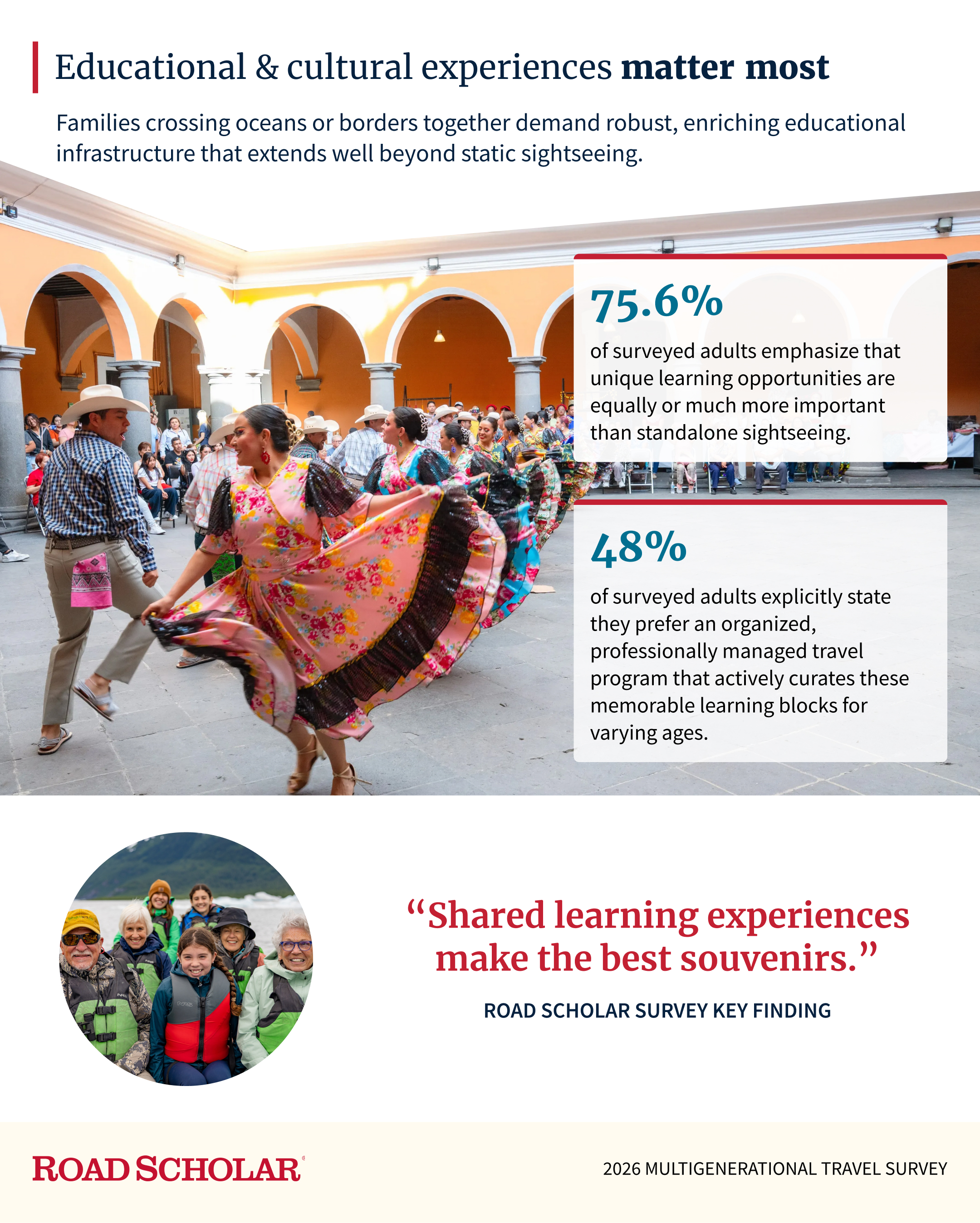
Families that cross oceans or borders together want enriching experiences that go beyond sightseeing. Our survey revealed that an overwhelming 75.6% of adults believe unique learning opportunities are equally or more important than simply visiting a landmark.
At a Glance: How important are learning opportunities like lectures, workshops, and local experts compared with pure sightseeing?
- Much more important: 14.3%
- Slightly more important: 24.3%
- Equal importance: 36.9%
- Less important: 24.3%
Further, the survey revealed that over 48% of adults prefer an organized travel program that offers unique and memorable experiences for their family. Educational travel with loved ones allows retirees and little ones alike to explore the world with fresh eyes, discover the beauty of new cultures, and get hands-on experiences that they can't find at home.
What does this mean for planners? The study suggests that shared discovery provides a more enriching and rewarding experience for learners of all ages. If you’re considering intergenerational travel with grandparents, adult children and grandchildren, trips that encourage learning work best.
View Our Grandparent/Grandchild Programs
Nature and National Parks Lead Multigenerational Travel Trends
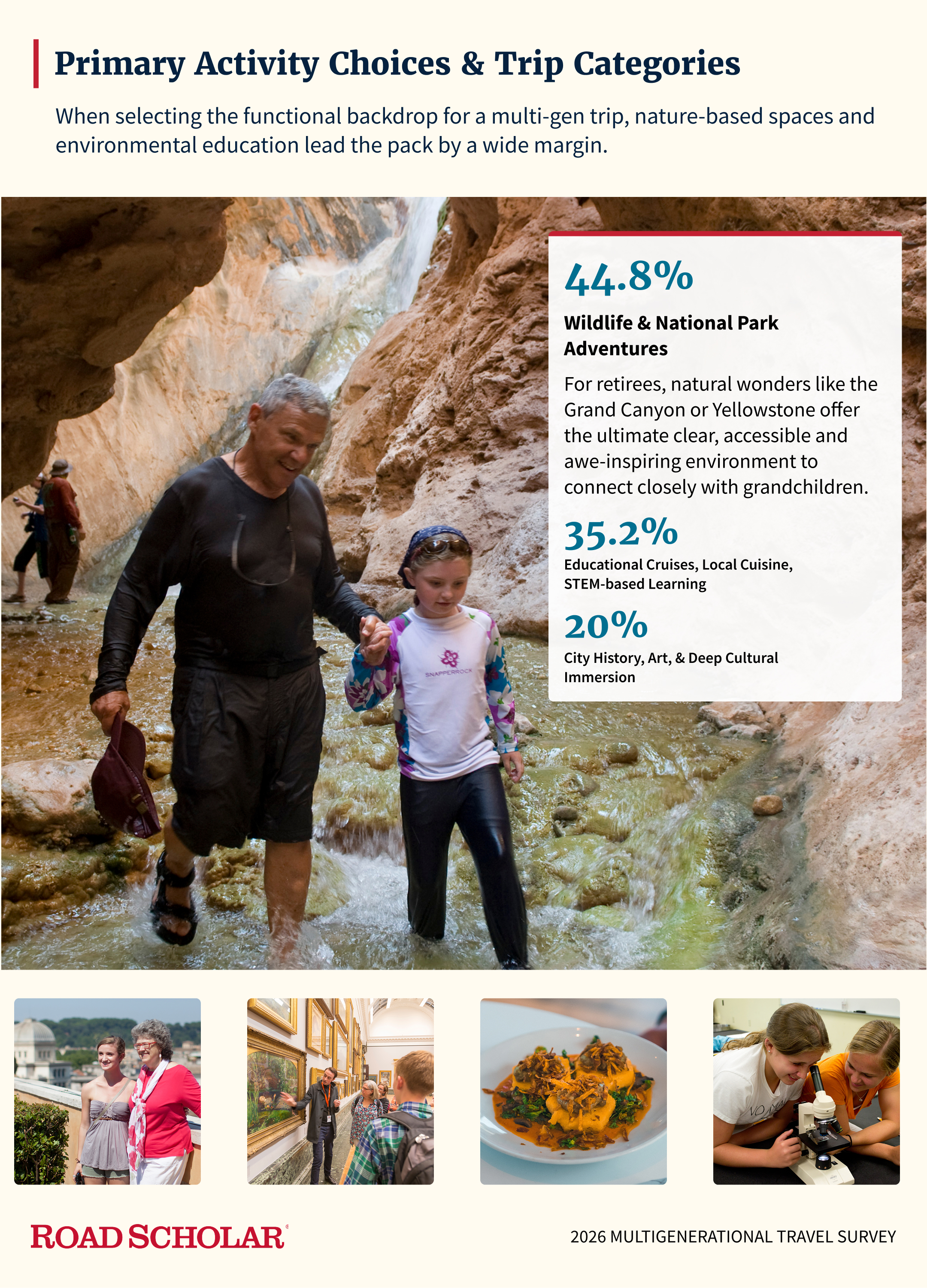
Where can you find the best combination of learning and discovery for the whole family? Our survey revealed that 44.8% of respondents chose wildlife and national park adventures as their top choice for multi-gen travel.
Nearly 20% of respondents preferred exploring the history, art, and culture of a given city. Educational cruises, local cuisine tours, cooking classes, and STEM-based learning programs round out the top choices.
So, why do wide-open spaces and natural wonders dominate multigenerational travel trends? For many retirees, these trips may be their first chance to experience the natural world after leaving the workforce. Whether stargazing on the rim of the Grand Canyon or watching geysers in Yellowstone, it’s the perfect opportunity to share the wonder with younger generations.
View Our National Park Programs
Destinations That Balance Learning, Comfort and Discovery
Now that we know what travelers want to do, the next question is where they want to go. Respondents shared which destinations they would most enjoy exploring during a learning-focused journey.
Top U.S. Regions
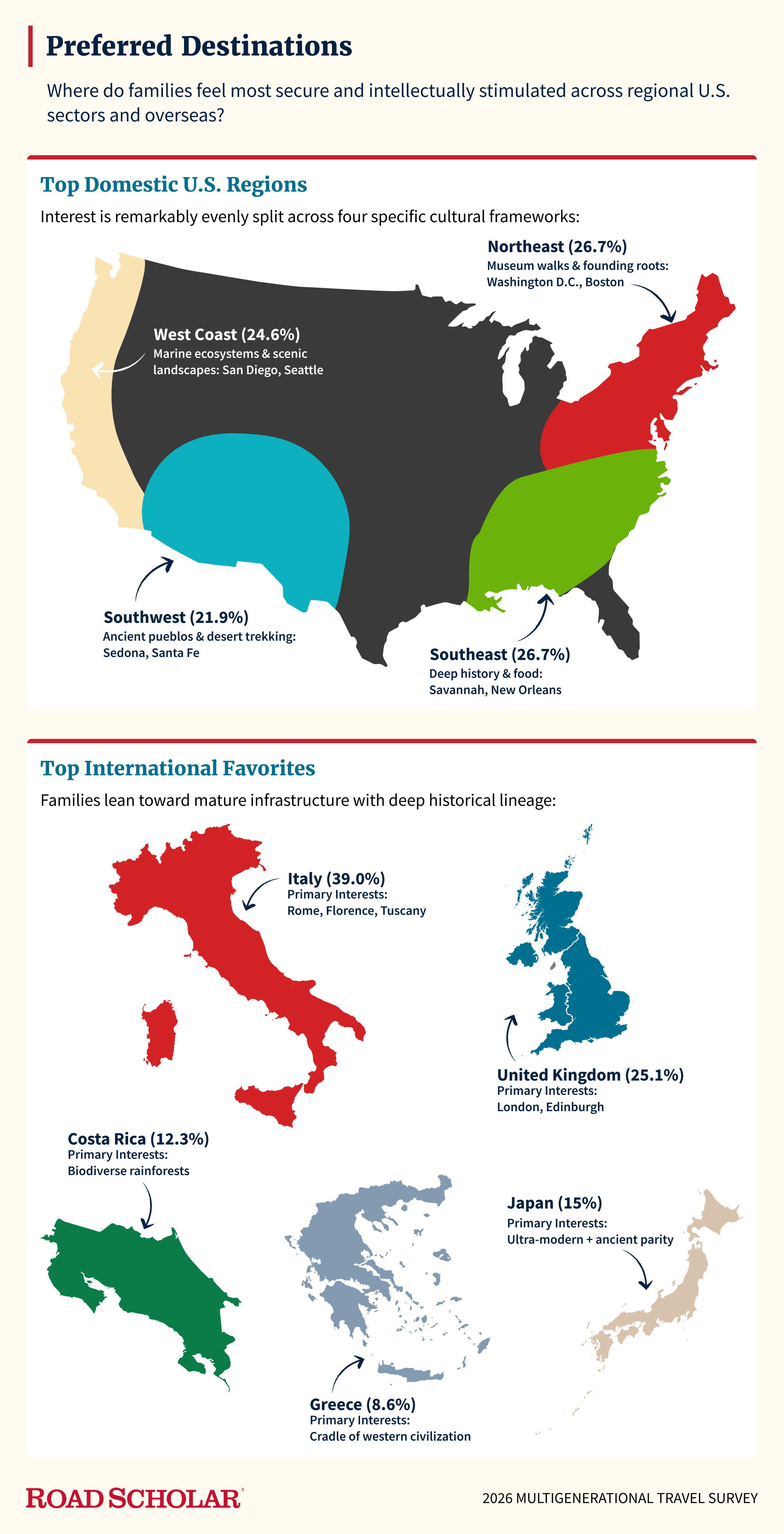
When asked which parts of the U.S. they would most enjoy exploring with family, survey respondents showed a remarkably even split across four areas:
-
Southeast: 26.9% of our respondents said they’d like to visit Deep South cities like New Orleans, Charleston and Savannah. These historic cities let families step back in time while enjoying some of the most famous food in the country.
-
Northeast: Only slightly fewer respondents (26.7%) preferred Washington, D.C., Boston and Philadelphia, where some of the world’s best museums let generations walk through the history of our country together.
-
West Coast: 24.6% said they’d rather head West to San Diego, San Francisco and Seattle. The sprawling, beautiful Pacific Coast offers some of the country’s most scenic landscapes and marine life encounters.
-
Southwest: Finally, 21.9% preferred the stunning deserts of Santa Fe, Sedona and Phoenix. From exploring ancient pueblo cities to trekking along the Grand Canyon, the Southwest offers unmatched frontier adventures.
From the whitewater rapids of Oregon to the lamplit streets of Charleston, every area of the United States offers exciting opportunities for multigenerational travel.
Top International Destinations
International travel remains popular across generations. Our survey results revealed that respondents overwhelmingly preferred two countries in particular when planning an overseas intergenerational travel experience:
-
Italy: 39% set their sights on Rome, Florence and Tuscany. It’s easy to see why! From ancient wonders to living Renaissance cities, from Alpine hikes to world-famous wine tastings, Italy truly offers enriching experiences for everyone in the family.
-
The United Kingdom: London and Edinburgh were the top destinations for 25% of respondents. The UK is a popular choice for retirees and children alike, thanks to the lack of language barrier, countless castles and UNESCO sites, and a legacy of art and culture.
While most survey respondents chose Italy and the UK, three other countries received a mention in our top five international destinations: Japan (15.1%), Costa Rica (12.3%) and Greece (8.6%).
-
Japan offers ultra-modern convenience combined with thousands of years of rich history. An island-hopping voyage is a great way for family members of all ages to experience the culture and cuisine of Japan’s four main islands.
-
Costa Rica provides endless natural wonders for kids, parents and grandparents to explore together, from volcanoes and rainforests to close encounters with wildlife.
-
Greece lets families explore the birthplace of Western Civilization. From Athens to Crete, Greece is popular with retirees and parents for its relaxed pace, deep history, and exceptional food.
What’s the takeaway? When planning travel with children or grandkids, look for history-rich, well-developed destinations. Navigating a new country feels much more manageable when you have reliable transportation, comfortable lodging, and amazing learning opportunities at your fingertips!
If you’re not sure where to start, Road Scholar offers convenient, guided learning adventures to destinations around the world, including city and nature travel, designed for you to share with your loved ones.
View Our International Favorites
All-Inclusive Programs Appeal to Multigenerational Travelers
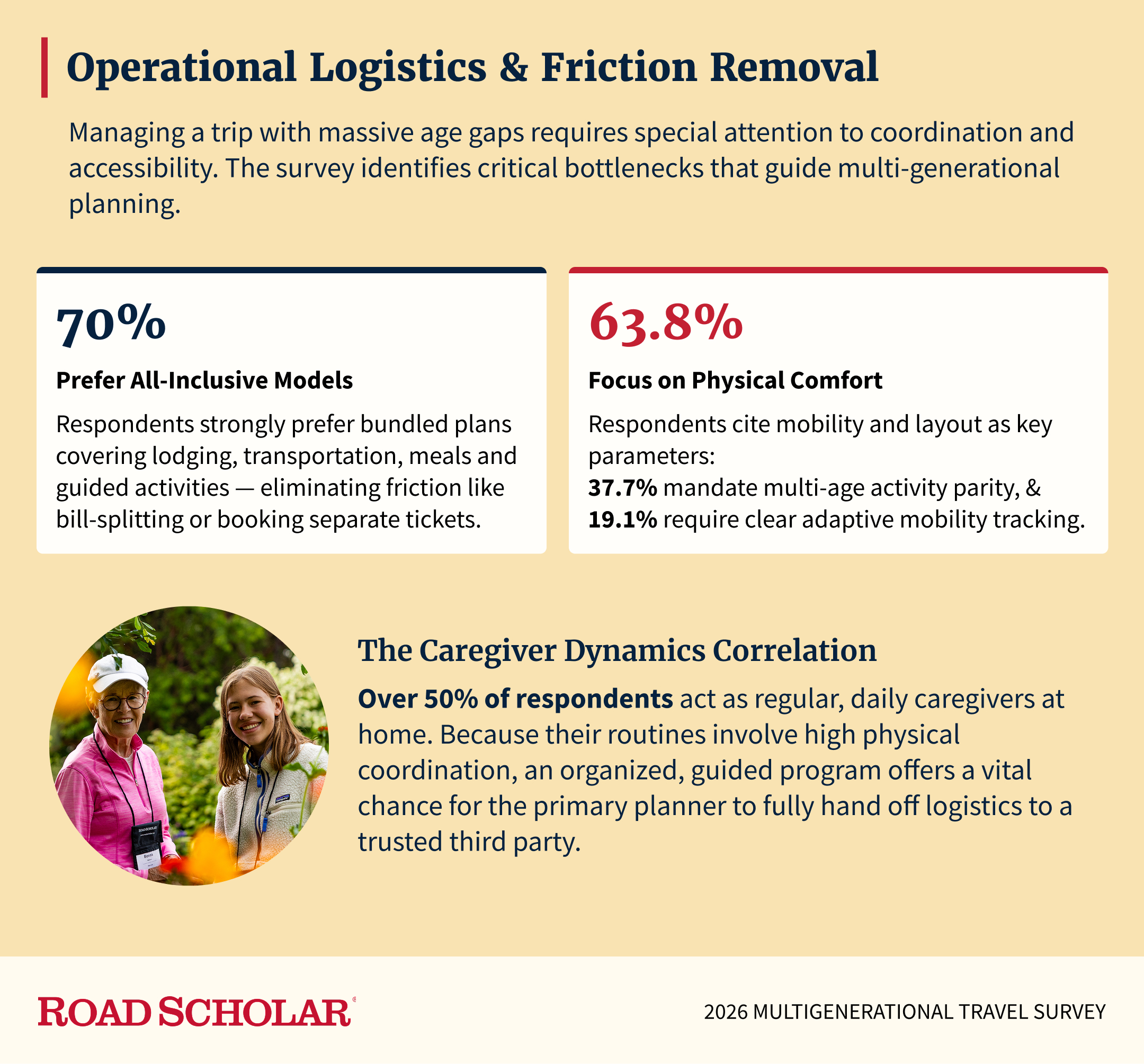
Here’s a travel tip for grandparents: You don’t need to plan everything! Nearly 70% of survey respondents preferred all-inclusive programs that bundle lodging, meals and guided educational activities.
All-inclusive programs remove the daily frictions of multigenerational family travel. Deciding where to eat, buying tickets, and arranging a ride to the next activity all create stress, especially if your family doesn’t speak the local language. For families with hungry children or retirees with a fixed income, the prepaid nature alone can make an all-inclusive package worth it.
Plus, an all-inclusive learning adventure for grandparents and grandchildren ensures every family member has something to do. Tailored multi-gen travel packages provide hands-on experiences that keep explorers of all ages engaged and stimulated throughout the journey.
When the planning, daily expenses and hassles of travel are handled for you, your family can focus entirely on enjoying your time together.
View the Grandparent Travel Guide
Accessibility and Cost Are Key Planning Factors for Multi-Gen Travel
Traveling with grandparents, grandchildren and other family members requires special attention to keep the adventure accessible for everyone while sticking to the family’s travel budget. Unsurprisingly, these are the most important factors when picking a multigenerational travel program.
Accessibility
Our survey revealed that traveling with grandparents and young children requires striking a balance between what people want to do and what they can physically manage.
37.7% of respondents ranked activities for all ages as the most important factor when choosing a multigenerational travel program. An additional 19.1% said accessibility for varying mobility levels mattered most. Survey data also showed that, while they may not be the primary concern, accessibility and physical comfort are concerns for a combined 63.8% of travelers.
Further, our survey data revealed that over 50% of respondents act as regular caregivers for children, spouses, and older parents. Since the family travel coordinator is so often the caregiver at home, a learning adventure shouldn’t feel like extra work. Guided family travel with accessibility options offers the primary planner a chance to let others handle the heavy lifting.
Cost
Respondents ranked cost and affordability as second only to accessibility concerns when selecting an intergenerational travel program. Packages costing less than $3,000 per person are the most popular. For a 7 to 10-day guided package (including accommodations, some meals and planned activities):
- 48.1% expect to pay between $1,500 and $2,999 per person.
- 35.3% expect to pay $3,000 to $4,999 per person.
- 16.7% expect to pay $5,000 or more per person.
The takeaway? Travel programs that balance accessible activities with a grounded budget can help family trip planners enjoy the experience without the stress. Look for trusted travel companies like Road Scholar that offer affordable, limited-mobility travel options to help your loved ones get the most out of your shared adventure.
Families Prefer Private Time With Some Shared Group Experiences
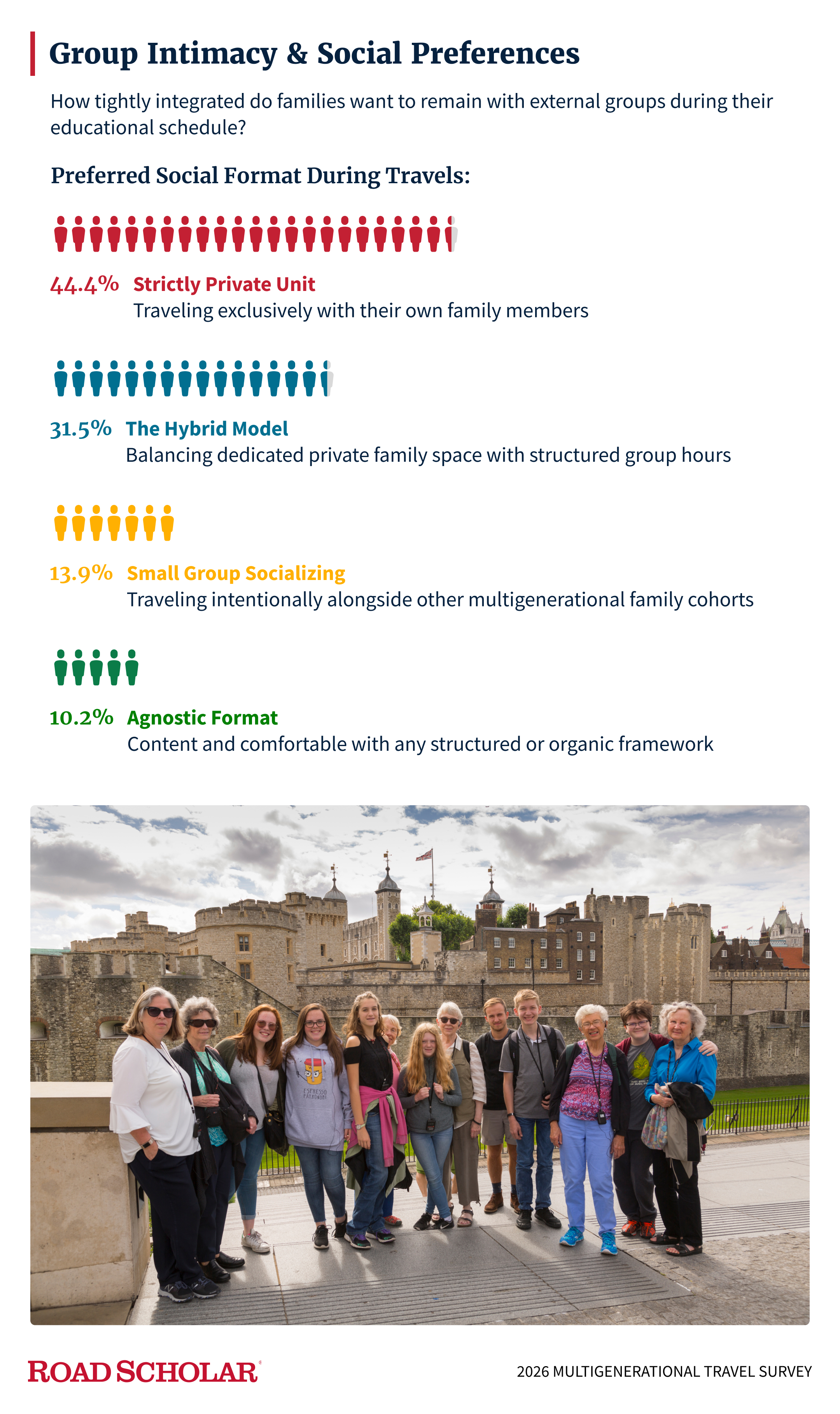
When planning a family trip, do you envision spending time together exclusively or sharing it with others? Our survey revealed that 44.4% of respondents prefer a private trip for their own family unit. On the other hand, 31.5% enjoy a mix of private family time and shared group experiences. 13.9% look for a small group program where they can travel alongside other families, while 10.2% enjoy any format.
Even within an organized learning adventure, family intimacy is incredibly important. As we saw earlier, sharing experiences with loved ones is the primary reason people travel in the first place. Families love the framework of an expert-led itinerary, but they also want the space to connect privately and create memories they can cherish together.
What Multigenerational Travel Trends Mean for Families Planning Their Next Trip
The Road Scholar 2026 Multigenerational Travel Survey revealed exciting trends for families who want to experience the world together. With over 50% of respondents open to or actively considering a multigenerational trip within the next year, there’s no better time to start exploring destinations and choosing activities.
Trends show that families prefer educational adventures over simple sightseeing. Guided tours, local experts and hands-on learning make child-and-grandparent adventures come to life. National parks, wildlife excursions and cities with rich culture and history are the most popular choices. Families prefer traveling to developed areas like the Deep South, Italy, the UK and Japan, which offer accessible infrastructure and a variety of activities for all ages.
To keep the budget under control, families look for all-inclusive programs that include lodging, transportation, and some meals.
That's why choosing the right program matters. When a trusted travel company handles the heavy lifting, older generations can focus on sharing time and creating memories with their loved ones.
If you're ready to explore the world with your family, consider a multigenerational travel package from Road Scholar. Whether you prefer getting immersed in a new city or exploring natural wonders, our educational adventures bring every generation together. Explore our packages and review our practical travel tips to find your perfect family adventure.
Frequently Asked Questions About Multigenerational Travel
What is multigenerational travel?
Multigenerational travel simply means traveling with any combination of grandparents, parents, adult children, and grandchildren. Over 57% of our survey respondents have taken a multi-gen trip, and even more would do it again.
What is the best trip length for multigenerational family travel?
Trips of about a week, plus or minus a few days, work best for intergenerational travel. According to our study, 38.2% of respondents find a 6 to 9-day trip provides the best balance of learning and leisure. Slightly fewer (34.9%) find that shorter trips of 4 to 5 days are easier to manage.
Weekend getaways of 2 to 3 days and multi-week trips were less popular. Shorter adventures can limit both the family’s time together and the availability of the experiences everyone wants. On the other hand, extended travel can strain both finances and the energy levels of kids, parents, and grandparents alike.
What destinations are popular for intergenerational travel?
National parks and cities with rich history and culture are the most popular destinations for multi-gen travel. Within the U.S., families are fairly evenly drawn to the Southeast, Northeast, West Coast and Southwest. Internationally, Italy and the United Kingdom are the most popular destinations.
What should families consider before booking multi-gen travel?
A multigenerational learning adventure should offer a variety of activities that all age levels can enjoy, while leaving plenty of free time for relaxation. Consider whether your group will need accessibility considerations and what budget you’re comfortable with. Finally, look for all-inclusive options to help reduce the stress of planning and managing the trip.