
Frank Kameny: American Patriot & the Fight for Equality

- Frank Kameny was an astronomer whose dismissal from federal employment in 1957 sparked a lifetime of LGBTQ+ activism and advocacy.
- He became the first person to challenge federal discrimination based on sexual orientation and helped launch the modern gay rights movement.
- Kameny's leadership contributed to milestones including early White House protests, the "Gay is Good" movement and the removal of homosexuality from the APA's list of mental disorders.
- His story illustrates how one citizen's commitment to equality, civil rights and democratic ideals helped change the United States.
Sometimes a powerful government doesn’t see it coming. It fails to anticipate the citizen who will refuse to capitulate when forced to reckon with policies that undermine everything that citizen knows to be true about his country’s foundational precepts.
The United States government failed to anticipate Frank Kameny, whose lifelong activism, fueled by the conviction that the nation’s ideals of freedom and equality applied to LGBTQ+ Americans, made him one of the most significant figures in the U.S. gay rights movement.
Quite a legacy for man who only every wanted to be an astronomer.
The Early Years
Born May 21, 1925, in New York City’s Queen’s borough, Frank taught himself to read at four. By age 16, the precious teenager had enrolled in Queens College, majoring in physics.
Following service in the U.S. Army during World War II, Kameny continued his studies at Queens; in 1948, he graduated with a baccalaureate in physics. Frank then moved to Cambridge, Mass. to begin a PhD program in astronomy at Harvard University.
The year 1956 was a consequential one for Frank. It’s when he earned his Harvard doctoral degree. It’s also the year he attended the American Astronomical Society annual meeting at UC Berkeley. While there, the young gay man followed a pattern familiar to all gay American men in a country that at the time criminalized homosexuality: He made his way to the public lavatory in San Francisco’s East Bay train terminal, a place gay men knew they could meet each other for clandestine trysts. Unfortunately for Frank, it was also a spot patrolled by members of the vice squad. On August 28, 1956, Frank Kameny was arrested, accused of “lewd and indecent acts.” The San Francisco municipal court offered him the option to plead guilty and accept a $55 fine and six-months’ probation, to which he agreed. Frank believed the incident was behind him.
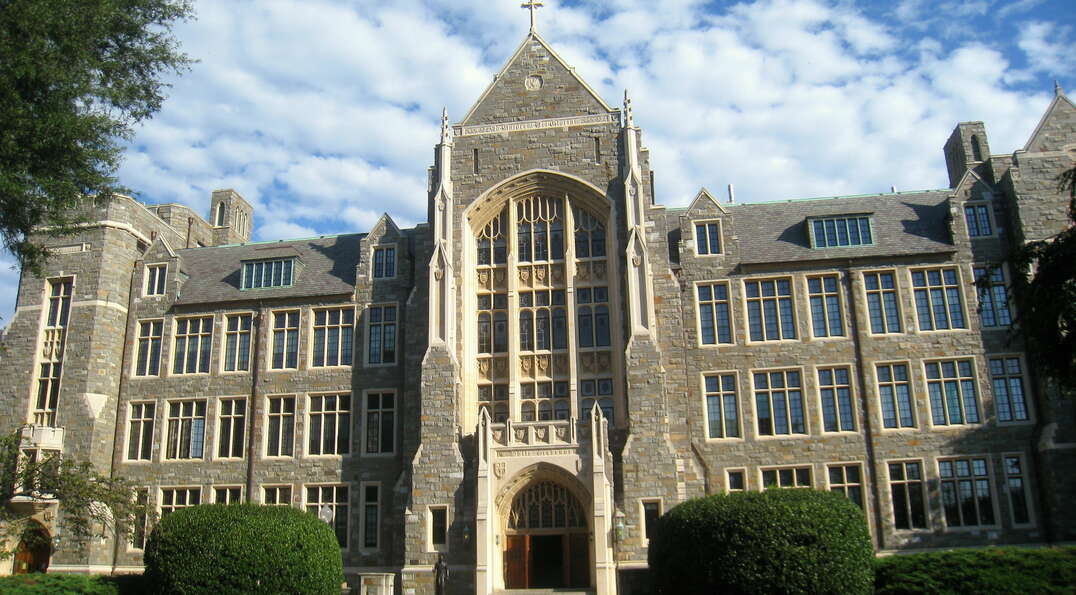
Georgetown University, Washington D.C.
Frank Kameny vs. the U.S. Government
In 1957, Kameny relocated to Washington, D.C. to teach in Georgetown University’s Astronomy Department. When an opportunity to work as an astronomer for Army Map Service on technology related to the country’s nascent space program, Kameny believed he had found his dream job. Yet, this dream was coming true for him four years after President Dwight Eisenhower had signed Executive Order 10450, which cited “sexual perversion” (i.e., homosexuality) as a reason to rescind federal employment and security clearances. Because he would require a security clearance in his new position, the Army Map Service conducted an extensive background check on Kameny. They discovered his San Francisco arrest record and questioned him about his suspected “sexual perversion.”
Rather than deny his homosexuality, during his investigation Kameny declared that his personal life was not the concern of the U.S. government. Nonetheless, on December 20, 1957, the Army Map Service dismissed Frank, citing his employment as a security risk.
Kameny then sued the government for the firing, and in doing so, became the first person to ask the courts to recognize discrimination based on sexual orientation. He wrote a letter to President Eisenhower demanding his case be reconsidered. H; he contacted members of Congress. He appealed to the ACLU to take up his case. “Homosexuality is a valid consideration in evaluating the security risk factor in sensitive positions,” replied the organization’s lawyers.
Leading the Gay Rights Movement
Frank Kameny would never work as an astronomer for the federal government again. In fact, he would never hold a full-time job in his field or any other. What should have been a life of career milestones was instead one of enduring financial hardship.
The federal government’s blatant discrimination toward him and its resulting professional ruin acted as a call to arms for Frank Kameny. The government might have assumed it had seen the last of the blunt and brash astronomer from Queens; the government was mistaken.
In 1961, Kameny helped launch the Washington, D.C. branch of the Mattachine Society, the nation’s first “homophile” (gay rights) organization. In 1965, Frank and other Mattachine members staged the first protest in front of the White House for gay rights.
In 1968, Frank heard Black Power activist Stokely Carmichael talking about the “Black is Beautiful” movement which inspired him to coin a slogan of empowerment for gay people: “Gay is Good.”
In 1971, Kameny became the first openly gay candidate to run for Congress when he entered the race to become the District of Columbia’s first elected representative. (He did not win the election yet declared victory because his campaign had given visibility to a gay candidate.)
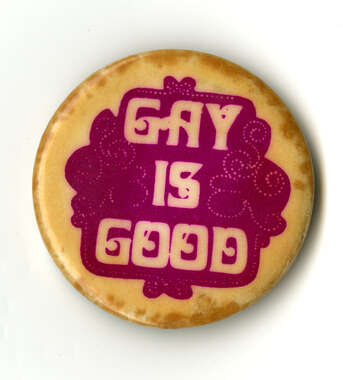
A button featuring the "Gay Is Good" slogan from the 1960s is a historic artifact attributed to activist Frank Kameny.
In 1973, thanks to the tireless advocacy of Frank and fellow LGBTQ activist Barbara Gittings, the American Psychological Association voted to remove homosexuality from its list of mental disorders.
In 1975, Kameny became the first chair of Washington, D.C.’s new Commission on Human Rights.
An Overdue Apology
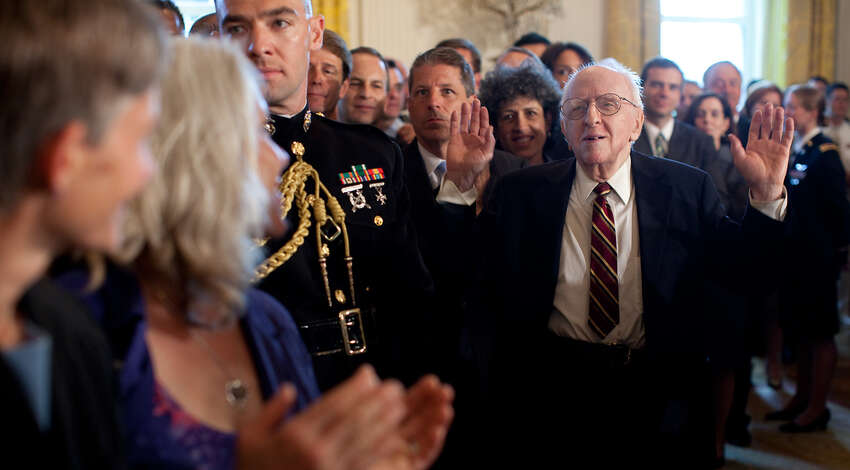
And then, on June 24, 2009 — 52 years after his unceremonious firing by the federal government — Frank Kameny attended a ceremony held at the Office of Personal Management headquarters. John Berry, its director was then the highest-ranking gay official in American history. He presented Kameny with a letter of apology from the government which he read aloud to all in attendance:
“With the fervent passion of a true patriot, you did not resign yourself to your fate or quietly endure this wrong. With courage and strength, you fought back.
“Please accept our apology for the consequences of the previous policy of the United States government.”
“Apology accepted!” replied Frank.
Frank Kameny’s Legacy
Earlier that year, Kameny’s Washington home had been designated an historic landmark by the District of Columbia's Historic Preservation Review Board. In 2011, it was added to the National Register of Historic Places.
On June 10, 2010, D.C. mayor Adrian Fenty unveiled new street signs designating 17th Street between P and R streets, NW in the city’s Dupont Circle neighborhood as "Frank Kameny Way."
And in what was perhaps his last act as a “Gay is Good” activist, Frank Kameny died at his D.C. residence on October 11, 2011, National Coming Out Day.
For further reading: The Deviant’s War: The Homosexual vs. the United States of America, a biography of Frank Kameny.
Carolyn Crouch is a Road Scholar lecturer and the founder of Washington Walks, with a deep appreciation for D.C.'s rich history. After earning an MFA in acting from The Catholic University of America, her passion for walking expeditions took root. A scholar in English and art history, she also updates Fodor's 25 Best Washington, D.C. guide. Serving on the D.C. History Center's board, Carolyn's influence extends beyond travel, impacting the historical community at large. A New England native, she brings a diverse perspective to her work.