
The Magic of Crete: A Winter In Immersive Experience
- Road Scholar Jean McMillan’s learning adventure to Crete was sparked by her desire for a diversity of experiences. She wasn’t disappointed.
- Thanks to expert leaders like Eleni Petroutsou, Jean was immersed in Greek culture, art and daily life. Jean’s Road Scholar group was even able to sit down to a meal of traditional dishes made by local women.
- Exploring Crete by foot offered personal experiences; Jean walked ancient, winding streets and was even able to dip her toes in the Aegean Sea!
- Overall, the inspirational setting of Crete and the ideal time of year came together to provide Jean with an unforgettable learning experience.
Why go to Crete? Personally, I wanted a diverse program with plenty of history, new foods and a variety of interactions with local folks. I found exactly the right mix when I enrolled in Winter in Greece: The Magical Island of Crete. I couldn’t wait for the adventure to start — and what luck to post in the Road Scholar discussion board and connect with a fellow traveler who was also coming into Athens a few days ahead with friends. We met for dinner and the adventure began!
The Magic Begins
This program begins and ends in Athens, so I was glad to have a day to explore the area before meeting our entire group for orientation and dinner. Our Group Leader helped us through the details of our flight into Crete, and we were ready to go!
Our Group Leader, Eleni Petroutsou, oriented us to our home base for the week with a walking exploration of Heraklion. She began by showing us the markets full of local produce, meats, fish and LOTS of sweets. My senses were full with the wonderful colors of the vegetable stalls, smells of the honeyed treats and local greens. She surprised us by suddenly stopping at a small shop and negotiating with the owner to make us variations of loukoumades, which are a dumpling-like treats made with honey. YUM!
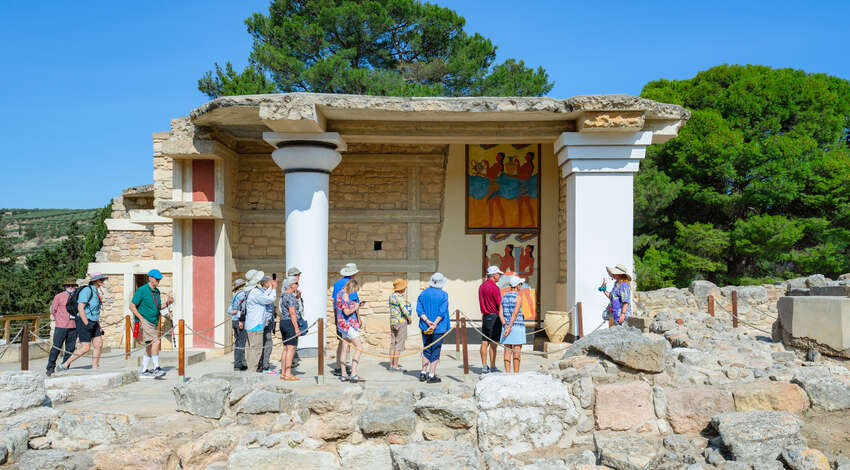
Exploring the island of Crete under the guidance of Eleni is an experience that I will remember for years to come. At Knossos, she reminded us of the mythology that has formed much of the Greek culture and provided information about the original frescos that artisans had to complete in a single day, as well as telling us about the daily lives of the inhabitants. I was interested to learn that they had developed the use of plumbing in 3000 BCE, including running water and a sewer system.
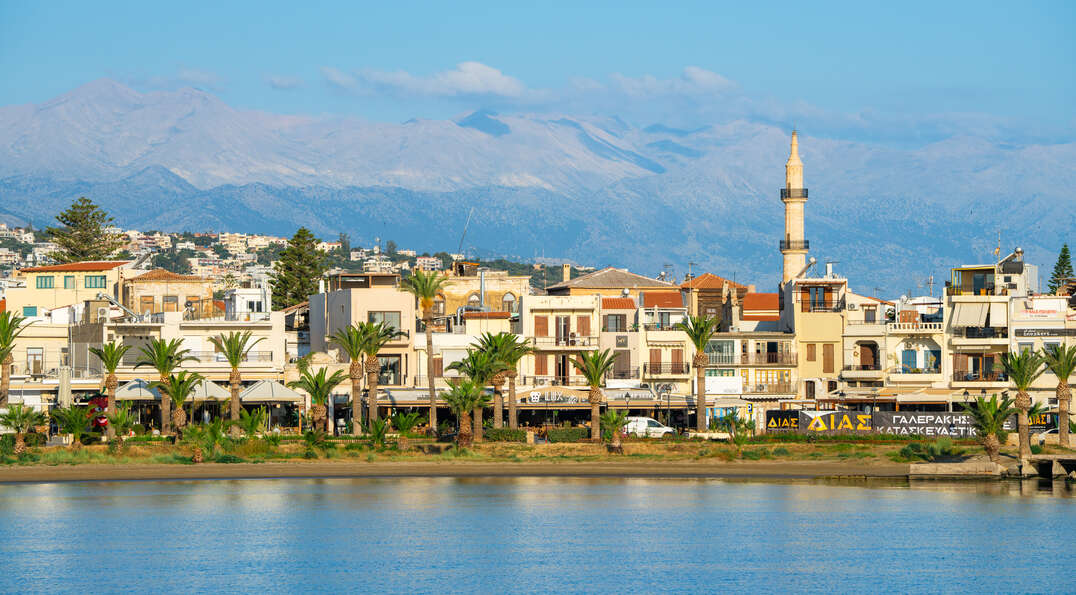
Rethymno, Crete.
During our lunch at the Ladies’ Cooperative in Kritsa, the local women treated us to a meal that included dishes learned from their mothers and grandmothers, including pickled wild narcissus bulbs, fresh wild greens made into pies, cheese pastries and dakos. As an extra treat, musicians played traditional Cretan tunes on the mandoula and lyra while we ate lunch. Eleni shared her belief that “Food is art, food is culture, food is civilization,” and that was definitely proving to be true in Crete.
I loved the visits to local artisans who continue to practice traditional skills. We were all amazed at the phyllo shop in Rethymno, when the gentleman allowed us to watch as he took a 10-inch flat circle of dough and worked with it until it covered a 12-foot square table! In Chania, we visited a knife shop, where for four generations, handmade knives of all sizes and types have been produced. In Thrapsano, the local potter demonstrated how to throw a two-foot vase in less than four minutes before giving members of our group an opportunity to try the potter’s wheel.
The Right Time to Explore Crete
November in Crete was a perfect time to explore. The temperatures were pleasant and our group seemed to be the only people at many of the locations we visited. This was especially true at the monastery of Agarathos, where silver medallions hung from the pomegranate tree, an expression of appreciation from the local people for their accomplishments, such as completing college.
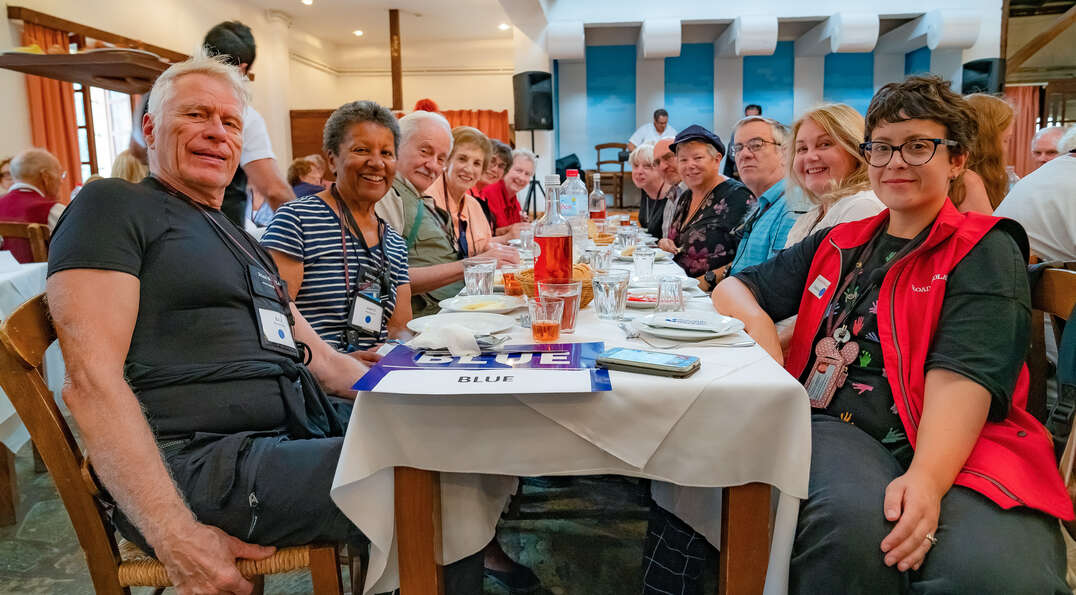
Participants dining together.
Sampling Greek Culture Through Cuisine
Olives grow and are served everywhere on Crete. We were fortunate to spend time at a modern pressing plant, where the local expert explained that harvesting is done using “alternate bearing,” where one half of each tree is harvested each year while the other half continues to grow and then be harvested the following year. The olives are pressed on the day that they are brought to the plant to ensure best freshness. Our brief lecture included an explanation about the various types of olive oil, and we were treated to samples for comparison, followed with raki, a traditional grape-based brandy that we had come to enjoy at the end of most lunches and dinners.
Grapes also seem to grow everywhere in Crete, so it was no surprise that the Lyrarakis Winery was on the itinerary. Three types of grapes that were nearly extinct have been restored using organic methods, due to the principles put in place by the winery’s owner. After tasting a few of their delicious organic wines, we were served a lunch that consisted of traditional Cretan dishes. Because the meals are served family style, we were able to share a variety of locally sourced specialties including dried fruits, breads, sheep and goat cheeses, vegetables and, of course, a bit of sparkling wine to accompany our dessert of Sfakiani pastry, a cheese treat made with local honey and crushed walnuts.
Honey is traditional in many of the foods. Even the breakfast buffet in our hotel each morning included a comb of honey that dripped slowly for our use in teas, on breads and more. Bees have been honored as far back as the days of the Minoans at Knossos, as is reflected in the antiquities displayed in the Natural History Museum.
Exploring Crete on Foot
Wandering by foot through Archanes, a community that also dates back to Minoan times, was a good way to explore. Eleni shared her knowledge about traditional wine making as we passed an ancient pressing installation. The winding streets made me feel as if I was in a maze!
English was widely spoken in hotels, restaurants and many shops in both Athens and Crete. Everyone I met was more than willing to communicate through a few rounds of charades when needed. Credit cards were accepted at most establishments, but I like to carry some local currency. I simply withdrew euros from an ATM after arriving.

One Learning Adventure, Many Highlights
One highlight was wading in the Aegean Sea. We made a stop as we traveled along the coast and some folks even went for a swim. The daily rides throughout Crete were always interesting, as we were able to view many historical landmarks including Mount Ida and Mount Dikta (both homes for Zeus), as well as enjoy the beautiful countryside featuring bee boxes, goats, olive trees and fantastic views.
As busy as we were, there was enough free time to enjoy a bit of independent exploring, including some dinners on our own and time to wander through the local shops or down to the waterfront where there’s a Venetian fortress that dates back to the 1600s.
From the archaeological excavations that help us learn about the past to tasting all of the delicious flavors of the country, this learning adventure provided a diverse group of experiences with just enough free time for personal exploration. I woke up each day curious about what new opportunity Eleni would have in store for us. She led our group of couples and singles, ranging in age from mid-50s to late-80s, and shared her abundant knowledge of Crete and her pride in this island that lies midway between Europe and Africa in the Mediterranean Sea. I arrived home with wines, olive oil and pottery in my suitcase — and the dream of returning to Greece in my head!

Jean McMillan began traveling with Road Scholar in 2012 on a program to Ireland, a journey that included her first transatlantic flight and her first passport stamp. When she is not on a learning adventure, she is planning her next road trip around the U.S. or playing dulcimer, a skill she first developed on a musical Road Scholar program.