
Rhythm of Resistance: Segregation & the Birth of Jazz in New Orleans

- Despite Jim Crow oppression, Black New Orleans musicians transformed hardship into the joyful, triumphant art form of jazz.
- Segregated spaces like Treme and Storyville were fertile ground for the inventive blending of diverse musical traditions.
- Venues like Preservation Hall and Dooky Chase’s restaurant nurtured both musical innovation and pivotal civil rights activism.
- Road Scholar’s Rhythm of Resistance program explores these places to learn their history and their contributions to jazz.
From the end of Reconstruction in the 1870s until the Civil Rights Act of 1964, the Jim Crow era was marked by laws designed to marginalize African Americans and roll back many of the rights secured during Reconstruction.
Jim Crow’s impact was widespread. One place it was keenly felt was in the artistic community. African American musicians faced varying degrees of hostility and injustice as they traveled across the country. Generally — but not always — they would find more acceptance in the North than the South, but it was never less than a struggle to adjust, to live with dignity, even to survive.
Towering figures like Count Basie, Louis Armstrong and Duke Ellington regularly had to confront the prospect of performing in the ballrooms of hotels at which they were not allowed to stay. Black rock-and-roll pioneers often played to audiences separated by color — if the crowds were allowed to be mixed at all. Locals were often violently opposed to the musicians’ mere presence.
The famed African American opera singer Marion Anderson sang in front of 75,000 people at the Lincoln Memorial in 1939 (and was heard on the radio by millions). She was not chosen to perform there as an honor. Rather, she had been barred from singing in D.C.’s Constitution Hall — and at a white high school there — because she was Black. Intervention by Eleanor Roosevelt helped arrange for her to sing at the monument — unsegregated federal property — on Easter Sunday.
Such were the realities of Jim Crow.
Music and segregation intersected in many other ways and in many other places across the U.S. Nowhere was the impact greater than in New Orleans. There, Jim Crow laws played an important role in the development and evolution of jazz. Road Scholar explores that relationship in the program Rhythm of Resistance: Civil Rights & Jazz in New Orleans, highlighting several places of historic significance to the saga. Among them:
Storyville
Storyville was New Orleans’ red light district in the early part of the 20th century, where jazz clubs flourished alongside segregated brothels, which themselves offered entertainment. The brothel workers were segregated, but Black men were prohibited from patronizing any of the establishments. Black musicians were, however, permitted to perform; in fact, only Blacks performed in Storyville during its early days. Seminal figures of jazz like Jelly Roll Morton and Manuel Manetta honed their styles in the brothels, incorporating the African, French, Spanish and Anglo-American musical influences that were beginning to collide and comingle in the city. Louis Armstrong, who grew up in Storyville, was in turn influenced by those early players. Road Scholars spend time learning the district’s history, musical and otherwise, at the Storyville Museum.
Treme
Treme is widely acknowledged to be the oldest Black neighborhood in the United States. It was one of the first places where free people of color and formerly enslaved people were allowed to own property. It was also home to similarly marginalized Creoles of color, people of mixed race who brought a diversity of ethnic backgrounds to the area. Treme was therefore a place where African and Caribbean influences (as well as European and North American traditions) shaped creative expression in all the arts, but especially music, and especially jazz.
In Treme, avenues for musical performance included celebrations by groups known as Mardi Gras Indians.
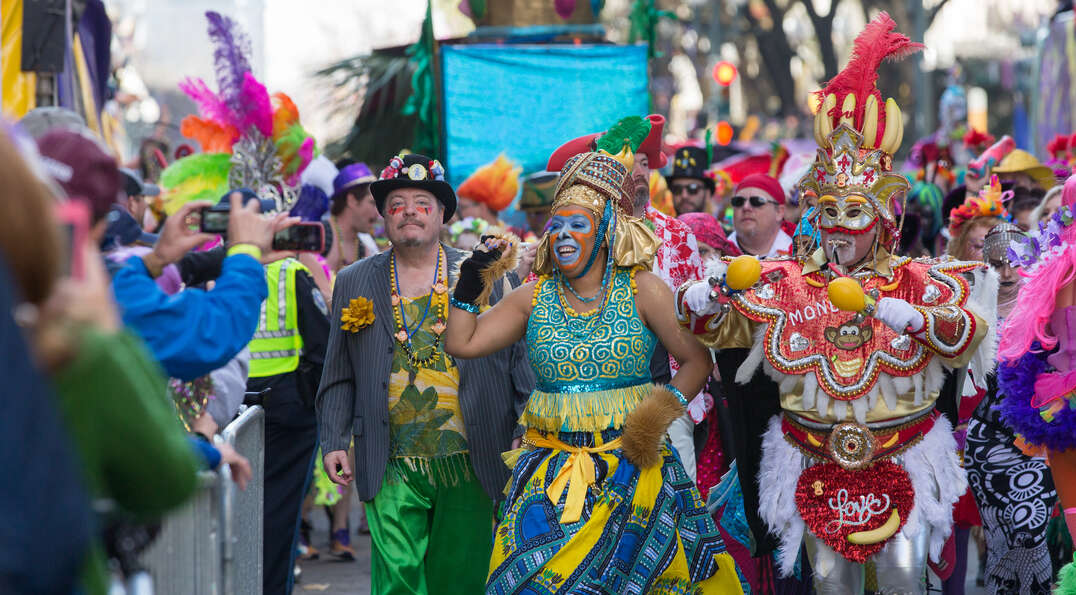
Current Mardi Gras in New Orleans.
Among many other restrictions, Black citizens of the time were not allowed to attend events during Mardi Gras, and to ensure they were not infiltrating the festivities, they were prohibited from wearing masks. Undaunted, Black New Orleanians began holding their own parades and other celebrations in Treme, led by neighborhood organizations that adopted face painting traditions in tribute to Native Americans. (Relationships between the two groups were strong, due in part to their shared experience of oppression and in part to the fact that Native Americans frequently sheltered fleeing slaves prior to emancipation.)
The parades led by the Mardi Gras Indians featured the abovementioned diverse musical styles, all anchored by drum-based bamboula rhythms, which originated in Africa and are considered foundational to jazz and other New Orleans music. Here, as in Storyville, the chaotic and joyful collision of styles further seasoned the delightful stew that jazz represents.
There was another offshoot of these celebrations. The musical troupes in Mardi Gras Indian events usually featured a “second line” of brass and drums, and these performers would also play in the unique jazz funeral processions still common in New Orleans today. Road Scholars learn more about the Mardi Gras Indians at the Backstreet Cultural Museum, and about their musical contributions at Treme’s Petit Jazz Museum.
The Dew Drop Inn
Late in the Jim Crow era, the Dew Drop was a Blacks-only establishment where local performers would interact with visiting musicians who were able to stay at the inn. The influence of such performers and guests, including Ray Charles, James Brown, Otis Redding and Little Richard (who wrote “Meet All Your Fine Friends at the Dew Drop Inn”) would be felt in the local rhythm and blues scene, whose musicians in turn influenced the visiting artists. Road Scholar makes a stop at the inn — now open to all, of course — during the Rhythm of Resistance program. (It’s also worth noting that even in the Dew Drop’s “segregated” days, whites who knew the right people or had the right connections could visit and enjoy its music without consequences.)
Preservation Hall
This famous jazz hall began in the 1950s as an art gallery — a unique space where racially integrated bands and audiences could play and listen to music together. It was one of the few such venues in the Jim Crow era — and remains today a hallowed place for performers and aficionados of jazz. Road Scholars go behind the scenes to explore Preservation Hall, to hear about the history of the club and to meet with a musician who describes what it was like to play during that tumultuous time.
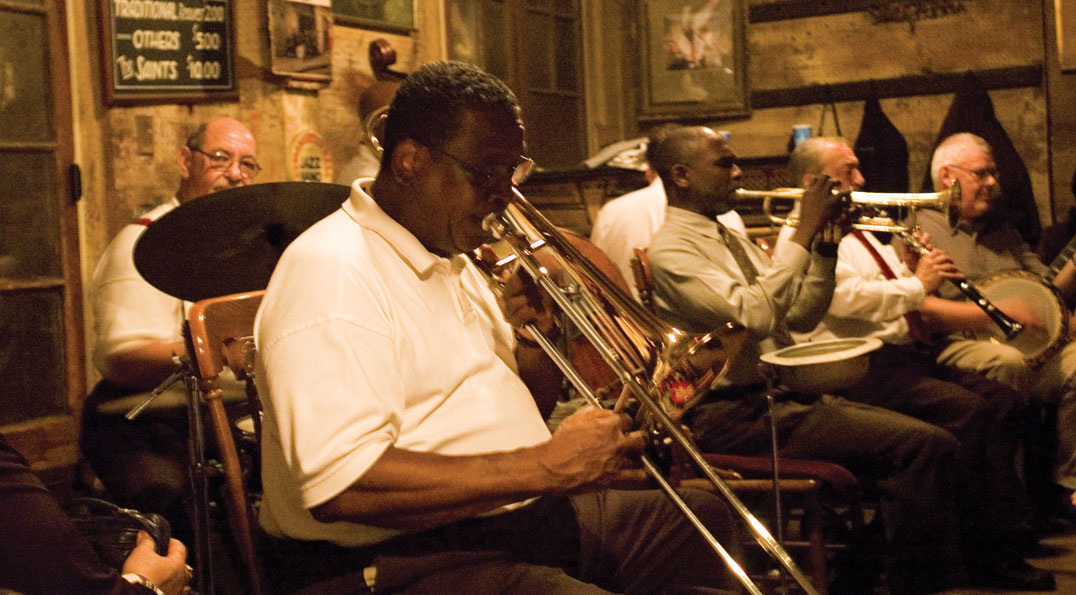
Jazz performance at the Preservation Hall.
Dooky Chase’s Restaurant
From its opening in 1941, Chase’s in Treme was a meeting place for civil rights activists including Martin Luther King Jr. and Thurgood Marshall. It was also a place for local jazz musicians to gather and share ideas. Road Scholars enjoy a meal at the restaurant, now one of the most awarded in America.
Certainly, there’s irony in the fact that the very segregation designed to keep people apart contributed to the cultural cross-pollination of jazz, and there’s arguably no other place in the country where that could have occurred as it did in New Orleans.
One thing that will strike you in New Orleans today is that jazz and all the musical forms that sprang from it are virtually everywhere. There’s a solo musician or group performing on seemingly every street corner. You hear strains emanating from packed clubs, from funeral processions, from parks and bandstands. Everyone in the city seems to be a musician, and they’re all good. Throughout history, great art has emerged from hardship, from novels chronicling wartime to paintings providing an outlet for personal anguish. Despite the injustice and deprivation that prevailed at the time, jazz emerged in New Orleans as a triumphant and joyful art form that can be savored all the more today in light of its origin story.
You can learn more about Road Scholar’s jazz programs in New Orleans and elsewhere in the country. And you can explore our programs on the Civil Rights movement.