Lizzie’s Behind-the-Scenes Experience in Mythical Greece, Part One

- Lizzie G. travels to Greece, shares what happens behind the scenes of a Road Scholar learning adventure and describes why this country, steeped in history, is a perfect fit for our 2026 Campus of the Year.
- Her journal takes us to Athens, from the Acropolis up to the Parthenon, Hephaestus Temple, the Plaka Agora and Anafiotika, then onto the Corinth Canal and the Peloponnese region to Nafplio.
- This three-part series focuses on archeological sites, ruins and temples dating back thousands of years that tell the stories of Greek mythology and ancient civilization with a splash of modern culture.
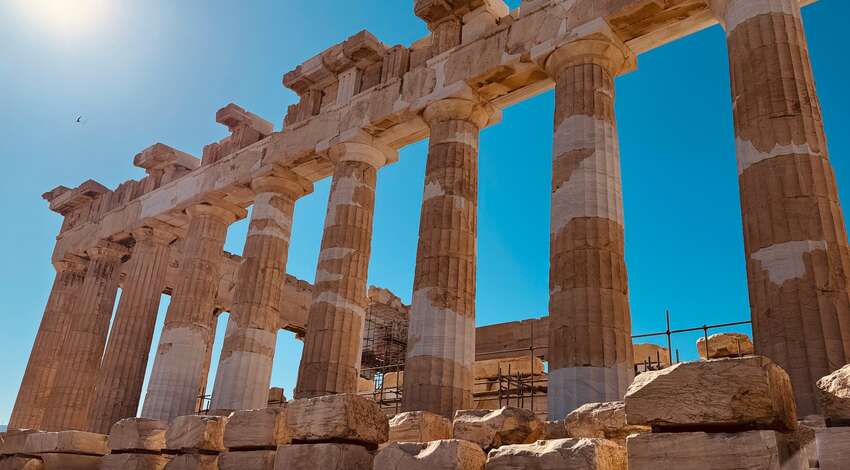
Hi there! I’m Lizzie from Road Scholar, and I’ve recently returned from an exploration of Greece — our 2026 Campus of the Year. My learning adventure allowed me the chance to experience still-standing ancient landmarks, archaeological sites, ruins and temples dating back thousands of years that tell the stories of Greek mythology. This educational journey also gave me the chance to immerse myself in current-day Greek culture.
In Part One of this three-part series, I’ll share some excerpts from my personal journal in the hopes of providing more insight into what it would be like to experience this magical, mythical learning adventure for yourself!
Although many folks tend to focus on the Greek islands while making plans to visit Greece, the mainland is the area that I had the great pleasure of exploring, on A Mythical Journey: Stories That Shaped Modern Greece.
This program begins in Athens and then takes you on a journey of the Peloponnese region before heading up into the mountains. It’s a 13-day journey into the ancient past that is nothing short of stupendous!
One thing I find so enjoyable about this program is that we spend quality time in some of Greece’s off-the-beaten-path villages. These small-town hidden gems are every bit as enchanting and memorable as the historical sites. And rather than being rushed through towns, we’re given ample time in each location to settle in and explore.
So, without further ado, here's a peek into my journal entries, starting with the first leg of this learning adventure — from Athens to Corinth.
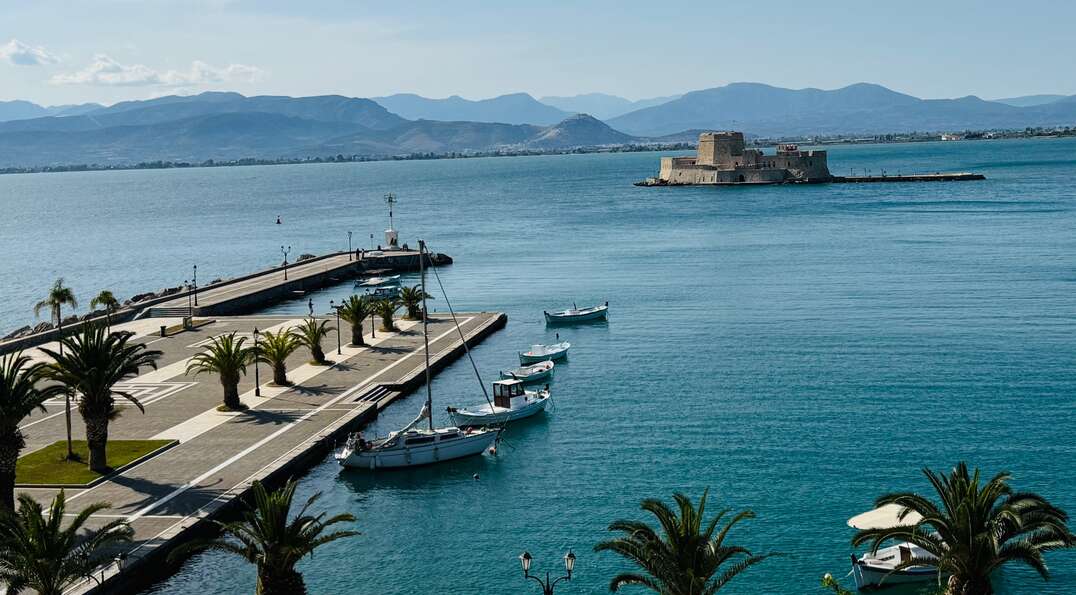
Nafplio fortress in the Aegean.
Days 1 & 2
After flying from Boston to Greece, I arrive in Athens at 7 a.m. local time. It’s mid-May, sunny and warm. Road Scholar’s given me detailed instructions about where to meet up with our personal driver, and it’s a very smooth process to pick up my luggage and find him. Another couple from our group has also just arrived, so we ride together to reach our first hotel and get to know each other along the way.
We reach the Divani Palace Acropolis within 45 minutes — a home run for its location in the Acropolis neighborhood of Athens. Although it’s still hours before check-in time, our Group Leader, Sophia Theona, is there to greet us. She’s confident, organized, and I immediately feel that I can trust her to tell me what’s what. Which, she says bluntly, is to get out there, explore, and not waste a moment of this opportunity to soak up Athens. She whips out a map, recommends where to go, and assures me that I will be perfectly safe walking in this neighborhood on my own. With my adrenaline high, I ignore my jetlag and step out of the lobby, immediately immersing myself in a city that’s brand new to me.
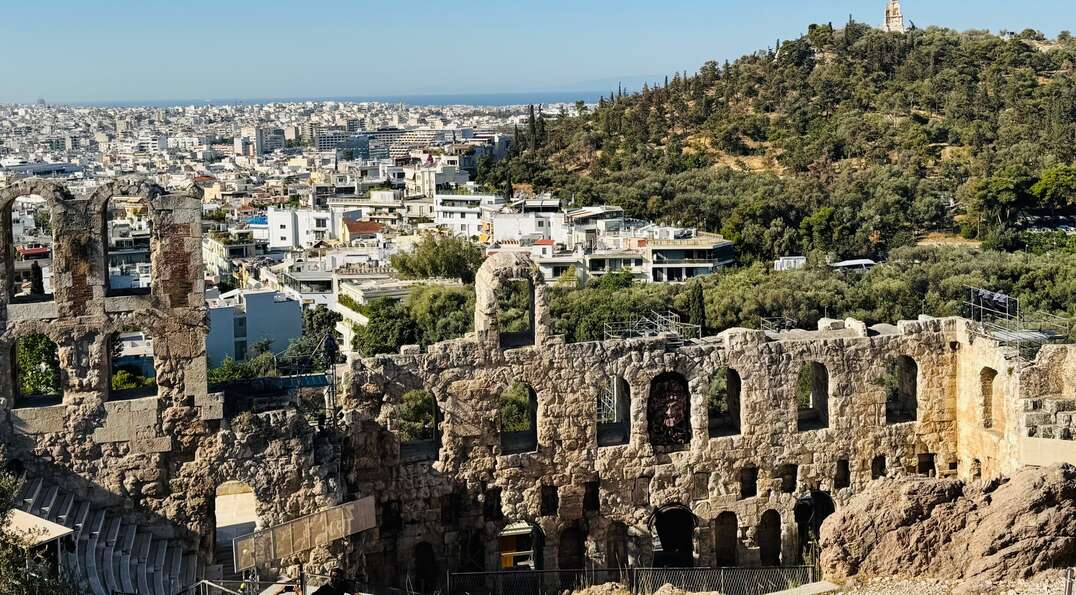
Overlooking Athens.
First Impressions
The Acropolis neighborhood is ancient, vividly colorful and sun-drenched, with shiny marble walkways reflecting the sun. The streets and sidewalks are bustling with fellow walkers; there are plenty of outdoor dining options and local shop owners offer friendly greetings as I walk by. The Greek coffee (first thing I try!) is fabulous and — of course — everywhere I look I spot ancient monuments with stories to tell. The best part is that Sophia is right — I feel perfectly safe walking around and exploring this neighborhood on my own (which cannot be said of every city I’ve been to), so this gives me a dose of confidence even before our program begins. And it is, unexpectedly, love at first sight!
I find a lovely local restaurant and dine al fresco. Although I can’t read the menu, the owner welcomes me to take a seat among the locals, recommending a dish that turns out to be spectacular. I savor my first Greek meal while taking in the charming accordion player as he passes by, the cadence of the local language everyone’s speaking and the way people here seem to relax over a long meal rather than rushing through it. This neighborhood, by the way, feels more like a small village than part of a big city.
After lunch, I walk around for about an hour, as far as the Arch of Hadrian, which is an incredible piece of history that’s still standing. I absorb the view of the Parthenon from the foot of the Acropolis and really let it sink in that this is no longer a photo in some magazine — I am standing here, in the heart of ancient history! I pinch myself and smile.
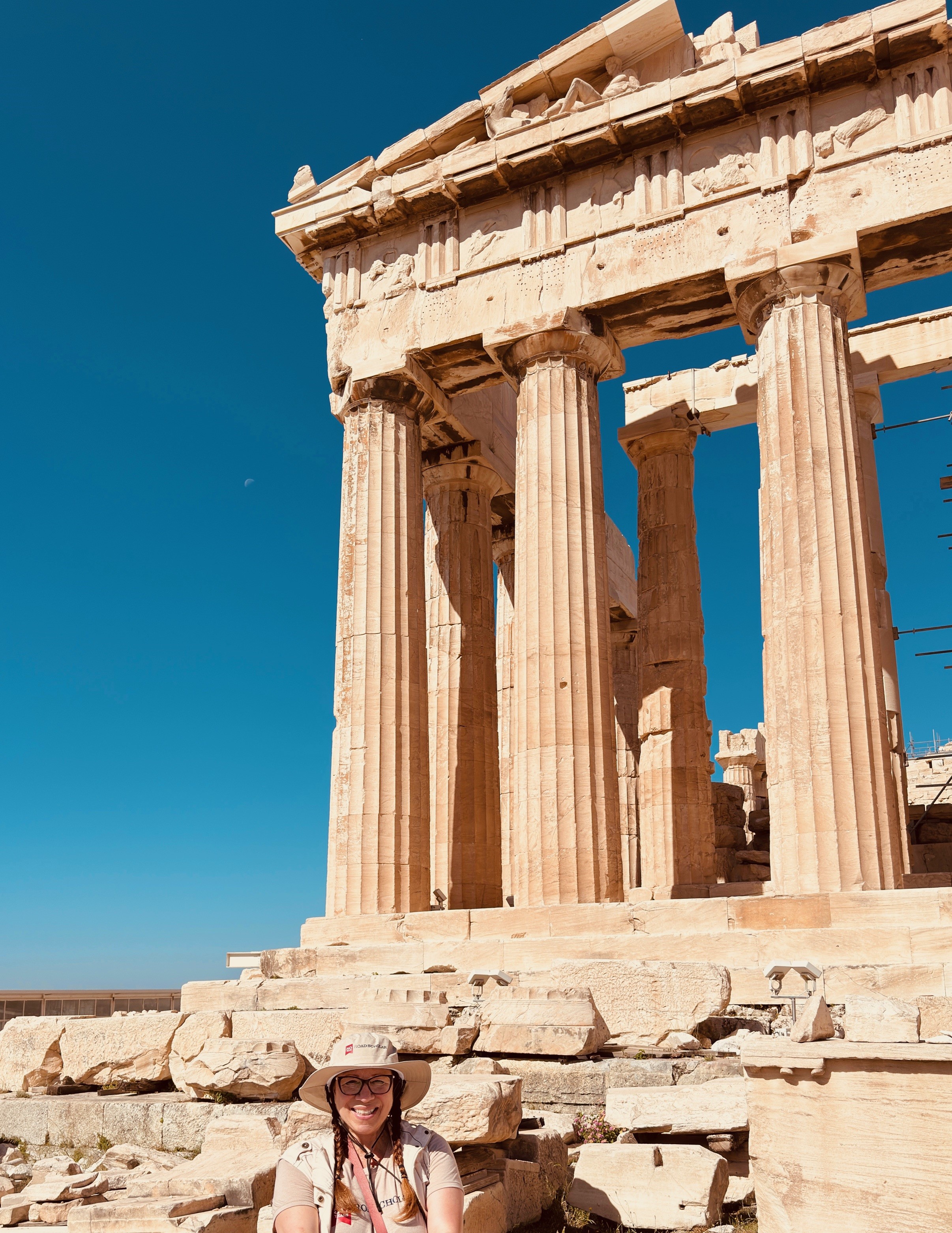
Lizzie at the Parthenon.
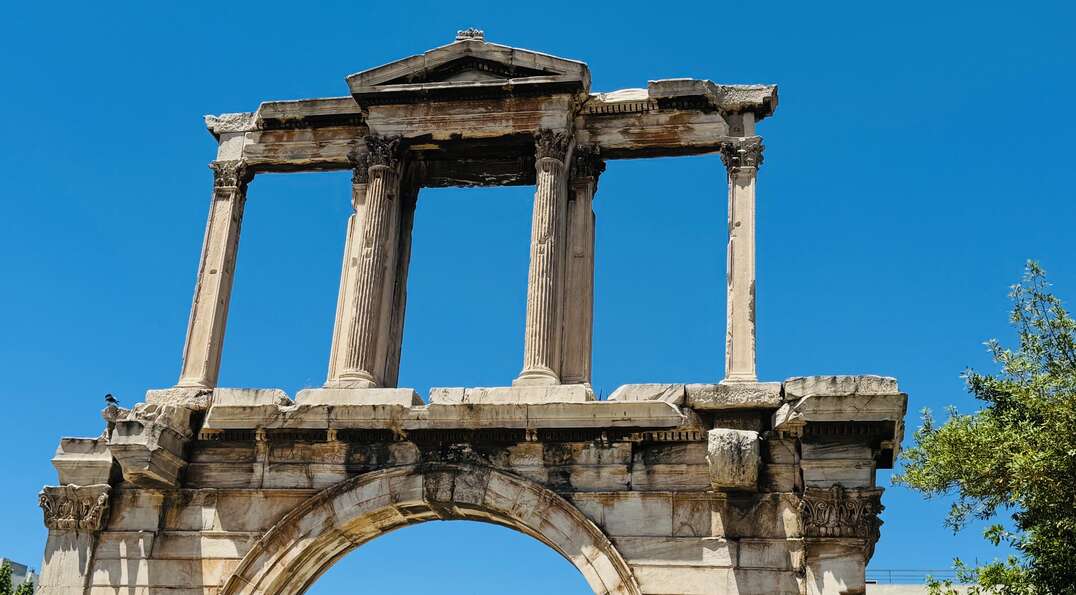
Arch of Hadrian
Meeting the Group
After returning to our hotel room at check-in time, it’s finally time to meet the rest of the group at early evening orientation. There are 24 of us, and each Road Scholar, upon introductions, is more interesting than the next. When fascinating people come together for a shared experience, it’s easy to understand how, within the hour, we already feel connected and are genuinely curious to learn more about each other over our first shared meal at a local restaurant.
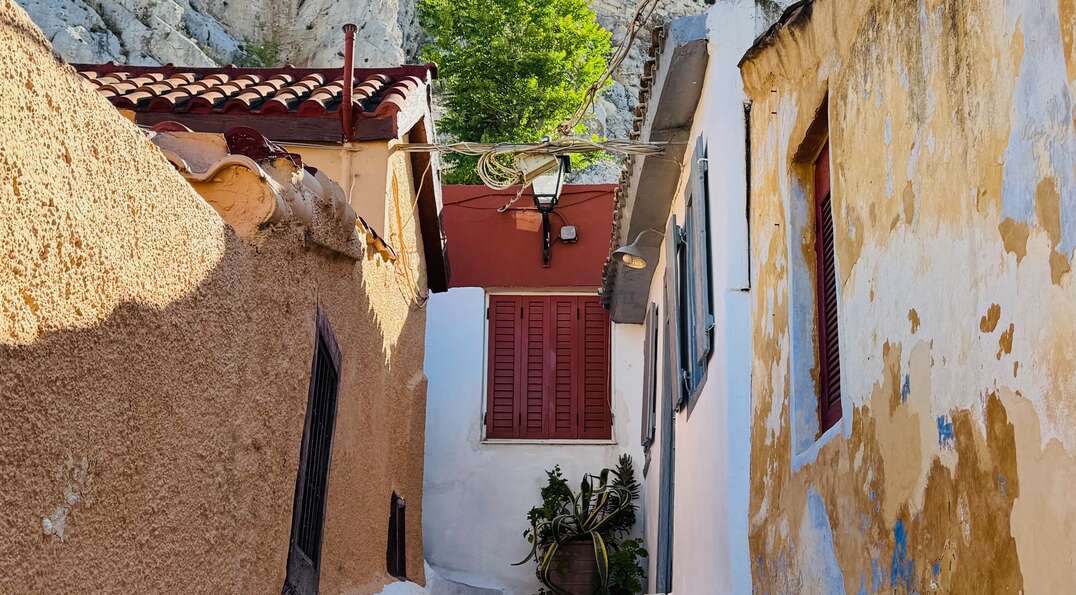
Ancient residential district of Anafiotika.
Day 3
Today we begin exploring Athens on foot as a group. There’s no need for public transportation since we’re in such a great location on the south slope of the Acropolis. What a bright and festive city this is. At the end of our hotel’s street is a smooth, shiny, marble, pedestrian-only walkway that circles the Acropolis. The buildings in this area have ancient white facades and are not very tall. If you’ve been to Paris, this area of Athens reminds me a lot of the Marais, except that here, there are olive and pomegranate trees everywhere you look, bright-green parrots flitting all around us and chunky tortoises lumbering in and out of some of the ancient ruins!
We visit what was once ancient Athens’ biggest agora (marketplace), which was the place to gather as far back as the sixth century B.C. for political, cultural, spiritual, artistic and athletic events. Socrates once roamed these pathways discussing philosophy! Atop the hill in the agora on the northern slope of the Acropolis is Hephaestus Temple — the place where democracy was born and a stage for many Greek philosophers.
After taking our time exploring the ancient agora, we continue our stroll — this time along Hadrian Street – an ancient and quaint cobblestoned pathway leading through the more modern marketplaces of the “old Athens” neighborhood — Monastiraki and Plaka’s Agora. For lunch, we dine in a local outdoor café, live musicians performing all around us. I am loving Greek food!
Later in the afternoon, we are given an opportunity to visit the Acropolis Museum, with the remainder of the afternoon and evening free to explore on our own. I walk through a magnificent neighborhood that is thoroughly worth the climb up ancient narrow staircases until I’m almost as high up as the summit of the Acropolis! Here, in this magical little community called Anafiotika, are fairytale-like colorful cottages offering breathtaking views of the city. Adorable little restaurants are perched on street corners at the top of each terraced staircase, decorated with red-checkered tablecloths, surrounded by emerald vines climbing the walls and bright yellow lemons hanging off tree branches. Handwritten signs asking visitors to please visit quietly and be respectful of the locals.
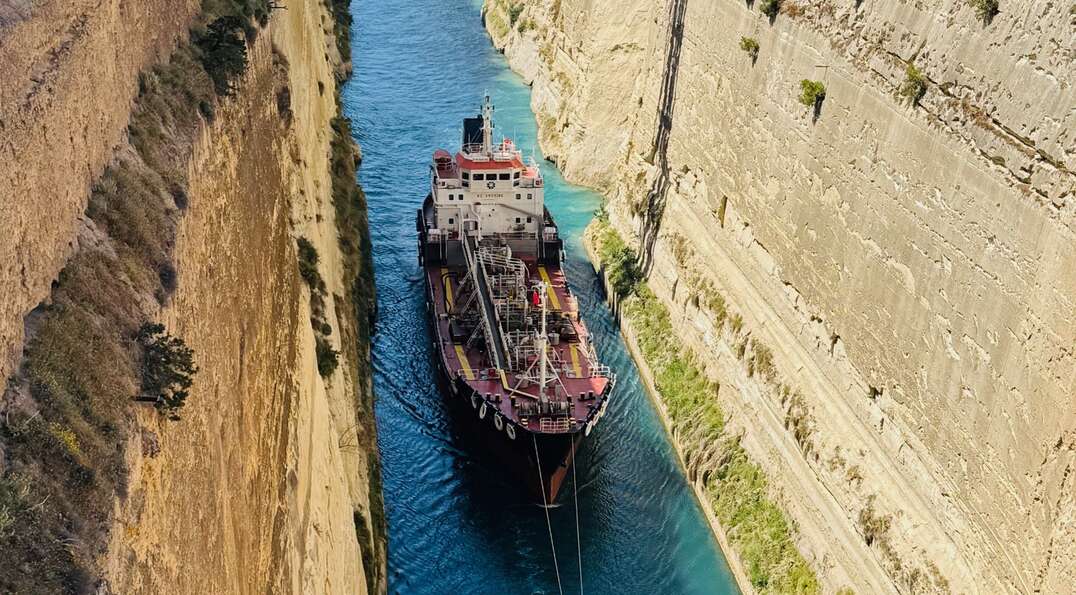
A ship transiting the Corinth Canal.
Day 4
This morning, we have one more very important thing to do before leaving Athens. And that, of course, is climbing up to the Parthenon! It’s an ascent up a rather rocky, sometimes slippery stone pathway without many handrails for support. The 100-step climb can be a bit of a challenge, so we are careful and take our time. We’re motivated to reach the top and have a chance to explore some of the most iconic monuments of ancient Athens! And the views, oh, the views from the summit — they overlook all of Athens. For those who have been to Paris, this overlook reminds me so much of the views of Paris from Montmartre — an off-white color palette of low-rise homes and buildings as far as the eye can see (except that here in Greece, you’ve got the cobalt-blue Mediterranean Sea in the distance).
Reaching the summit, we find ourselves standing at the foot of the Parthenon, built in honor of the city’s patroness Athena and completed in 432 B.C. After time spent exploring the ancient buildings atop the Acropolis and the magnificent views in every direction as far as the eye can see, we carefully made our way back down the hill and enjoy a well-earned lunch — our last in the Plaka at yet another charming local outdoor restaurant. We feast, sing and even dance as the live musicians entertain us. Celebration is in the air here. Opa!
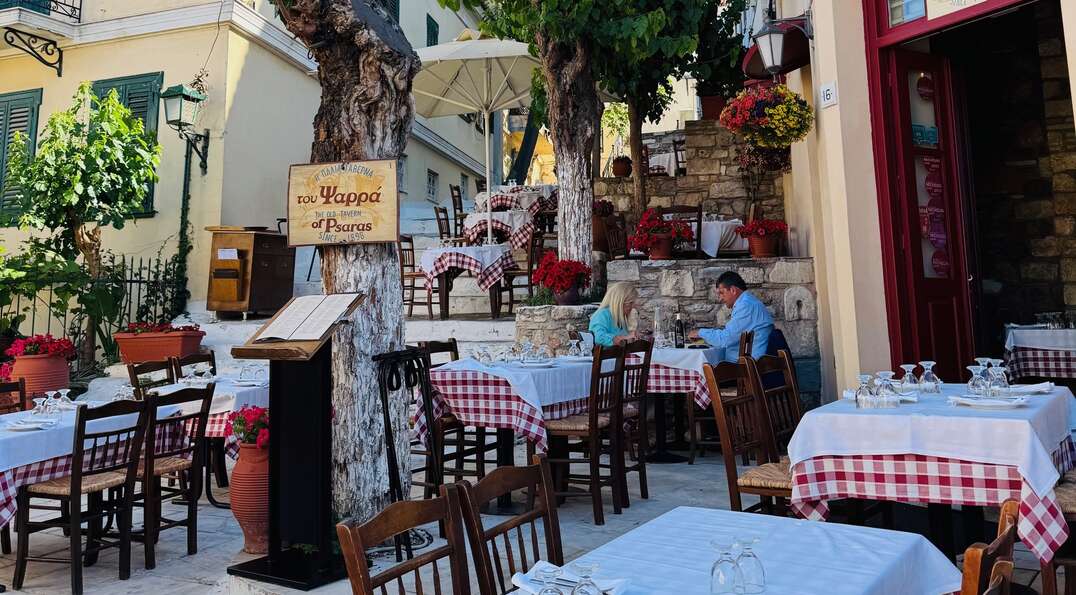
Restaurant in Plaka.
Bidding farewell to Athens, we meet George, who will be our motorcoach driver for the rest of our journey. The high-end motorcoach allows us comfortable personal space — there’s plenty of room to spread out, relax and take in the landscape during our three-hour drive to Nafplio, our next destination.
Halfway there, we’re in for an unexpected treat. We stop to take in an absolutely incredible site at the isthmus of Corinth — the Corinth Canal. After numerous earlier tries in ancient times, this canal was finally successfully cut in the 19th century. Similar in theory to the Panama Canal (minus the locks), this is a jaw-dropping example of what it takes to provide a shortcut between two seas (in this case, the Aegean and the Ionian) in order to save ship captains from having to navigate all the way around the Peloponnese peninsula.
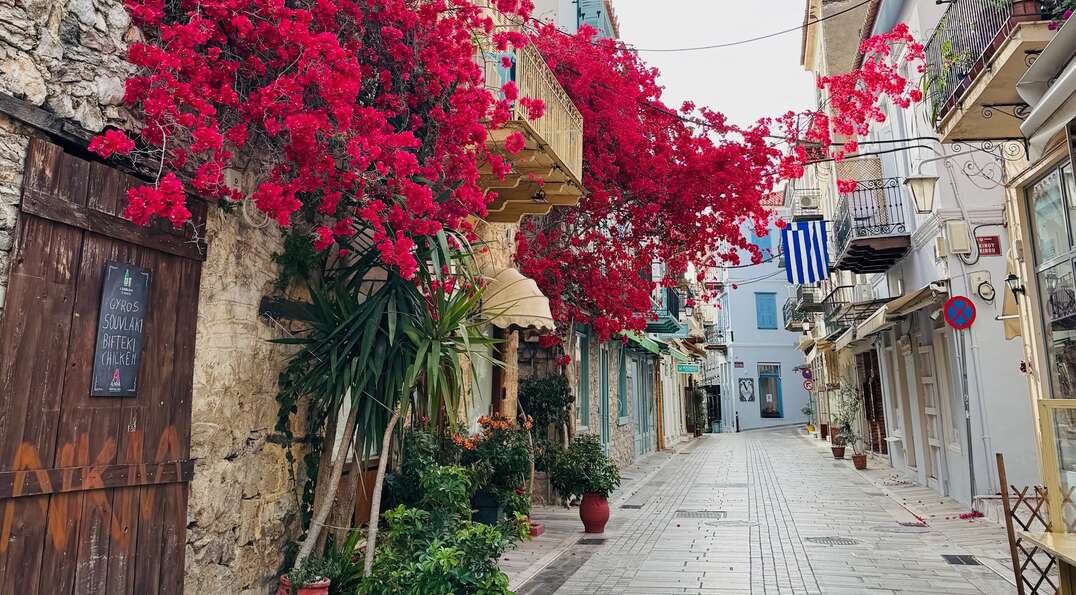
Old Town of Nafplio.
What an adrenalin rush it is to walk across a high bridge and look straight down into the canal — cut between two soaring cliffs — and witness tugboats carefully pulling giant ships through such a narrow waterway with enough height on either side to accommodate either sea’s rising tides.
After leaving the Corinth Canal and winding through the region of Argolis, the valley of Nemea and the territory of the ancient city-state of Argos, we reach the Gulf of Argolis and enter the town of Nafplio. Nafplio is a small town that instantly enchants me. It’s bursting with old-world charm. Pristine streets of marble shimmer and glow in the sunshine, while sea breezes waft off the Aegean. Quaint, cobblestone walkways and roads lead to monuments from the Venetian and Ottoman periods. This village is made for long strolls along streets lined with local artisan shops. Cafes are draped in bougainvillea, with vines weaving a trail of magenta blossoms that climb every wall. Delightful outdoor waterfront restaurants offer fresh seafood. The grilled octopus is a must!
This terraced community, reminiscent of Cinque Terre in Italy and topped by a fortress, is framed by lemon and orange trees. Nafplio — the original capital before Athens — is loved by the Greeks, who often choose this destination as their favorite weekend getaway.
See Part Two of this series — the Peloponnese region of Greece! In the meantime, feel free to explore all of the programs that Road Scholar’s 2026 Campus of the Year has to offer!