
Air Force Pilot Returns to Greenland 53 Years After Heroic Rescue

- In 1973, Air Force helicopter pilot Marty Martin performed the longest one-way medevac in a helicopter ever conducted at that time. He followed it with a heroic rescue off the coast of Greenland.
- 53 years later, Marty and his wife Rosemary returned to Greenland for the first time on a Road Scholar learning adventure.
- With the help of Road Scholar instructors and the support of fellow participants, Marty connected with the son of one of the men he had rescued, and he and Rosemary visited the remote site of the recovery.

In July 1973, a young U.S. Air Force helicopter pilot from Tennessee found himself in Greenland in the middle of a life-saving mission. More than five decades later, through Road Scholar, that same pilot would return to Greenland with his wife to retrace the events of that extraordinary rescue.
An Unexpected Mission
A graduate of the Air Force Academy, Maurice “Marty” Martin of Chattanooga, Tennessee served in active duty and later in the reserves. In 1972, he arrived at Thule Air Force Base in Greenland as a newly qualified Aircraft Commander. On July 7, 1973, his helicopter departed Thule Air Force Base carrying two critically ill Danish patients to reach a more advanced hospital in Nuuk.
The mission was anything but routine. Flying through dense fog, the helicopter traveled approximately 500 miles before rendezvousing with a Search and Rescue tanker plane from Iceland. The aircraft refueled the helicopter in flight over the Greenland ice cap, allowing the crew to continue to Nuuk and deliver the patients to the hospital.
The mission was later reported by Air Combat magazine as the longest one-way medevac in a helicopter ever conducted at that time. But that’s only half the story.
Marty and his crew were preparing to return to Thule when word arrived that a light aircraft had disappeared. Two members of a local flying club were missing. Marty’s team immediately joined the search effort, coordinating with another crew and a helicopter operated by Greenland Air. For hours, they scanned the vast Arctic landscape and icy waters for any sign of the missing aircraft.
Then came a breakthrough. They picked up a Mayday call.
The missing aircraft had crash-landed on a tiny rocky outcropping, about six or seven kilometers south of what is now Sisimiut on Greenland’s west coast. This location presented an enormous challenge. “The rock outcropping was so heavily gashed by wind and waves that we were unable to land,” Marty recalled.
Instead, he performed a delicate maneuver. He placed a single wheel of the helicopter on a stable section of the rock while hovering over the North Atlantic. As the aircraft balanced in place, the flight engineer helped bring the stranded men aboard.
After that adventurous rescue, life moved on for Marty. The mission became one of many stories from his years of military service. Yet one question remained: Whatever happened to those men? It was a question that would linger for more than half a century.
Returning to Greenland
In 2026, Marty and his wife Rosemary finally had an opportunity to return to Greenland. “When I first realized Road Scholar was offering a learning adventure there, we jumped on it,” says Rosemary. Just one week before the 53rd anniversary of the rescue, the couple arrived in Sisimiut. There, an unexpected chain of events began.
Road Scholar instructor Justin Fornal became fascinated by Marty’s story and wanted to help uncover what happened to the survivors. He posted a message to a Sisimiut community Facebook group explaining that he was traveling with a retired Air Force officer who had saved two men from a rock island in July 1973.
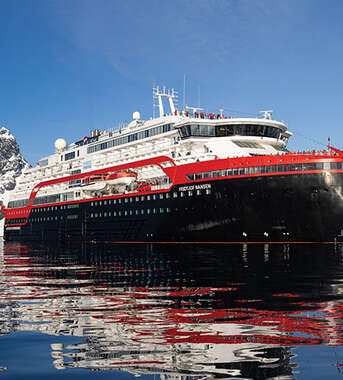
The response was immediate. Within hours, local residents began sharing photographs, memories and information. The online search led to the son of the owner of the crashed aircraft, one of the men Marty had rescued. The son, now living in Denmark, had been nine years old when his father was stranded on that rock. More than five decades later, he was able to speak to Marty through WhatsApp. In broken English, he thanked the American pilot for saving his father’s life.
But the story didn’t end there. After arriving in Sisimiut, Marty, Rosemary and Justin visited local residents who still remembered the rescue. “There was a lot of excitement when Marty showed up,” Rosemary recalled. “Big smiles all around.”
One of the locals offered to take them by boat to the tiny rock island where the rescue had occurred. For the first time, Rosemary saw the place she had heard about throughout their marriage. The small skerry that had once served as the precarious landing site for her husband’s helicopter was still there, standing alone in the cold North Atlantic waters.
Rosemary had nothing but praise for their Road Scholar cohort. “Group Leader Liz Broomfield offered fantastic support to us. She was keen on letting us follow our leads and see what we could find out and then was so excited for us when she heard we had gotten to the rock. The whole Road Scholar group was amazing. They were all just as involved as we were.”
For Marty, the journey was about more than revisiting a place. It was about finishing this story that had connected two countries, two families and two moments in time separated by 53 years.
Lizzie Gerecitano began writing and editing for Road Scholar in 2021 following a career as a journalist and on-air radio personality. She’s loved composing and performing since childhood, and at age 12 her first poem was printed in a national publication. Lizzie has taught and mentored students at schools including Monmouth and Rutgers Universities. She now serves in public relations and as a travel influencer on Road Scholar’s social media pages. Lizzie lives in NYC and loves nothing more than experiencing the world with her two sons.
