
The UNESCO List You Might Have Missed: Worldwide Cultural Treasures

- UNESCO promotes protection not just of physical places, but also intangible elements of heritage, focusing on human traditions and customs.
- The Representative List of the Intangible Cultural Heritage of Humanity highlights practices ranging from Chinese shadow puppetry to North African fishing methods.
- Many of the list’s highlighted traditions are in danger of disappearing entirely as societies change.
- The list is an excellent resource for people seeking to broaden their awareness of world cultures.
All over the world there are places of exceptional importance to human and natural history, and more than 1,000 of them have been designated as UNESCO World Heritage Sites. The designation serves both to highlight these places and to establish guidelines for preserving them and interacting responsibly with them. They are becoming ever more popular as travelers seek deeper cultural understanding and meaningful engagement in the places they explore. Road Scholars are solidly in that group, and a large number of our programs feature one or more UNESCO World Heritage Sites.
While the list of sites is familiar to many, there is an equally fascinating UNESCO list that’s not nearly as well known. It has the somewhat cumbersome title of Representative List of the Intangible Cultural Heritage of Humanity. Begun in 2008 and added to steadily since, the list focuses not on places but human activity — distinctive cultural practices unique to an area, sometimes an entire country (or multiple countries), other times a small region or even a single village.
Absent from the list are entries pertaining to several countries, most notably the U.S. and Canada. Canada is a UNESCO member but has not ratified the convention regarding intangible heritage. The U.S. has joined and left UNESCO several times over concerns about governance, most recently withdrawing in 2025. During its active membership, it also had not ratified the convention. Hence, neither country has practices on UNESCO’s list, though each takes its own steps to highlight and preserve vital aspects of its culture.
Nonetheless, the list is endlessly fascinating, with examples from the more than 180 countries that have ratified the convention. Many of the practices highlighted will be familiar to you: The Mediterranean diet is on the list. Yoga in India is on it, too. The reggae music of Jamaica. The baguettes of France. Swiss yodeling. But far greater in number are the entries of which you’ve likely never heard.
Here’s a representative sampling, with the years they were added to the list:
The Oral Tradition of Calling Camel Flocks (2022)
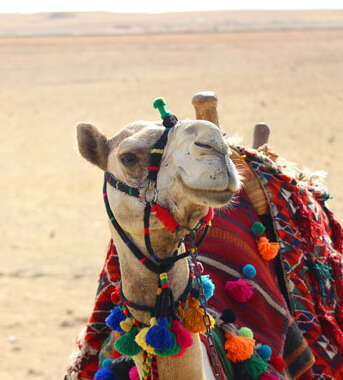
Alheda’a is defined by UNESCO as “an oral polyphonic expression accompanied by gestures or musical instruments that herders use to communicate with their camels” in Saudi Arabia, Oman and the United Arab Emirates. It is employed to direct camel herds to food and water, assemble them in times of danger and instruct them when to kneel, turn left or right, and so on.
Processional Giants and Dragons in Belgium and France (2008)
Enormous effigies of giants, dragons and animals have been part of processions in certain Belgian and French towns since the 14th century. Some stand over 25 high and weigh as much as 750 pounds. They represent mythical and legendary heroes, historic characters, tradespeople and other figures related to their respective towns. For example, Bayard, the legendary horse of Charlemagne, canters through Dendermonde, Belgium; Cassel, France, is home to father and mother giants Reuze-Papa and Reuze -Maman.
Taquile and Its Textile Art (2008)
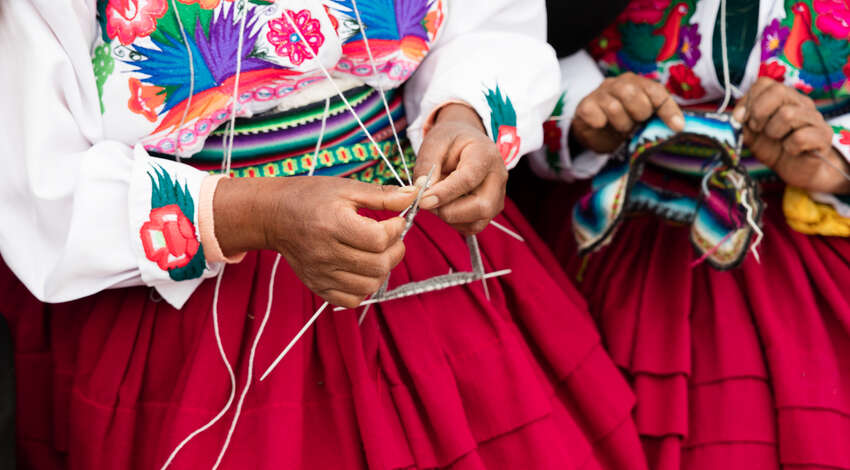
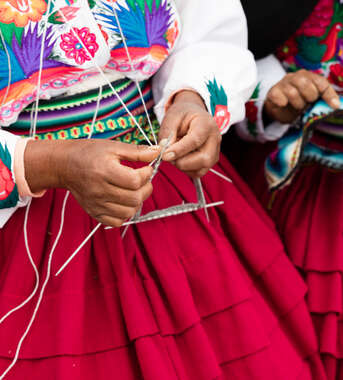
Men and women on the Peruvian island of Taquile, in Lake Titicaca, produce textile art as an everyday activity. Their weaving tradition dates to Incan times and uses ground looms to produce garments including a hat with earflaps known as a chullo, and a calendar waistband that depicts agricultural and other cycles.
Secret Society of the Kôrêdugaw, the Rite of Wisdom in Mali (2011)
This ancient group helps socialize young members of several Malian peoples through morally instructive performances. Dressed in ragged coats adorned with red bean necklaces, initiates use humor and exaggerated behavior to demonstrate human flaws and promote the virtues of generosity, tolerance and learning. An individual becomes a Kôrêduga either through inheritance of the title or through training with a master.
Pakistani Bareendo (Bhorindo): Ancient Dying Folk Musical Instrument, Its Melodies, Knowledge and Skills (2025)
The bareendo is a round clay instrument about the size of a tennis ball. The player blows through it, tilting it and covering air holes to change the sound. A traditional instrument among the Thari community of Pakistan, it is played by men, decorated by women and played at weddings and other festive occasions.
Culture of Jeju Haenywo (Women Divers) (2016)
On Korea’s Jeju Island, women divers — some as old as 80, and nearly all over 60 — dive up to 60 feet under the sea without oxygen masks to harvest sea urchins and shellfish. They hold their breath for between one and three minutes during each dive and work seven hours a day, 90 days a year. The practice dates to the 5th century, when it was done exclusively by men. Women began to dive around the 17th century, and by the 18th they were in the majority. (Road Scholars can observe the divers on The Best of South Korea: Local Culture and Ancient History.)

Charfia Fishing in the Kerkennah Islands (2020)
Fishing communities in the Kerkennah Islands of Tunisia use a passive system wherein palm fronds are fixed into the seabed in a triangular formation that traps fish during receding tides and channels them eventually into traps, where they are held safely until raised. The practice includes virtually the entire community at some point in the process, from placing the charfia to raising the catch.
Swimming Pool Culture in Iceland (2025)
One of the world’s coldest countries seems an unlikely place for outdoor swimming, but the practice thrives in Iceland, where heated public swimming pools are places to exercise, socialize and simply relax. All ages participate, with children being introduced to the practice as infants and learning rules and customs as they grow.
Know-How of Cultivating Mastic on the Island of Chios (2014)
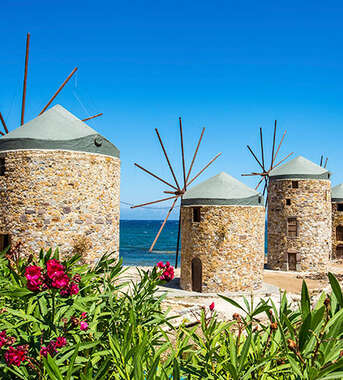
“Tears of Chios” are droplets of resin harvested from mastic trees, which grow in various areas around the Mediterranean but produce significant amounts of resin only on this Greek island. Mastic is a treasured ingredient in food and beverages throughout the Mediterranean, so highly prized in Ottoman times that high walls were built around the villages that produced it. The trees require year-round care and grooming to which community members of all ages contribute. (Road Scholars on The Ancient Aegean: Discover the Best of Greece & Turkey meet with a mastic producer on Chios.)
Skills Related to Attieke Production in Cote D’Ivoire (2024)
Attieke is a food made from steamed and fermented cassava that has a look and mouthfeel similar to couscous. Men typically grow and harvest the cassava, while women prepare the dish, which is an accessible and affordable staple in Cote D’Ivoire. UNESCO notes that becoming proficient in preparing attieke is a way for women to attain a degree of financial autonomy and social integration.
Mongolian Knuckle-Bone Shooting (2014)
Mongolians have a reverence for certain bones of domesticated livestock and use them in religious ceremonies and traditional games. One of those games involves flicking small marble tablets toward a collection of sheep knuckle bones, trying to knock the bones into a target circle. It’s a team activity — and costumes, rules, rituals and painstaking craftsmanship of the equipment help elevate the game into an exercise in social cohesion.
2012 Mesir Macunu Festival (2012)
Every March in Manisa, Turkey, residents commemorate the invention of a paste that cured the mother of Suleiman the Magnificent of illness. For the occasion, the paste is recreated by chefs using 41 herbs and spices, is then wrapped in paper by a team of 14 women and finally is blessed by 28 imams and apprentices. The packets are then tossed from the highest minaret of the Sultan Mosque to the public below, who believe catching pieces will bring them good fortune.
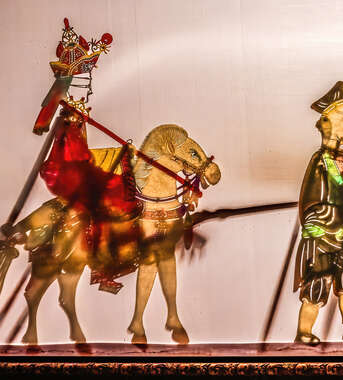
Chinese Shadow Puppetry (2011)
This form of theater uses leather or paper silhouette figures manipulated by rods to create the illusion of movement as the figures’ shadows are cast onto a screen. The puppets are used to perform traditional plays, several dozen of which can be in the repertoire of an older master. Individual members of the troupe often manipulate several puppets simultaneously while also playing instruments or singing improvisationally. The complex puppets can have as many as two dozen moveable joints.
There you have a small sampling from the UNESCO Representative List of the Intangible Cultural Heritage of Humanity. There’s nothing like spending an evening perusing the list to ignite your passion for exploring the world. There are so many wondrous things out there — get out and experience some!
John Watters is an aficionado of the eclectic — quirks of history, unusual places and
whimsical pursuits. When he’s not crafting more mainstream pieces for Road Scholar, he sometimes reports on things off the beaten path — or just offbeat. His professional
expertise is derived from a long career as an advertising writer and creative director, while his personal expertise with vacuum cleaners and lint rollers is derived from a long association with Bernese Mountain Dogs.