
Galápagos Islands, Ecuador
Nature’s Laboratory: Wild Finds in the Galápagos With Your Family
Program No. 20873RJ
See More Photos
Nature’s Laboratory: Wild Finds in the Galápagos With Your Family
Nature’s Laboratory: Wild Finds in the Galápagos With Your Family

1 of 6
Itinerary
While we make every effort to ensure the accuracy of our published materials, programs are typically advertised more than a year prior to their start date.
Read More.
All itineraries and excursions are subject to change. Weather and water conditions may affect the progress of the ship, and we may miss ports if it is not safe to dock. The operators reserve the right to change the content and duration of excursions without prior notice and so the cruise itinerary should always be regarded as provisional. Whenever possible, Road Scholar’s published daily schedule will indicate port arrival and departure times. Prior to departure, if there is a major change, we will make every effort to alert you. For less significant changes, we will update you during orientation. Thank you for your understanding.
Duration
11 days
10 nights
What's Included
27 meals (
10B, 8L, 9D
)
3 expert-led lectures
16 expert-led field trips
2 flights during the program
1 hands-on experience
An experienced Group Leader
10 nights of accommodations
Taxes and customary gratuity
Road Scholar Assurance Plan
Day
1
In Transit to Program, Arrive to Quito
Location:
Quito
Stay:
Hosteria Rincon de Puembo
Activity Note
Quito Elevation: 9,223 ft - 9,883 ft. To minimize your chances of experiencing altitude sickness while in Quito, try to get plenty of rest before you travel, stay hydrated, avoid alcohol and fatty foods, consume high carbohydrate foods, and avoid strenuous exercise at high elevations. Hotel check in from 3:00 p.m. Remember to bring your nametag (sent previously).
Evening:
At leisure. Settle in and get a good night’s rest for the day ahead.
Day
2
Equator, Orientation to Quito, UNESCO World Heritage Site
Location:
Quito
Meals:
B,L,D
Stay:
Hosteria Rincon de Puembo
Activity Note
Getting on/off a bus; driving about 40 miles, approximately 2.5 hours riding time. Walking about 1.5 miles; mostly flat terrain, some steps. This leisurely-paced day in Quito is very important as it will give the group time to acclimate to highland elevations.
Breakfast:
At the hotel.
Morning:
Orientation: 8:00 a.m. The Group Leader will greet everyone and lead introductions. We’ll review the up-to-date program schedule and any changes, discuss roles and responsibilities, logistics, safety guidelines, emergency procedures, and answer questions. This is a Road Scholar Family program. Adult participants are responsible for their children at all times. If/when separate age group activities are conducted concurrently, program staff will supervise. Minors are never to be left unsupervised. Periods labeled “Free time” and “At leisure” offer opportunities to make the program more meaningful and memorable while going out to explore on your own, engaging in available activities independently, making new friends among fellow Road Scholars, or simply relaxing. The Group Leader will always be happy to offer suggestions. We will learn from the Group Leader as well as local experts who will give lectures and lead field trips. Program-related ground travel and transfers will be via private bus unless noted otherwise. Meals on our program feature local cuisine. Program activities, schedules, personnel, and indicated distances or times may change due to local circumstances/conditions. In the event of changes, we will alert you as quickly as possible. Thank you for your understanding. After boarding our bus, we will ride to the famous Middle of the World complex for a once-in-a-lifetime experience of being in two hemispheres at the same time! During this field trip led by the Group Leader, we’ll not only learn important facts, myths and legends surrounding our planet and the equator, but we will also become acquainted with the history of the first group of scientists who in 1743 had the hard mission of trying to determine Earth’s shape. Before returning to the bus and driving to downtown Quito, we’ll pay a visit to the on-site Ethnographic Museum for an overview of Ecuador’s demographics, geography, and economy.
Lunch:
At a local restaurant including an introduction to typical Ecuadorian food products and cuisine.
Afternoon:
We will ride to the old center of the city for an orientation to Ecuador’s capital. Once there, we will accompany our Group Leader on a walking exploration of old Quito--a UNESCO World Heritage Site. The architecture found in Quito’s historical center is a great example of the Baroque style which is a fusion of Spanish, Moorish, Flemish and Indigenous art. Our field trip will include visits to La Basilica Church and La Plaza Grande--Quito's main square. Then, we'll ride to a local atelier for a presentation by a chocolatier about the history of cacao and the process of making chocolate. And the best part-- we will get to create our own chocolate truffle! Late in the afternoon we will ride back to the hotel to drop off our gear in our rooms and freshen up. Then we'll join a local expert for a pre-dinner presentation on the Conservation, Sustainability, and Ecology of the Galapagos Islands.
Dinner:
At the hotel.
Evening:
At leisure. Prepare luggage for early check-out and flights to the Galápagos tomorrow. This is a Road Scholar Adventures Afloat program. All routes, field trips, and excursions are subject to change as weather and sea conditions may affect the itinerary. Sea conditions could affect the progress of the ship, making it run late and sometimes miss sites because it is not safe to dock. Because of this, the cruise itinerary should always be regarded as provisional. The operators reserve the right to change the content of field trips and excursions without prior notice.
Day
3
Flight to Baltra, Embarkation, Black Turtle Cove
Location:
Galápagos Islands
Meals:
B,L,D
Stay:
Tip Top IV
Activity Note
Flight to/from the Galapagos takes approximately 2.5 hours and makes a stop in Guayaquil; passengers remain onboard during the stop. This flight allows a 50 lb checked bag/suitcase, plus a carry on per person. Excess luggage can be stored at the hotel in Quito until our return. Actual cruise itinerary and islands visited are determined by the Galápagos National Park. The park reserves the right to change cruise itineraries without prior notice. Black Turtle Cove: no landing, dinghy ride.
Breakfast:
Early, at the hotel.
Morning:
Hotel check out. After boarding the bus we will transfer to the airport in preparation for our flight to the Galapagos Islands. Our Quito Group Leader will assist us with check-in procedures and bid us farewell as we proceed through security and get ready to embark on our flight. Upon arrival to the Galápagos Islands we'll deplane and walk across the tarmac to the airport building and follow the arrival signs to Immigration. With passport in hand we will stop at the Immigration counter for an inspection of our travel documents before we can proceed to the baggage claim area. After collecting our luggage, we will meet our naturalist Galápagos Group Leader and board a bus that will drive us to the pier, followed by a short panga ride to the boat. Once on board, we'll take part in a welcome orientation and a safety drill as we sail to our first visitor site in the Galápagos.
Lunch:
Aboard the yacht.
Afternoon:
We’ll take part in a quiet dinghy ride through the mangroves at Black Turtle Cove, on the northern coast of Santa Cruz Island. During this activity, the motor will be turned off to allow close observation of marine turtles, white tipped reef sharks, yellow rays and other marine species. We’ll also be on the lookout for pelicans and other sea birds that are known to frequent the site.
Dinner:
Aboard the yacht, after enjoying a welcome cocktail with the crew.
Evening:
Orientation to the next day's activities.
Day
4
Genovesa Island, Darwin's Bay, Prince Phillip's Steps
Location:
Galápagos Islands
Meals:
B,L,D
Stay:
Tip Top IV
Activity Note
Darwin Bay: easy to moderate hike on coral sand and slabs of lava. The trail is approximately 1 mile in length. When the tide is high, parts of the trail might be covered in water. Prince Phillip's Steps: difficult dry landing onto the rocky shore, followed by a climb up a steep stone staircase (about 40 steps) with railings. Much attention must be given when climbing and descending the staircase since steps might be slippery.
Breakfast:
Aboard the yacht.
Morning:
After a panga ride and wet landing, we will accompany our naturalist leader on a walking exploration of Darwin Bay. The island's volcanic sea cliffs and salt bush offer a prime habitat for the birds of the Galápagos. In March and April, male frigatebirds begin courtship rituals, showing off their inflated red pouches. By August, the island is full of Nazca Boobies (Masked Boobies) and Red-footed Boobies, and Swallow-tailed Gulls can be found nesting. Darwin Bay is the caldera of an extinct volcano which has been partially eroded and offers superb swimming and snorkeling. Opportunity for swimming and snorkeling before we return to the yacht.
Lunch:
Aboard the yacht.
Afternoon:
Dry landing at Prince Phillip's Steps (a.k.a. El Barranco). After climbing the stone steps we will walk on local trails in search of local birds. This visitor site includes a steep stone staircase and a rocky trail that extends for approximately 1 mile through squadrons of frigatebirds and Red-billed Tropicbirds. Red-footed Boobies perch on the branches of Palo Santo trees and Storm Petrels, which serve as prey for Short-eared Owls, are found in the open lava fields at the end of the trail. At the end of our field trip we'll loop back to the staircase and board pangas for our return trip to the yacht.
Dinner:
Aboard the yacht.
Evening:
Lecture and orientation to the next day's activities. (Please note that the day/time of lectures is subject to change)
Day
5
Santa Cruz, Fausto Llerana Center, Highland Tortoises
Location:
Galápagos Islands
Meals:
B,L,D
Stay:
Tip Top IV
Activity Note
Fausto Llerana Center: dry landing; mostly flat, paved paths. Highlands: walking on trails and forested areas with irregular terrain and small incline. Potentially muddy conditions.
Breakfast:
Aboard the yacht.
Morning:
We'll tender ashore to Santa Cruz and make a dry landing in preparation for our field trip to the Fausto Llerena Center inside the Charles Darwin Research Station. Our naturalist will lead us on foot through the facility and introduce us to the station's mission and its tortoise breeding projects. The Charles Darwin Research Station (CDRS) is a biological research station based on Santa Cruz Island and operated by the Charles Darwin Foundation. The organization plays an important role in scientific research, environmental education, and conservation efforts in the islands. The station conducts its projects with the help of a large team of scientists, educators, volunteers, research students and support staff from all over the world. After our visit we will climb aboard a bus and ride to a highland reserve.
Lunch:
At a local ranch in the highlands
Afternoon:
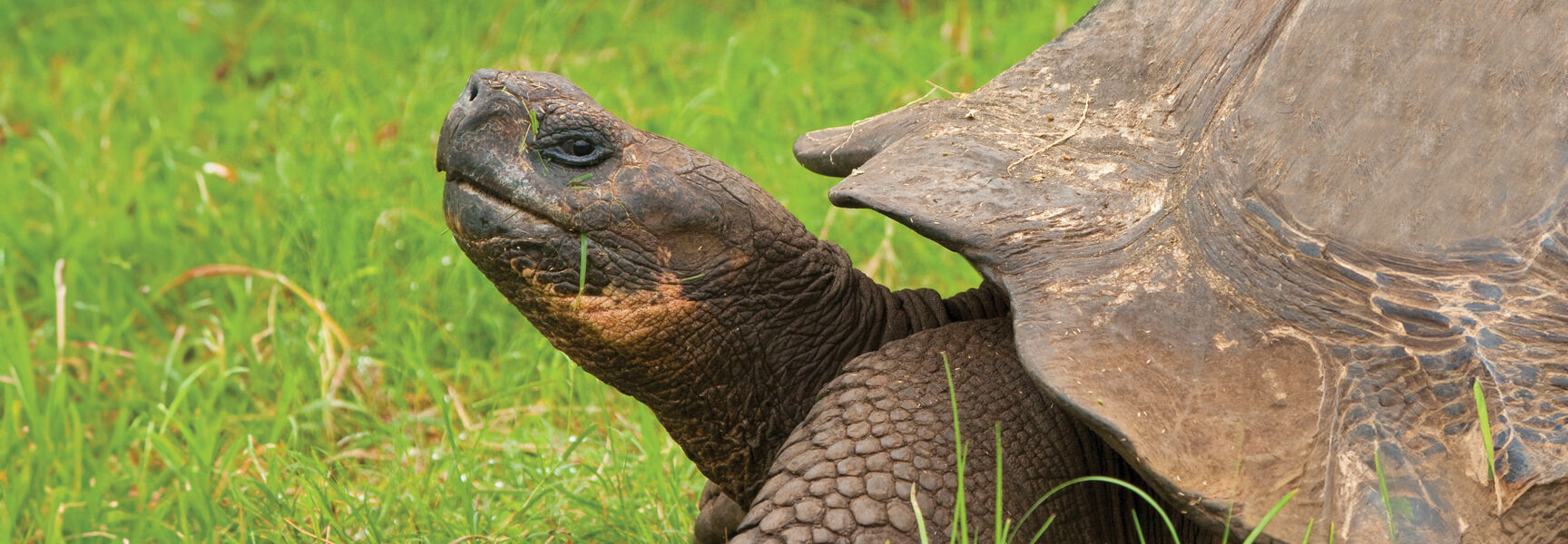
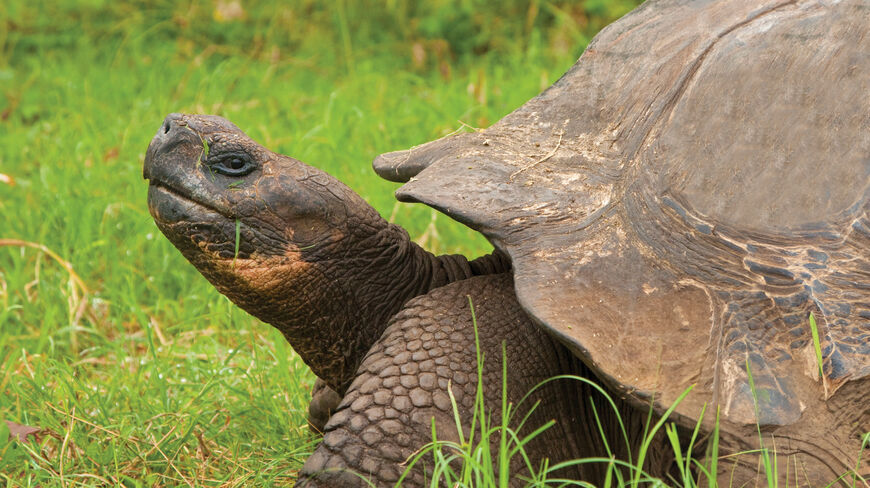
After lunch, our naturalist will lead us on a walking field trip on grassy trails and lightly wooded areas in search of giant tortoises living in the wild. We'll learn more about their diet, breeding habits and overall biology as we observe them in their natural habitat. In addition to giant tortoises, Santa Cruz is home to several species of Darwin's finches as well as Yellow Warblers, Galápagos Rails and Paint-billed Crakes. A dramatic change in vegetation zones can be seen as one travels into the highland region of the island. Later, we will ride the bus back to the coast and return to our yacht by panga.
Dinner:
Aboard the yacht.
Evening:
Orientation to the next day's activities.
Day
6
Isabela, Punta Vicente Roca, Fernandina, Punta Espinosa
Location:
Galápagos Islands
Meals:
B,L,D
Stay:
Tip Top IV
Activity Note
Punta Vicente Roca: panga ride. Punta Espinoza: dry landing, moderate trail conditions due to uneven terrain. Challenging landing at low tide due to slippery rocks. Good walking shoes are a must for the 1.2 mile walk on sharp volcanic rocks.
Breakfast:
Aboard the yacht.
Morning:
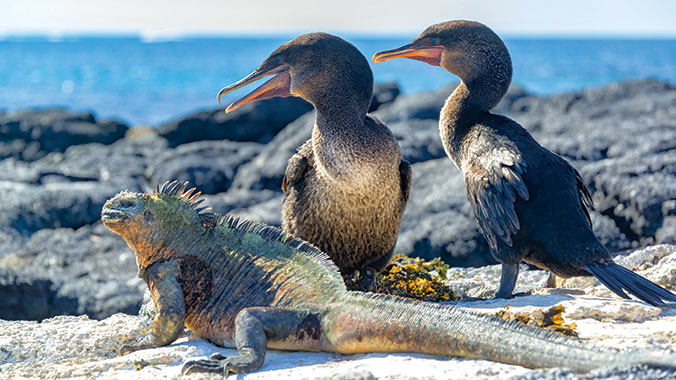
We'll join our naturalist leader in a panga ride to Isabela Island. As we navigate in and around the coves we will look for resident wildlife. As cold currents flow around the northwestern tip of Isabela, food-rich waters are brought closer to the surface, attracting all sorts of marine life and birds. Punta Vicente Roca’s coves, rich marine life, and well protected bay have made this into a prized diving location in the islands. Flightless Cormorants, Masked Boobies and Blue-footed Boobies can be seen along the cliffs and the water’s edge. We'll have the opportunity to swim and snorkel before returning to the yacht.
Lunch:
Aboard the yacht.
Afternoon:
After making our dry landing at Punta Espinoza on Fernandina Island, we’ll walk on local trails in search of the resident sea lion colony and a flightless cormorant nesting site. Fernandina has some of the most dramatic landscapes found in the Galapagos archipelago and is also one of the best places to see the lava cactus. The aa and pahoehoe lava formations create a unique landscape and provide visitors with a great chance to study lava flows and the forces which gave birth to the Galápagos Islands. Return to the yacht.
Dinner:
Aboard the yacht.
Evening:
Enjoy an expert presentation by our naturalist Group Leader, followed by an orientation to the next day's activities. (Please note that the day/time of lectures is subject to change).
Day
7
Isabela, Tagus Cove & Elizabeth Bay
Location:
Galápagos Islands
Meals:
B,L,D
Stay:
Tip Top IV
Activity Note
Tagus Cove: panga ride and swimming/snorkeling opportunities. Elizabeth Bay: panga ride along mangroves and islets.
Breakfast:
Aboard the yacht.
Morning:
We'll take part in a scenic panga ride along the shoreline in order to spot wildlife and view Tagus Cove's historic graffiti, which was left behind by sailors, some as far back as the 1830s. Sea lions, Flightless Cormorants, marine iguanas, Blue-footed Boobies, and Galápagos Penguins are frequently spotted at this site. Opportunity for swimming, snorkeling, and/or kayaking before returning to the yacht.
Lunch:
Aboard the yacht.
Afternoon:
This afternoon we will enjoy a panga ride in and around the mangroves and islets of Elizabeth Bay on Isabela Island to look for shore birds, marine turtles, rays, sea lions, and more. Elizabeth Bay, located on Isabela's west shore, is an extremely interesting site for observing marine life. It is also one of the best areas to spot and photograph the elusive Galápagos Penguin. A colony of these unique birds inhabits a rocky islet at the entrance to the bay. A small passage lined with mangroves leads into an enclosed cove. The sheltered waters host marine turtles, rays, Flightless Cormorants, and sea lions. Although the marine life is the star of this visitor's site, don't forget to look up once in a while and scan the skies; Galapagos Hawks are oftentimes seen circling overhead.
Dinner:
Aboard the yacht.
Evening:
Orientation to the next day's activities.
Day
8
Isabela, Urbina Bay & Punta Moreno
Location:
Galápagos Islands
Meals:
B,L,D
Stay:
Tip Top IV
Activity Note
Urbina Bay: strong waves can make disembarkation tricky at this site. Use a zip-lock bag to protect cameras and binoculars from splashes during the wet landing. Please take steps to remain hydrated during this approximately 2-mile hike. Punta Moreno: moderate to difficult hike on sharp, accordion-like Pahoehoe lava. Wear comfortable tennis shoes with good ankle support. Please take steps to remain hydrated during this hike as the black lava absorbs and radiates the heat from the sun.
Breakfast:
Aboard the yacht.
Morning:
We will make a wet landing at Urbina Bay and begin our walking exploration of this unique site, which is situated approximately two-fifths of the way along Isabela’s western coast. The flattened area of the bay exhibits signs of a coral reef on land—proof that the flat land we see today in that area was once uplifted from the sea. Cormorants, pelicans, marine iguanas, and Flightless Cormorants frequent this site in addition to marine turtles and rays, which are sometimes seen swimming in the bay. Before making our way back to the yacht, we’ll have the opportunity to swim, snorkel and/or kayak.
Lunch:
Aboard the yacht.
Afternoon:
After a wet landing at Punta Moreno, we’ll continue our explorations on foot. This visitor site is situated on Isabela Island’s western coast and includes a 1.3-mile trail through a Pahoehoe lava flow and past lagoons and mangroves. The seemingly barren landscape at Punta Moreno is home to three kinds of cacti. Numerous coastal lagoons in the area attract an abundance of bird species, while lookout points afford panoramic views of the active Sierra Negra, Cerro Azul, and La Cumbre (located on nearby Fernandina) volcanoes. Be on watch for flamingoes, Paint-billed Crakes, White-cheeked Pintails, and Common Gallinules that commonly frequent the area. We'll board pangas and make our way back to the yacht.
Dinner:
Aboard the yacht.
Evening:
Orientation to the next day's activities.
Day
9
Floreana, Punta Cormorant & Giant Tortoises
Location:
Galápagos Islands
Meals:
B,L,D
Stay:
Tip Top IV
Activity Note
Punta Cormorant: wet landing and easy trail conditions. Champion Islet: snorkeling and swimming. Post Office Bay: wet landing and easy trail conditions. Baroness Viewpoint: wet landing and ~0.6 mile walk.
Breakfast:
Aboard the yacht.
Morning:
We’ll make a wet landing on the green beach at Punta Cormorant, Floreana. During our walking explorations we hope to observe shorebirds and flamingos at the local lagoon and spot endemic plants such as Scalesia vellosa and Lecocarpus pinaffitidus. We will most likely have the chance to view sea lions lounging lazily on the beach. The beach's unusual color is a result of the olivine crystals present in the sand. From here, a trail leads us to a lagoon where flamingos can be found wading with other birds such as oystercatchers, and Black-necked Stilts. A white sandy beach near the lagoon is good for swimming and is a known nesting site for green sea turtles. Around January, pregnant females come ashore at night to dig nests and lay eggs (between 75-100 eggs per nest) before returning to sea. The eggs begin hatching in April and May. Next, we’ll take a panga ride to Champion Islet. The small island is located off the northern coast of Floreana Island. It has earned a reputation for being one of the Galápagos' best snorkeling and diving sites due to its clear waters and abundant marine life including sea lions, sharks and rays. Another claim to fame is that Champion Islet is one of only two locations in the archipelago where one has the chance to spot Charles Mockingbirds (Nesomimus trifasciatus).
Lunch:
Aboard the yacht.
Afternoon:
After a wet landing on Floreana Island, we’ll join our naturalist Group Leader on a short hike to the Baroness Viewing Point or Lookout, located at the top of a basaltic tuff formation between Punta Cormorant and Post Office Bay. It was once a favored spot of the infamous Baroness Eloisa von Wagner ("The Galapagos Affair" by John Treherne)--one of the island's colorful first inhabitants. Visitors who make it to the top are rewarded with views of the coastline from Enderby Islet to Post Office Bay, as well as a large palo santo forest, Punta Cormorant's flamingo lagoon, and Cerro Pajas. Next, we’ll navigate to Post Office Bay. Our half-mile walk will begin with a wet landing on the sandy beach and then a visit to the Post Office Barrel located on the northern side of Floreana Island. This is the site where whalers used to "mail" their correspondence. A barrel was used as a makeshift postbox, and held letters from sailors across the globe. If a passing ship happened to be heading where the mail was addressed to, the captain would collect and deliver it. Although the barrel is no longer the original one, the system still works since visitors continue to collect and drop off their letters and postcards. We will finish our visit to the highlands with a stop at Asilo de la Paz to see the giant tortoises. We’ll have the opportunity to swim and snorkel before going back to the yacht and preparing for dinner.
Dinner:
Aboard the yacht.
Evening:
Orientation of next day's activities. Prepare luggage for final disembarkation.
Day
10
Mosquera Islet, Baltra Airport, Flight to Quito
Location:
Quito
Meals:
B,D
Stay:
Hosteria Rincon de Puembo
Activity Note
Participants with international flights departing very late this evening/before dawn next morning will check out of the hotel after dinner, then transfer to the international airport in preparation for airline check in. Due to limited flight times from the Galápagos to Quito, the timing between the farewell dinner and the transfer afterwards to the airport can be diminutive. See notes section for more details regarding departure options.
Breakfast:
Aboard the yacht.
Morning:
We'll board pangas and make a wet landing at a white sand beach on Mostquera Islet. From there, our naturalist will lead us on an exploratory walk along the beach to observe resident sea lions, colorful sally lightfoot crabs and coastal birds. Once we complete our walk, we'll board pangas and return to the yacht so we can freshen up and prepare for final disembarkation. We will disembark at a local pier then transfer by bus to the airport. After checking in for our flight to Quito, it will be time for us to bid farewell to the Islas Encantadas and our Galápagos Group Leader.
Lunch:
On your own, at the airport. Sandwiches, empanadas and snacks are available for purchase after going through security.
Afternoon:
Late afternoon arrival in Quito. We'll board a bus to our hotel and check in, followed by free time to finish packing or relax before joining the rest of the group for dinner.
Dinner:
At the hotel. During a farewell dinner, share your favorite experiences with new Road Scholar friends.
Evening:
At leisure. Prepare for check out and international flights to North America. Participants with international flights departing very late this evening/before dawn next morning will check out of the hotel and transfer to the Mariscal Sucre International Airport (UIO) in preparation for airline check in.
Day
11
Program Concludes, In Transit from Program
Location:
In Flight
Meals:
B
Activity Note
Hotel check out by 11:00 a.m. See your program's preparatory information regarding transfers.
Breakfast:
At the hotel (dependent on flight times). This concludes the program.
Morning:
If you are returning home, safe travels. If you are staying on independently, have a wonderful time. If you are transferring to another Road Scholar program, detailed instructions are included in your Information Packet for that program. We hope you enjoy Road Scholar learning adventures and look forward to having you on another rewarding program in the future. Don’t forget to like our Facebook page and follow us on Instagram. Best wishes for all your journeys!
Please Note:
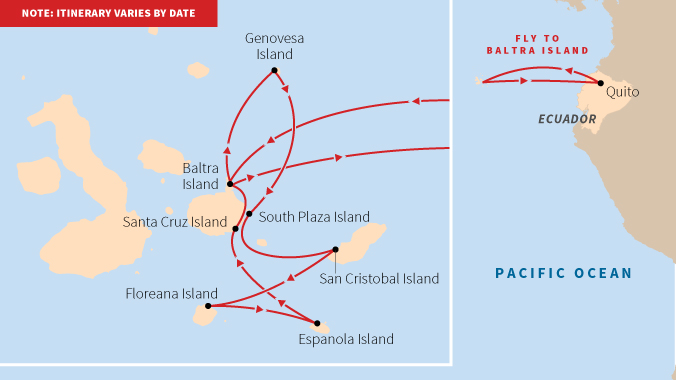
This program has itinerary variations on certain dates.