
Eye on the Sky: A Veteran Birdwatcher Recounts His Adventures
Jack P. always had an interest in birdwatching, but his passion really took flight in 1967.
A middle school science teacher at the time, Jack was on an academic-year fellowship when he decided to enroll in an ornithology class at Montclair State University in New Jersey. His professor was Dr. S. Marie Kuhnen, whose course, Jack recalls, involved all of about 20 minutes in the classroom. The rest took place outdoors, doing field work on bird habitats and behaviors. It was fascinating, and Jack was hooked.
Dr. Kuhnen would soon become a dear friend and colleague of Jack’s, and the two participated in countless birding experiences over the years. Among them were the annual Big Day events in New Jersey each May, with the goal of counting as many species as possible in a single day. They did this together for 39 years, and Jack recalls counting 196 species on their most successful “Big Day.”
At Jack’s retirement celebration in 2002, Marie credited him with an eagle eye for, well … eagles. She said: “Jack has amazing eyesight and quick identification skills. Driving along the Delaware River at 50 mph, most of us are straining to focus on the trees, let alone the birds in them. Invariably, Jack is the first to spot an eagle and the first to set up his scope.”
Expanding His Habitat
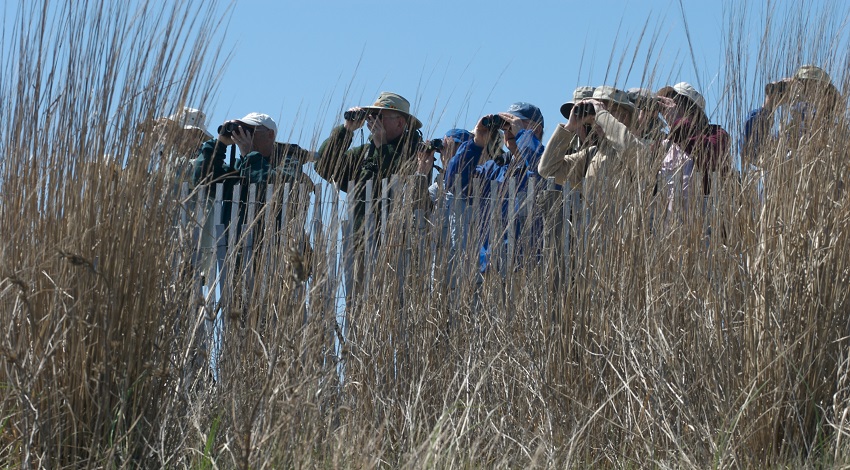
As his passion for birdwatching grew, Jack ventured far beyond New Jersey. He crisscrossed the country, sometimes alone, sometimes with other birders. In a single year, he recorded sightings of more than 600 species.
Jack’s birding activities remained steady across the years, blossoming even more in his retirement — thanks in great measure to his connection with Road Scholar.
Jacks’s first exposure to Road Scholar — back in its Elderhostel days — had come by virtue of his role at the Pocono Environmental Education Center (PEEC), a respected nonprofit in the Delaware Water Gap National Recreation Area dedicated to awareness and appreciation of nature. He became director of the center in 1976, and under his leadership the PEEC established numerous natural history programs. Among them were several early Elderhostel programs.
Jack’s first experience with Road Scholar as a participant came in the early 2000s, around the time he transitioned out of teaching. It’s fair to say he found the initial experience rewarding — after all, in the two decades since, he has participated in an astounding 124 Road Scholar programs, all of them focused on birding, and all of them in the United Sates.
He’s been to nearly every state in the union on Road Scholar programs, some of them multiple times. One of the biggest draws, according to Jack, is the quality of the Group Leaders and instructors. As he talks about instructors who have impressed him over the years — Mark Garland in New Jersey, Michael Marsden and Bob Prescott in Texas, Tom Bassett in Ohio, Tom Wolfe and Sherry Williamson in Arizona — he confesses: I “usually pick the program because of the instructors. When they’re top birders, I make sure to sign up.”
When asked about his most unusual sighting, Jack cites the Northern Tufted Flycatcher, native to Mexico and virtually never seen in the U.S. He saw it on a program out of the American Museum of Natural History’s Southwest Research Station in Portal, Ariz. But he’s quick to credit the initial sighting to an eager young Canadian whose parents had brought him along and who then led the rest of the group to the location.
A Lifelong Commitment to Education
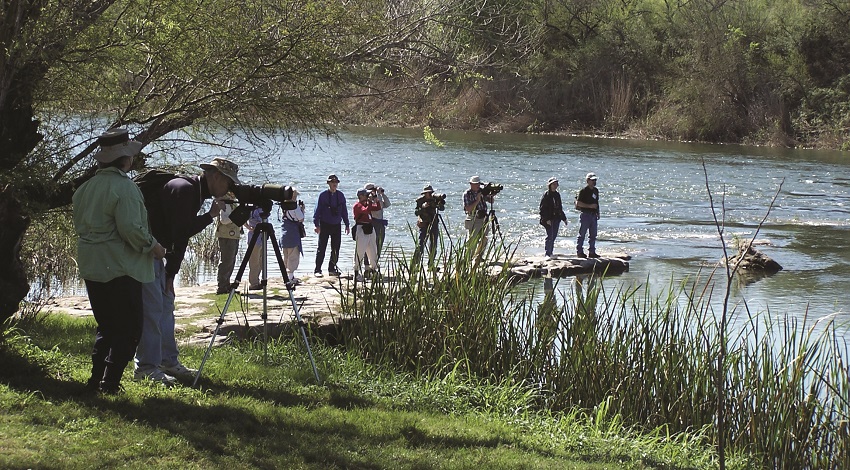
Introducing young students to birding, and watching their interest blossom, has been one of the great joys of Jack’s life. He’s proud when he talks about former students like Dan Casey, someone he taught nearly 60 years ago. “Dan got really psyched on the birding trips our class took,” he recalls, “and went on to a career with the Fish and Wildlife Service. He also co-authored an important book, ‘Birds of Montana.’ When he came back for his 50th high school reunion, we spent a day birding together.”
Jack’s efforts to introduce others to birdwatching have ranged far beyond the traditional classroom, as well. While he was at the PEEC, Jack was one of the founders of the Brandwein Institute in Greenville, N.Y., dedicated to conservation and nature education. The Institute offers robust community outreach including lecture series, summer camps and frequent activities (including birdwatching, of course) in its nature reserve.
Jack also gives frequent talks to local birding clubs and other organizations, where he is an enthusiastic ambassador for Road Scholar. “Any time I give a talk at a bird club,” he says, “I tell them the best bang for their buck is a Road Scholar birding program. I have never had a negative experience.” For the newcomers increasingly flocking to the popular pastime, Jack recommends joining such clubs, and also reading the works of noted bird experts. One he particularly recommends is Pete Dunne, whom he knows personally and whom the Wall Street Journal refers to as “the bard of birding.” Dunne’s books are well-represented in the Road Scholar bookshop.
The Quest for the Next One
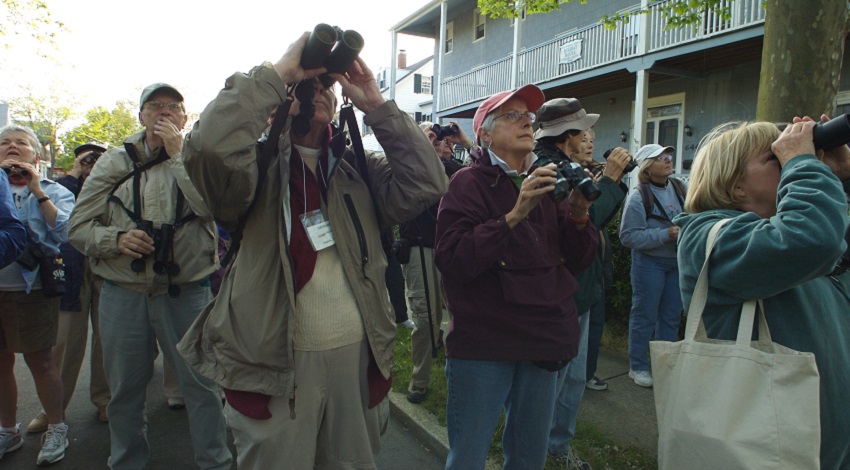
Now in his mid-80s, Jack has been slowed by recent hip surgery in his quest to achieve a personal goal — to participate in 125 Road Scholar programs. He’s one shy of that mark, but it would be a mistake to count him out. For Jack, every journey into the field presents the opportunity for a new find. In fact, on his most recent Road Scholar program, to Ohio in 2024, he found a “life bird” (the term for a first-in-one’s-lifetime sighting) — a Kirtland’s Warbler.
And as he is fond of telling anyone who asks, his favorite bird is “the next one”!