
Go for the Gold! A Baker’s Dozen “Golden” Experiences Around the World
Road Scholar turns 50 this year! Our golden anniversary has us thinking about our favorite places and things in the world that feature gold prominently. Put these destinations on your “must explore” list!
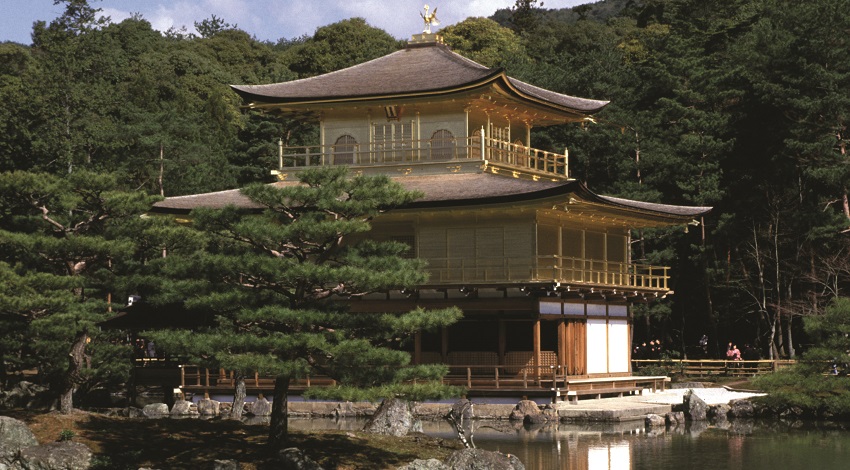
Kinkakuji
Kyoto, Japan
Kinkakuji, the Golden Pavilion in Kyoto, is a Zen temple the top two floors of which are entirely covered in gold leaf. Originally constructed in the 14th century, it has burned down and painstakingly been rebuilt several times, most recently in 1955. Surrounded by lush gardens, topped by a golden phoenix and set beside a large pond, the pavilion and its mirror image on the pond make for a stunningly beautiful landscape.
Golden Conure
Brazil
Of all South America’s incredible variety of beautiful birds, few match the Golden Conure for sheer spectacle. Entirely golden yellow save for streaks of green in its wings and tail, the Golden Conure inhabits the Amazon basin in northern Brazil, preferring tall forests in non-breeding seasons and open fields when breeding. Popular as pets, they are gifted mimics, but be forewarned: When seeking attention, they can screech at upwards of 100 decibels, about as loud as a jackhammer.
Gold Hat
Berlin, Germany
In the Neues Museum in Berlin sits the remarkable object known as the Berlin Gold Hat. The best-preserved of just four known to exist, the conical hat is believed to date from 1,000 to 800 B.C. Roughly 30 inches tall and 88% gold (10% silver), it is profusely ornamented with rows of bands and symbols. These were most likely used to mark key dates in lunar and solar calendars, though the method is still not fully understood, and little is known about the sun cult that used the hat in ceremonies.
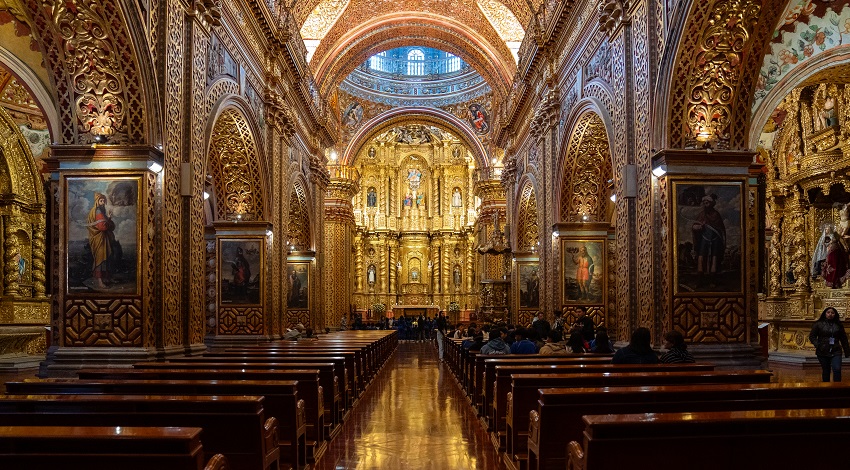
Iglesia de la Compañia de Jesús
Quito, Ecuador
In the historic center of Quito sits this remarkable church, begun in 1605 and requiring 160 years to complete. A masterpiece of Spanish Baroque architecture, its central nave is almost entirely decorated with gold leaf and gilded plaster. Two green and gold domes occupy the vaulted ceiling, and masterpieces of sculpture and oil painting grace the walls.
“The Kiss”
Vienna, Austria
Gustav Klimt’s most famous work hangs in the Upper Belvedere Palace in Austria. An oil painting glittering with gold and silver, “The Kiss” evokes styles and traditions ranging from Art Nouveau to Japanese prints to illuminated manuscripts, and is distinctly reminiscent of Byzantine mosaics, which Klimt was indeed inspired by during a 1903 visit to the Church of San Vitale in Ravenna, Italy.
Golden Arches
Downey, California
There are more McDonald’s restaurants around the world — roughly 38,000 — than there are people in Juneau, Alaska. But only 12 of the sites still sport the original golden arch (not arches) designed by Ray Kroc, the first McDonald’s franchisee. The oldest of them is in Downey, Calif., and features both the arches original to the building when it opened in 1953, and the single-arch sign out front, erected in 1959. The latter features Speedee, the chain’s mascot in the days before Ronald McDonald. While the arches as they were in the 1950s, sadly the 15-cent hamburger offered then is long gone.
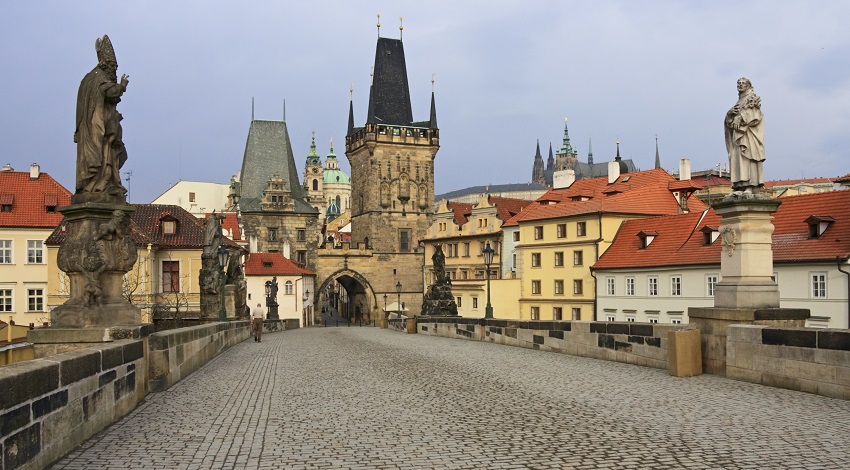
The Golden Dog of Prague
Prague, Czech Republic
Thirty statues flank the Charles Bridge in Prague, most of them of saints, with a few depicting moments in the life of Jesus Christ. At the base of the statue of St. John of Nepomuk is a bronze relief of a knight scratching the head of his well-behaved dog. While most of the bronze has taken on centuries of dark patina, over time so many visitors have given the dog a “good boy” petting that the lucky canine has a golden shine.
The Goldens of Golden
Golden, Colorado
On the subject of “good boys” (and girls), each year since 2019, the town of Golden, Colo., has invited Golden Retrievers and their humans to a “Goldens in Golden” celebration of the breed. Around a thousand pups and even more humans take over the streets and dog- friendly venues. The group photos are spectacular!
Sunflowers
Tuscany, Italy
In July, hills and fields all across Tuscany explode with color. Covered in acres and acres of sunflowers as far as the eye can see, they create a breathtaking vista. Sunflowers are a cash crop, of course, but visitors who flock to the region are less interested in the economics than in views that capture the romantic quintessence of the Italian countryside
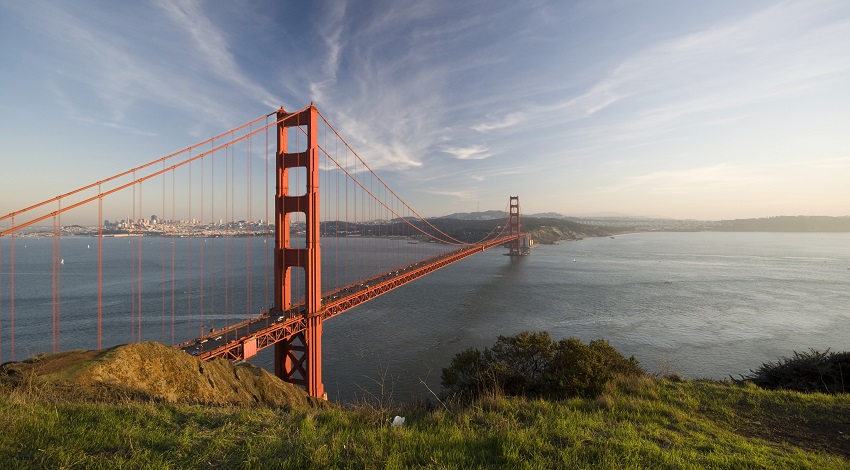
The Golden Gate Bridge
San Francisco, California
It’s orange and gateless — so why “Golden Gate”? That’s actually the name of the strait it spans, which is the entrance to San Francisco Bay. From the time of its completion until it was surpassed by New York’s Verrazano-Narrows Bridge in 1964, the Golden Gate Bridge was the longest suspension bridge in the world, with a total length of 1.7 miles. You can visit it (when it’s not enshrouded in fog), on our Signature City San Francisco program.
Golden Buddha
Bangkok, Thailand
It reads like something straight out of Indiana Jones. One day in 1955, workers were moving an unremarkable but heavy 10-foot plaster statue of the Buddha into a new building at a minor temple, when the statue slipped its ropes and fell to the ground. Where the plaster had chipped off, workers saw the gleam of gold. It turned out that what they were transporting was a circa-14th-century statue made of 5.5 tons of solid gold. It had been concealed in plaster in the 18th century just prior to a ruinous war and its true identity was. The present-day value of the gold in the statue is right around $500 million.
Gold Nugget
Washington, D.C.
In the Smithsonian Institution lies a small, otherwise unremarkable flake of gold that changed American history. It is believed to be the first gold discovered at Sutter’s Mill in California in 1848, sparking the great gold rush and with it, westward expansion and a sea change in the economic landscape of the United States.
The Golden Spike
Palo Alto, Calif.
Twenty years after the California gold rush began, the first transcontinental railroad in the U.S. was completed. Leland Stanford, then president of the Central Pacific Railroad, drove the final, ceremonial golden spike linking that line to the Union Pacific Railroad at Promontory Summit, Utah Territory, in 1869. Removed immediately after the ceremony to prevent theft, the spike now rests in the Cantor Arts Center at Stanford University.
If you happen to be exploring in any of these far-flung regions of the world, do take time to seek out the remarkable places and things featured here, not just for their glittering appeal but for the fascinating history and culture behind them.