
Take a Deep Breath: What You Need to Know About Traveling With a CPAP Machine

- Traveling with a CPAP machine might seem complicated. But with a little advance planning, it can be a smooth and simple process!
- If you’re traveling by air, check your airline’s website to ensure compliance with their regulations. Bringing a doctor’s note along might be helpful as well.
- If you’re planning on long travel days or going to a remote location, you might want to consider a battery-powered travel CPAP machine.
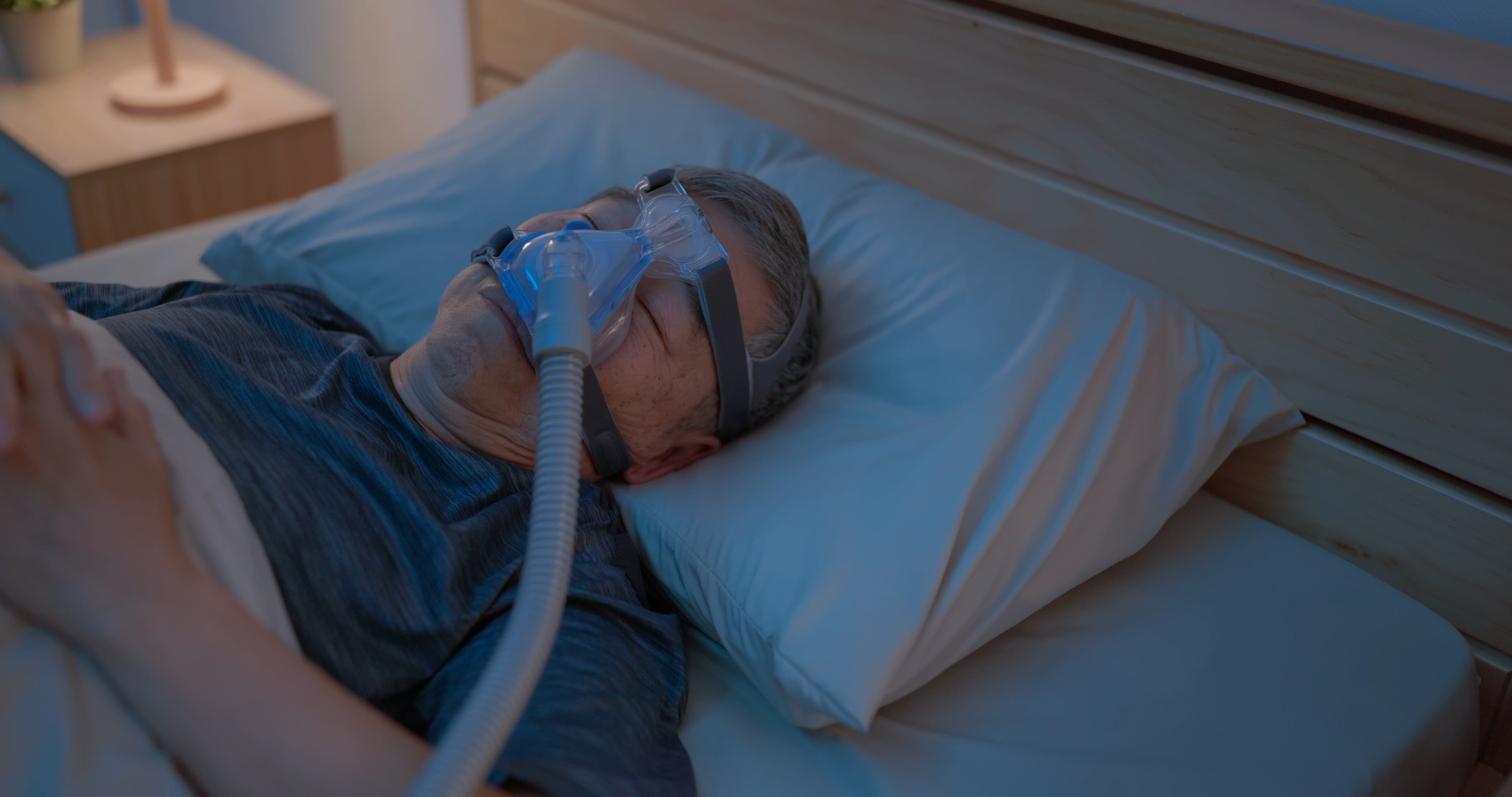
Continuous positive airway pressure (CPAP) machines are helping millions of people overcome sleep apnea and get a better night’s rest. One thing that might cause CPAP machine users to lose sleep, however, is the prospect of traveling with one. What are the obstacles? What needs to be thought out in advance? Is it even possible to travel to some places with a CPAP machine?
Let’s dive in and address these questions.
Rules and Regulations
First and foremost, is it even possible to travel with a CPAP machine? In a word, yes. You can bring a CPAP with you when traveling by land or over water. However, things are a bit more complicated when you’re traveling by air.
The TSA recognizes CPAP machines as essential medical devices. As a result, all major airlines must allow you to bring one on board and use it on the plane if you wish. (It doesn’t impact your luggage allowance.)
But there are some important “howevers.” Airlines have some leeway in setting policy for bringing and using CPAP machines on board. Some have pre-notification requirements if you plan to use your machine on a flight, others have special rules about batteries and humidifiers and so on. What’s more, some international carriers place more restrictions on CPAP machines than domestic carriers. Other airlines require various combinations of pre-registration, doctor’s notes stating why the machine is needed and battery restrictions.
These variations lead us to one very important piece of advice: Check your airline’s website before you travel to make sure you’re prepared to comply with whatever their specific policies are.
Once you’re at the airport, the security process is generally quite straightforward. Always carry your CPAP machine in your carry-on bag, not your checked luggage, to ensure you have it if you need it and to guard against loss or theft. At the TSA checkpoint, you’ll need to remove the CPAP machine from your bag. You might be asked to turn it on for a brief functional check. Rarely should there be an issue — TSA agents see a lot of CPAP machines.
You should also face little difficulty getting through airport security in other countries with a CPAP machine. Having a doctor’s note with you and the owner’s manual explaining what the machine is for could give you some added peace of mind, even though you’re unlikely to be asked for them.
Another piece of documentation to consider bringing along is a copy of your prescription. Should your machine be lost or stolen and you need to replace it, your prescription info will be helpful. You could even take a photo of your prescription, just as a backup.
Accessibility of Power Sources
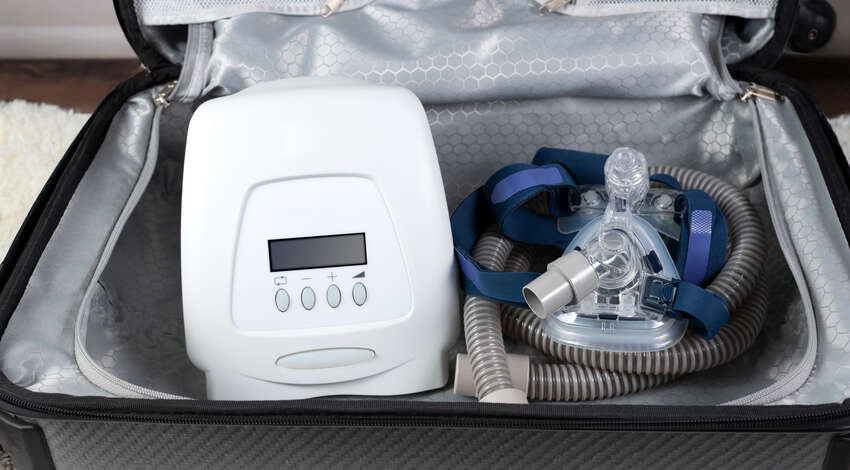
Most airlines have power outlets in the cabin, but there won’t necessarily be one accessible from your seat — obviously a concern if you plan to use your CPAP machine while in flight. Some regular CPAP machines can operate on batteries, but there are also battery-operated travel versions that have the added advantage of being more compact and easier to transport. If you’re planning to use your CPAP machine on a plane, check the carrier’s policy with respect to battery operation, and perhaps plan on using a battery so that power outlet availability won’t be an issue. Be sure your battery will last the duration of your flight.
On the ground, there are other things to consider when it comes to power availability. In some circumstances, there may be no power outlets available at all in rustic cabins or remote areas. Here, too, a battery-powered CPAP machine would be a wise option.
In more standard accommodations with power outlets, the outlets may not be close enough to your bed to plug in, or they may be competing with other devices for “plug space.” A short extension cord can be a handy bring-along for these occasions.

Ensuring Electrical Compatibility
Compatibility should always be top of mind when planning international travel. First, you need to be prepared for different outlet configurations. An outlet adapter is essential, but luckily, many types are readily available online. When purchasing, make sure you choose adapters that will work with the outlets at your destination.
The other compatibility issue concerns voltage. Countries throughout the world use varying standard voltages, with 110/120 V most common in the Americas and 220 V/230 V in Europe, Asia and elsewhere. Most CPAP machines today are dual voltage, meaning they can be operated on both voltage standards. On the power plug of your CPAP machine, look for INPUT A/C 100 V-240 V. That means you’re all set for both voltages. If your adapter is 120 V only, you will need a travel voltage converter, often sold in tandem with outlet adapters.
If you’re beginning to think you may need an electrical engineering degree to figure this all out, rest assured that in practice, it’s not at all difficult to navigate these issues. Know the plugs and the voltages and outfit yourself with the right adapters and converters as needed. Done!
When you travel with Road Scholar, every day is an adventure, and you want to be ready for it. That means getting a good night’s sleep — and if it means using a CPAP machine, bring it!
Lauren Briggs first discovered Road Scholar at the age of ten, when she embarked on a Grandparent Adventure with her grandfather. In 2022, she reconnected with the
organization and began writing for Road Scholar full-time. Lauren is especially passionate about sharing participant stories, including her own Road Scholar experiences in South Dakota and Grand Teton National Park. She lives in Massachusetts and enjoys spending summers exploring New England in her campervan.