Reflections off a "Dark Continent" Part 3
- The talking drum shaped communication across Africa and the African diaspora, including during resistance to slavery.
- Colonial authorities banned drums after recognizing their ability to coordinate action across long distances.
- Misunderstanding African technologies reinforced harmful global narratives about the continent.
- Reframing these histories reveals Africa’s role in the development of communication, science and global knowledge systems.

Global impact, resistance and reframing the metaphor
This is Part 3 of a three-part essay by instructor Tunde Adegbola, who has led online lectures for our participants on African history, language and technology.
After exploring early perceptions of Africa and the science behind the talking drum, this final section looks at its global impact and what these histories reveal about how knowledge is shaped.
Estimated reading time:
Part 3: ~9–10 minutes
The Talking Drum in Global Context
Like Stanley, many European visitors to Africa in the 18th and 19th centuries failed to grasp the scientific principles underlying the talking drum. Yet its effectiveness had long been demonstrated far beyond the African continent. For centuries, it may have been the most advanced telecommunications system in Africa, Europe and the Americas.
Before early telegraphy emerged between 1791 and 1829, long-distance communication relied on human couriers, homing pigeons and, later, the Pony Express. Herodotus reported that the courier Pheidippides ran roughly 240 km from Athens to Sparta in two days, averaging about 5 km/h. Homing pigeons later carried messages at speeds near 80 km/h. The Pony Express, operating across rugged terrain in the United States, averaged about 16 km/h. Meanwhile, the African talking drum — using sound traveling at roughly 1,234 km/h — had been transmitting information across vast distances for centuries.
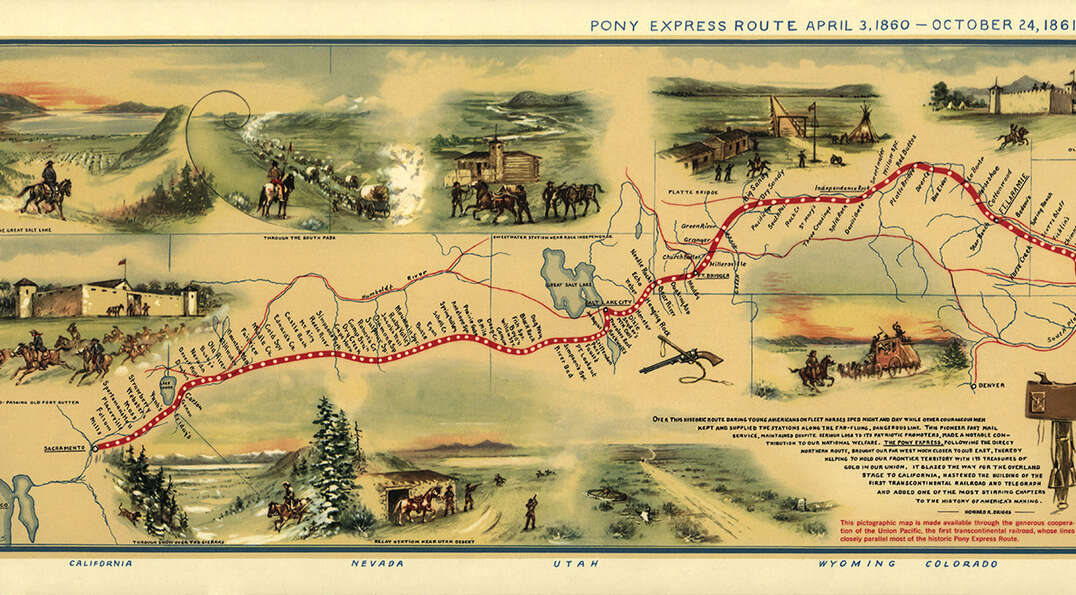
Pony Express map route.
The Talking Drum and Slave Revolts
Long before Stanley’s journeys into the African interior, enslaved Africans in the Americas and Caribbean used speech surrogacy, including talking drums, to organize and sustain resistance. Revolts often displayed a level of coordination suggesting sophisticated long-distance planning. Drums carried encoded messages across plantations and regions at the speed of sound, creating serious challenges for slave owners. Their effectiveness was so clear that drums, horns and similar instruments were eventually banned across many slave societies.
The Stono Rebellion (1739)
The Stono Rebellion of September 9, 1739, began on a Sunday morning while enslavers attended church. Near the Stono River in present-day South Carolina, enslaved Africans marched toward Spanish Florida, beating drums to recruit others along the way. Spain had promised freedom and land to those who escaped British territories.
Rebels raided a warehouse, seized weapons and killed two storekeepers. Drums played a central role in mobilizing participants and coordinating movement. Their use confirmed long-standing fears among enslavers about the communicative power of African instruments to organize large-scale resistance.
Tacky's Revolt (1760)
On April 7, 1760, Tacky's Revolt erupted in Jamaica. Enslaved Africans across widely separated plantations coordinated action through the talking drum. The revolt aimed to establish an independent Black state by overthrowing British rule.
Messages relayed by drum traveled more than 100 km between centers separated by up to 126 km. These coded communications — unintelligible to enslavers — signaled attacks and synchronized movements across parishes. The uprising continued for roughly 18 months, sustained by military strategy and rapid communication. It was ultimately suppressed in late 1761 by British forces, militia and Jamaican Maroons.
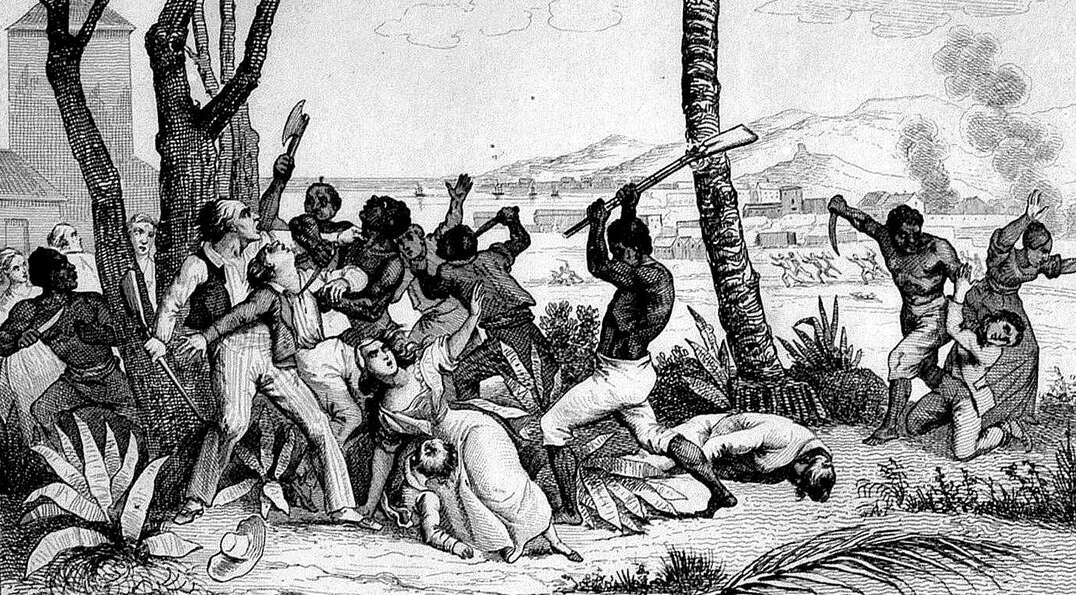
Slave revolt illustration.
Legislative Responses to the Talking Drum
Across Jamaica, Haiti, Cuba, Brazil and the southern United States, colonial authorities banned drums after recognizing their role in coordinating resistance. Drums carried detailed information across plantation boundaries faster than overseers could monitor, even though authorities rarely understood how the messages worked.
The Barbados Act of 1688 outlawed drums, horns and other loud instruments that might signal collective action. Slave owners were required to search enslaved quarters regularly and destroy such instruments if found. The law was reaffirmed in the 1826 Slave Consolidation Act.
Similar measures appeared elsewhere:
- St. Kitts laws of 1711 and 1722 targeted distance signaling.
- Jamaica Assembly Acts of 1717 and 1760 prohibited drumming among enslaved people, with fines imposed for violations.
- The South Carolina Negro Act of 1740 banned drums, horns and other loud instruments, classifying them as dangerous tools of coordination.
Even in later colonial administrations across Nigeria, Ghana, Senegal and Benin, authorities restricted or confiscated messaging drums when they were used to warn communities or mobilize resistance.
Rethinking the “Dark Continent”
Stanley’s misinterpretation of the talking drum reflects a broader misreading of Africa. His portrayal of Africa as a “dark continent” stemmed less from absence of knowledge than from failure to recognize it. Where he perceived menace or superstition, he encountered a sophisticated communication technology.
By the same logic, colonial authorities often saw drums not as technologies to be understood but as threats to be suppressed. The widespread banning of drums and horns may even have delayed formal recognition of key scientific principles. If early prohibitions such as the Barbados Act of 1688 had not suppressed these systems, developments such as telephony and information theory might have emerged sooner.
To reconsider the metaphor of darkness more precisely, physics offers a useful analogy. Only a tiny fraction — less than 0.004% — of the electromagnetic spectrum is visible to the human eye. A body may appear dark not because it lacks reflected energy, but because that energy falls outside the range observers can perceive.
So, too, with Africa. What Stanley and many Europeans perceived as darkness may simply have reflected the limits of the instruments — intellectual and cultural — with which they attempted to observe it. Africa and its observers were, in effect, attempting to communicate across languages without an interpreter.

Henry Morton Stanley
Cargo Cult Mentality
Stanley and other early visitors can also be understood through the lens of cargo cult mentality — the tendency to imitate or judge complex systems based only on their visible surface without understanding underlying principles. The term originated in Melanesia during the Second World War, when islanders associated military supply deliveries with the construction of airstrips and control towers they had observed, rather than with the global logistics systems behind them.
This pattern appears widely in human behavior. When the relationship between effort and outcome is unclear, people often replicate visible forms while overlooking underlying causes. Businesses copy competitors without grasping their strategies. Athletes buy equipment used by champions in hopes of replicating success. Even scientists, as Richard Feynman warned, may practice “cargo cult science” that mimics the appearance of rigor without its substance.
Such tendencies are not peculiar to any one culture. They are intrinsic to human learning. Stanley, unable to grasp the scientific foundations of the talking drum, interpreted what he heard through this same human impulse. His failure to understand a sophisticated communication system contributed to his broader conclusion that Africa was a “dark continent” — a claim reflecting not absence of knowledge, but failure to perceive it.
Recommended Reading From Tunde
This essay draws on decades of scholarship in African history, language and technology. Explore a curated selection of titles referenced by the author in the Road Scholar Bookshop.
Read the full series:
- Part 1: Origins of the “Dark Continent” myth
- Part 2: Technology, bias and the talking drum
- Part 3: Global impact and reframing the narrative
Tunde Adegbola is a research scientist, consulting engineer and culture activist. As the executive director of the African Languages Technology Initiative (Alt-i), he leads a team of researchers in appropriating modern information communication technologies (ICTs) for African languages. Tunde’s research interests lie at the intersection of information science, telecommunications and linguistics, including the exploitation of speech surrogacy and other features of African tone languages in speech technologies and modern telecommunications.

Tunde Adegbola