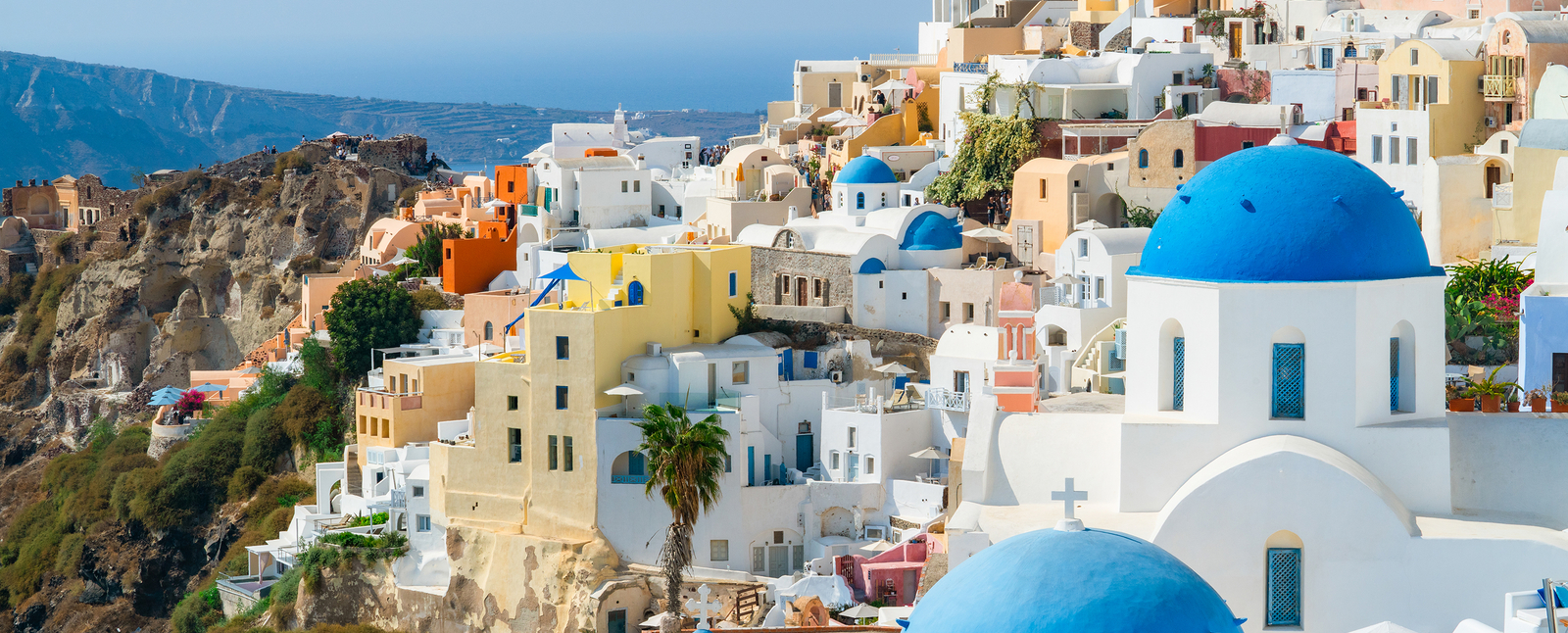
Olympia’s Stones Give Up Their Secrets: An Archaeologist’s Musings

- Ancient Olympia offers one of Greece’s most powerful windows into the origins of the Olympic Games and ancient Greek identity.
- Road Scholar learners explore the site with expert archaeological guidance, uncovering temples, athletic training grounds, and sacred rituals honoring Zeus.
- The experience highlights Olympia’s mix of religion, competition and festival culture, from sacrifices at the great altar to roaring crowds in the stadium.
- Stories of Nero, Alexander the Great and Pheidias bring the ruins into sharp human focus.
Bringing the Past to Life:
There are few places in Greece, Road Scholar’s 2026 Campus of the Year that instill in me a more visceral response than ancient Olympia. I guess it's the archaeologist in me, but I think it's just impossible not to feel the full weight of Greece’s extraordinary history when you're standing on ground where the greatest athletes of the ancient world converged every four years for nearly three millennia. Think about that for a moment — three thousand years of continuous athletic competition!
When I'm teaching, students will often ask me to identify the one institution that most powerfully captures the very heart of ancient Greek civilization. My usual reply: the Ancient Olympics. No other cultural ritual more fully embodied the Greek ideals of excellence, competition and panhellenic identity than these games.
As a Road Scholar lecturer and Group Leader, I’m always thrilled to draw upon my experience as a classical archaeologist to paint as vivid a picture as possible of what this UNESCO World Heritage Site must have looked like during its heyday in the 4th century B.C. Trust me, this isn’t easy. Fortunately, when leading a ship-based program, I have the advantage of giving a preparatory talk, usually on a day at sea before we dock at Katakolon, the port town situated about 25 miles west of ancient Olympia.
I’ll begin the lecture by telling my lifelong learners, “When we arrive at the site, don’t expect to be immediately wowed as you were when you caught your first glimpse of the Parthenon.” The virgin goddess Athena’s most famous temple packs an immediate visual punch that Olympia simply doesn't deliver.
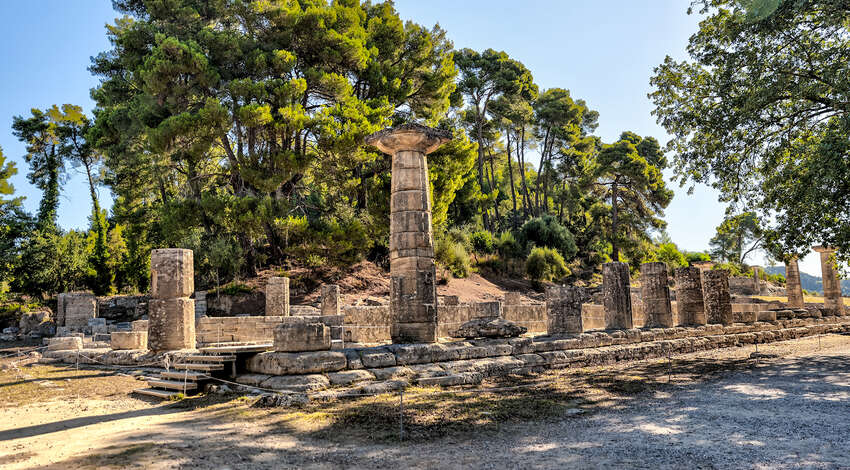
Sure, there's the partially preserved palaestra — the wrestling school, and the gymnasium, recognizable by its partially intact colonnade that once surrounded an open courtyard where competitors trained in the nude (yes, in the nude — the Greek word gymnos means "naked"). But beyond these structures, much of Olympia presents itself as a vast field strewn with fallen limestone column drums, mostly from the toppled Temple of Zeus, and a jumble of massive blocks that can be difficult to decipher without expert guidance. I tell them that they must use their imagination and have a willingness to see beyond the fragmentary evidence that archaeology has left us. I then say, “Just have a little patience because the stones will eventually give up their secrets.”
The Sacred and the Secular
The ancient Olympics were first and foremost religious in nature. For athletes who traveled from every corner of the Greek-speaking world, this spectacle was above all a pilgrimage, a profound religious experience played out in the sanctuary of Zeus, to whom the Games were dedicated.
I really want Road Scholars to grasp how impassioned these athletes were when they first entered the Altis — the sacred grove at the heart of Zeus' sanctuary. Picture this: you're a young man, perhaps in your late teens, who has trained for years for this moment. You've traveled for weeks, maybe months, to get here. You step into the sacred precinct and stand before an altar where one hundred oxen are about to be slaughtered and burned as an offering to Zeus. And we're not talking about just any altar here — this was a gargantuan structure, built up over centuries from the ashes and bones of previous sacrifices, rising like a massive man-made mountain toward the heavens.
Although the athletes were striving for kleos (glory) and the victor's crown — a simple olive wreath — they understood first and foremost that they were competing in honor of Zeus himself. Their superhuman demonstrations of excellence, which the Greeks called arête, weren't just about personal achievement or bringing honor to their city-states. These performances were acts of worship, a way of pleasing the chief Olympian god.
But outside the sacred area? It was far from pious. In the wide-open spaces along the ancient rivers Alpheus and Kladeos, thousands upon thousands of spectators were caught up in absolute revelry. We're talking about a raucous affair that must have rivaled Woodstock in 1969. Drunken spectators going gaga, cheering themselves hoarse for their hometown heroes. Imagine vendors hawking food and souvenirs, debates in makeshift forums, philosophers like Plato reciting their latest works — the whole scene was dizzying and chaotic. The sacred and the profane, existing side by side.
The Olympic Flame
In front of the Temple of Hera, I point out that every two years — before each Summer and Winter Olympics — a ceremony takes place here. Women dressed in ancient Greek robes use a parabolic mirror to focus the sun's rays and ignite a flame. This Olympic flame is then carried by relay to wherever the games are being held. Although no record is preserved that this ritual was performed in antiquity, it makes for great theater. It’s a way of saying our modern Olympics are connected to their celebrated forerunner. It's a tangible link across the centuries, a reminder that the past isn't dead.
Listening to the Stones
As our local expert shares myths associated with Olympia's foundation, especially the legend of Pelops and his famous chariot race, I encourage participants to get comfortable on one of the stones under a canopy of pine, oak, olive and plane trees. The natural beauty of this site has changed little in 28 centuries.
Even in late August, when temperatures hover around 90°F, there's often a gentle, breeze wafting through the trees. I'll point to a particular flat stone, half-buried in the grass and explain where it was originally placed on the temple. "See those three vertical grooves? That's a triglyph — a nearly square decorative panel that was part of the Doric frieze adorning the Temple of Zeus."
Then I ask them to close their eyes for a moment and "let these stones reveal their secrets from centuries past." I know it might sound unusual, but there is a kind of magic that takes place when the fragmentary evidence of archaeology suddenly gives up its hidden secrets. “Imagine you’ve been transported back two millennia.” These stones now seem to speak — if you know how to listen — of historical events, of the rise and fall of empires, of human hubris and divine retribution.
Scandal at Olympia: Nero Was Here
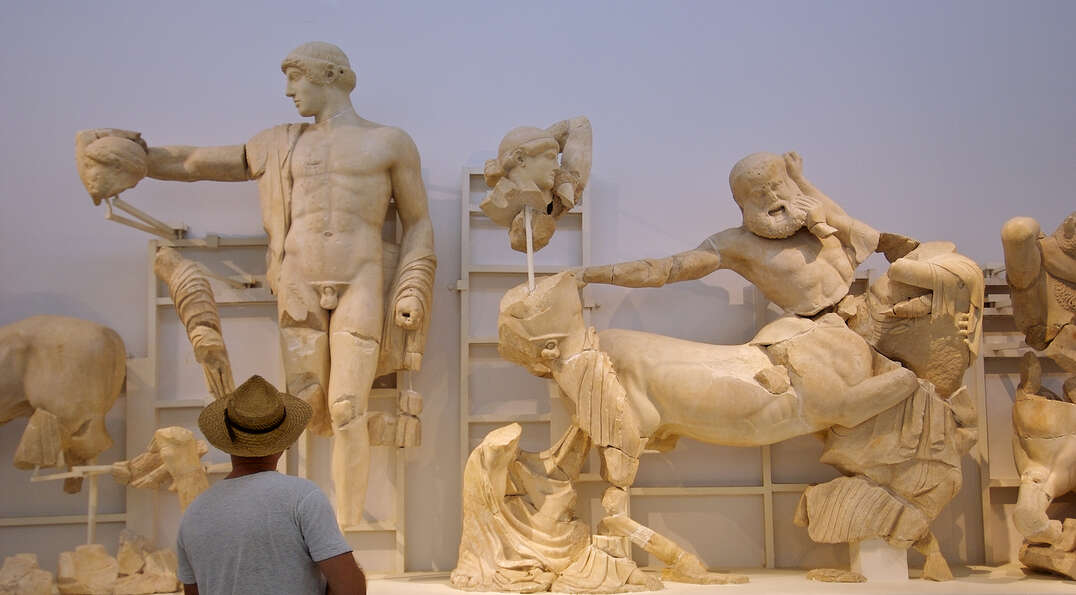
As we meander through the sacred grove and clamber over fallen columns, our local expert entertains us with one of my favorite scandalous episodes from Olympia's history. In A.D. 67, Rome's megalomaniacal bad boy, Emperor Nero, decided he wanted to compete in the chariot race at the hippodrome. Nero fancied himself as a gifted musician — no, he wasn’t playing the fiddle but a lyre while Rome burned — and quite the athlete. But to prove his prowess at the Games, he had to cheat, resulting in a scandal. The ancient sources record that when he entered the race and was promptly thrown from his chariot — now, wait for it — he still declared himself the victor even though he never reached the finish line!
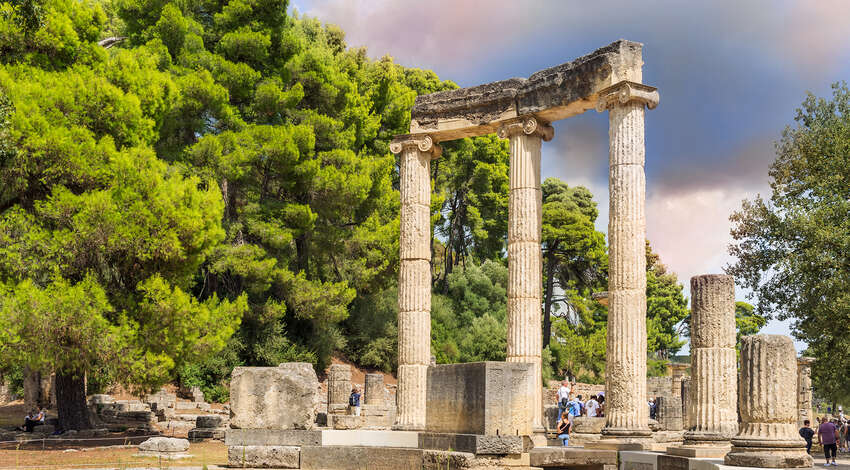
We are also reminded that the great sweep of ancient history can be traced at Olympia through monuments like the one Alexander the Great erected in 336 B.C. After his father Philip II was assassinated, Alexander dedicated an elegant circular marble and limestone memorial — the Philippeion — containing statues of Philip and other members of the Macedonian royal family. Here was the young conqueror, not yet having marched his armies to India, already understanding the propaganda value of associating his family with the most sacred athletic site in the Greek world.
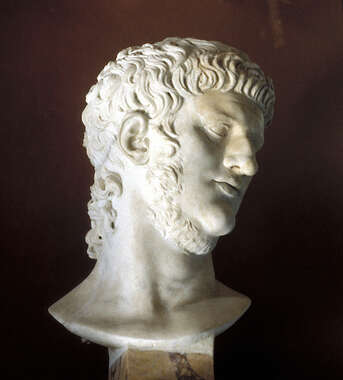
Nero
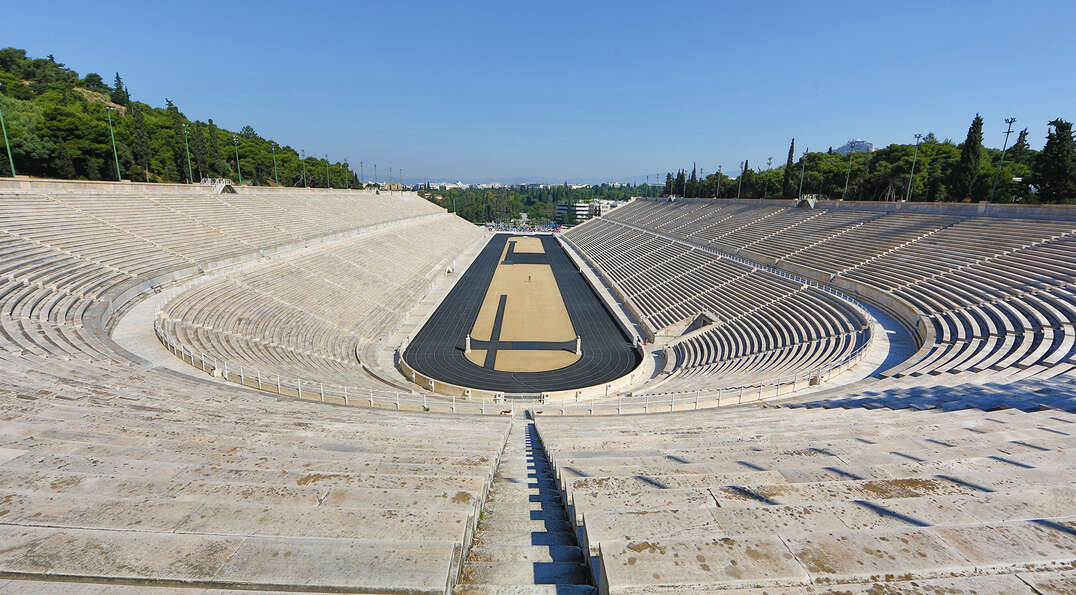
The Greatest Show on Earth
Excitement takes hold nearly every time I lead my group through the vaulted arched tunnel leading into the stadium. It's the climax of the day, what everyone’s been waiting to see ever since we arrived at the site.
The stadium at Olympia is nearly identical to how it appeared when runners from across the Greek world competed here in foot races. The earthen embankments on either side, which could accommodate about 45,000 spectators, are still there. The starting line, with its grooves for the runners' toes, is partially preserved.
"Who wants to run a stade race?" I ask. BTW, the word stade gave us our English word "stadium." It was a 630-foot sprint — the most prestigious and oldest competition held at Olympia, dating back to 776 B.C., which the Greeks used as the starting point for their chronology. Usually, six or seven Road Scholars join me at the starting line. I show my participants the proper stance — crouched, weight forward, just like modern sprinters.
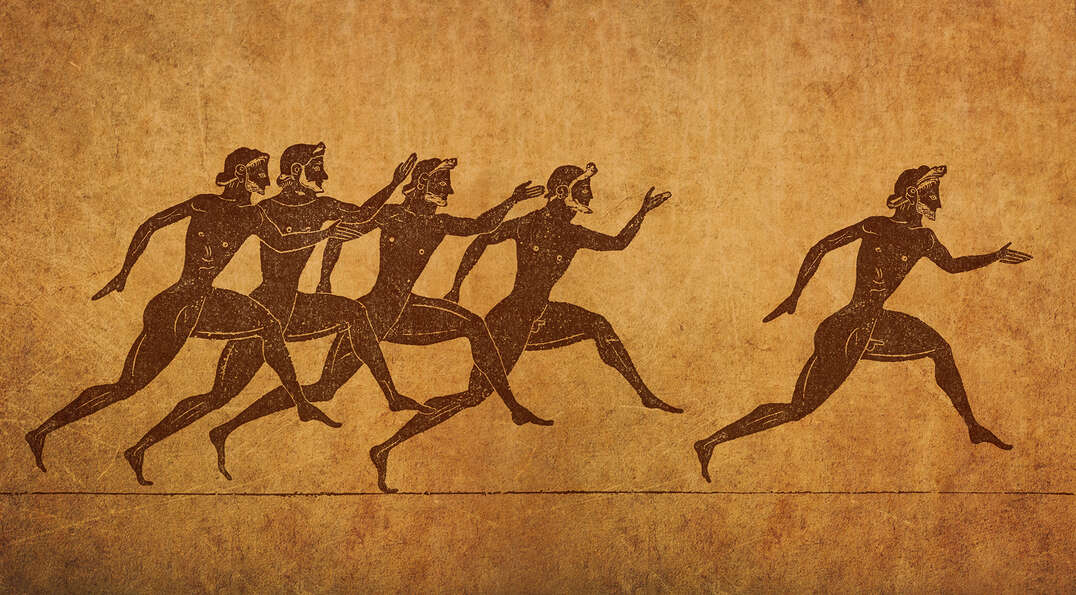
When a participant wins our impromptu race, I cry out "Kallinikos! Glorious victor!" While ancient Olympic victors would have been awarded a crown fashioned from olive branches, I present a Road Scholar cap. Still a valuable prize! As the spectators sitting on the earthen embankment break into applause, shouting "Kallinikos!" again and again, we are — just for that moment — caught up in the sweep of history, eyewitnesses to antiquity’s “greatest show on earth.”
Olympia is only one chapter in Greece’s extraordinary story. Discover more Road Scholar programs in our 2026 Campus of the Year and travel alongside archaeologists, historians, and local experts.
About the author: Nicholas Stavrinides is a trained archaeologist and art historian. He has excavated in Israel and Greece and has conducted field studies in Italy and Provence. He received his bachelor's in classical studies from the University of California, Berkeley, and his master's in classical art and archaeology at the University of Michigan, where he also pursued his PhD. Nick is an educator who currently teaches in northern California.

Nicholas Stavrinides