Reflections off a "Dark Continent" Part 2

- The African talking drum functioned as an advanced long-distance communication system centuries before modern telephony.
- European observers often misinterpreted the drum due to cultural, linguistic and technological bias.
- Tone languages and acoustic engineering enabled complex messages to travel over vast distances with speed and accuracy.
- Understanding this technology challenges assumptions about innovation, intelligence and where scientific knowledge develops.

Misperception, Bias and the Science of the Talking Drum
This is Part 2 of a three-part article by instructor Tunde Adegbola, who has led online lectures for our participants on African history, language and technology.
In Part 1, he examined early European perceptions of Africa and the realities they encountered. Here, he looks closely at the talking drum and how cultural and technological bias shaped its interpretation.
Estimated reading time:
Part 2: ~10 minutes
Wonder Without Understanding
In many instances, visitors’ reports of marvel and astonishment revealed only a superficial understanding of the complex processes that undergirded everyday life in the African interior. Applications of natural principles that sustained harmony within local ecologies were often understood with misleading simplism or misunderstood altogether.
Humans everywhere apply knowledge of natural principles as technology to improve the human condition. Yet such technologies are not always easily appreciated by outsiders. The local conditions that produced them may no longer be visible, and unfamiliar systems are often filtered through existing assumptions. European visitors, encountering technologies grounded in scientific principles they did not recognize, frequently interpreted them through limited or prejudiced frameworks.
The Talking Drum: A Case Study in Misperception
An illuminating example of this misunderstanding appears in Henry Morton Stanley’s early reports of the “talking drum.” Developed centuries before his arrival in 1874, this indigenous telecommunication system served far-flung communities across large regions. Carefully engineered and refined over generations, it operated according to predictable acoustic and linguistic principles and reflected a sophisticated understanding of sound, language and information.
Yet Stanley and many other European visitors mistook the talking drum for little more than noise or menace.
During his travels in the Congo basin in the 1870s, Stanley became accustomed to hearing drums over long distances. Responding with his early military sensibilities, he soon made the connection that these drums transmitted information of his movements well ahead of his expeditions. He noticed that messages forewarned of his arrival, the messages traveling much faster than human couriers, and wide regions coordinated their actions without any visible movement of human couriers.
Telegraphy might have been conceived, but Europe was yet to develop an elaborate communication network at that time; hence, Stanley did not have sufficient experience to imagine an elaborate network of communication sites. Even though he recognized a transmission of information over long distances in these drumming routines, he assumed that the system operated, at best, on a simple dichotomous coding system.
His early reports suggest that he thought drumming always signaled hostility in an expression of primitive excitement on the one hand, and absence of drumming signified peace on the other. He viewed the drums and their sounds as superstitious instruments of warfare. He found the drumming menacing, chaotic and emotion-driven, with the sounds being more noise than information. He perceived and reported the whole procedure as ritualistic, lacking in any form of coherent processing, and based merely on instincts rather than intelligence. How wrong!

Telegraph machine.
Cognitive and Technological Bias
This initial perception of the talking drum suffered from the cognitive bias of familiarity — a subconscious favoring of the familiar over the unfamiliar. He assumed that all languages have the same structure as English, in speech and writing. He could not fathom that any language could allocate sufficiently high semantic value to pitch as an acoustic feature of speech to make it possible to communicate by complex manipulation of pitch on drums.
His perception of the talking drum as a telecommunication technology also suffered from technological bias. He was aware of telegraphy and was comfortable with it as a technological innovation. Telegraphy became available in the Western world by 1840. With technological bias based on his familiarity with tele-graphy — the transmission of information in the form of graphical symbols — he could not wrap his head around the idea of tele-phony — the transmission of information in oral form.
While he was exploring Africa, Europe was yet to experience telephony. It was toward the tail end of his exploration of Africa in 1877 that Alexander Graham Bell managed to summon his assistant, Thomas Watson, over the telephone in 1876. Hence, telecommunications by the transmission of oral signals must have been too advanced for him to imagine. Layered upon these biases were deep-seated prejudices that made Europeans of that age see African cultures through a prism of assumed primitive intentions. He therefore could not have seen the talking drum as the highly sophisticated telecommunication technology that it was at that time.
Back Home and Back to Africa
Stanley returned to Europe in 1877 as a celebrated explorer. He published his book, Through the Dark Continent, and went far and wide on lecture tours, becoming internationally famous. In his journals, he made frequent references to what he perceived as "sonorous war-drums" of tribesmen to incite attacks against his expedition. He viewed the "dull booming" simply as signals that he was about to be attacked by warriors.
His fame as an accomplished explorer who had sought and actually met David Livingstone must have brought him to the attention of King Leopold II. Stanley returned to central Africa to work for King Leopold II between 1879 and 1884, by which time he was better informed about the sophistication of the talking drum technology. He later remarked that while local tribes had not adopted electric signals, they possessed a system of communication that was "quite as effective." He observed that "huge drums, when struck in different parts, could convey language that was as clear to the initiated as vocal speech." He eventually realized that the drums did not just send simple signals like bugles or sirens, as was the case in Europe, but that they transmitted widely varying complex messages — such as news of births and deaths, pleasantries and even jokes, apart from communal administrative information.

Stanley and other contemporary travelers started taking note of the complexity, sophistication and efficiency of the technology, even though they still often referred to it as "bush telegraph" and referred to professional technologists who worked the system as "initiates." They noted the typical transmission speed of over 100 miles in less than two hours through a relay system from village to village. By now, Stanley had started reporting the technology with more scientific exactitude, noting that the drums could be heard from five to seven miles away, particularly at night when sound carried better over water or from hilltops. These observations led to the recognition of the utility of the talking drum and its adoption as a standard means of communication between the colonial authority of King Leopold II and distant chiefs of various colonized communities.
By the time Stanley published his autobiography in 1909, the telephone had become an experience in the U.S. and Europe. Stanley, having spent time in Europe after his 1874 to 1877 expedition, must have experienced the telephone. He now had a frame of reference within which he could contextualize the talking drum as an elaborate telecommunication technology — a technology based on the transmission of information in the form of sonic, rather than graphemic symbols, over long distances. Having now added the word "telephone" to his vocabulary, he wrote in his autobiography, "At every curve and bend they 'telephoned' along the river the warning signals," in describing the drum sounds he had earlier said to be menacing, chaotic and emotion-driven. This is in contradistinction to the time he saw them as more noise than information, signaling hostility in an expression of primitive excitement.
The Sophisticated Science Behind the Talking Drum
To be fair, Stanley could not have imagined that the communication system he encountered encoded complete sentences through tonal patterns that mirrored spoken language. Nor was he equipped to understand how carefully designed formulaic phrases reduced ambiguity and allowed complex information to travel clearly across long distances.
These messages could convey specific names, events and requests, as well as warnings, celebrations and everyday exchanges of goodwill. From his standpoint, however, a message announcing a marriage or expressing gratitude between distant communities might easily have sounded like a menacing signal of impending conflict.
There were many impediments that made it difficult for Stanley to properly contextualize the telecommunication technology employed by these African communities. He spoke English, a language in which tones carry little or no semantic value. In contrast, many African languages are tone languages in which it takes the manipulation of the pitch of speech as tones, in addition to the articulation of consonants and vowels to make meaning. The semantic load of tones in some of these languages is so high that the tones alone, in the absence of consonants and vowels, are still intelligible. Hence, the production of appropriate pitch sequences on drums can mimic human speech sufficiently intelligibly, taking due advantage of information redundancy.
Sound travels at a speed of about 1,234 km/h. The sounds of a drum with a suitable resonator, on an appropriate hill on a quiet night, can travel up to 10 km comfortably discernibly. Strategically arranged networks of these drums as repeater sites easily covered distances of over 100 km. This could well have been the only available system capable of transmitting information at such a high speed over such long distances before the development of telegraphy.
Hence, when Stanley was exploring the African interior between 1874 and 1877, there was no known means of carrying speech sounds over such distances at such speed in Europe or any other part of the Western world. Stanley was already aware of telegraphy. He did compare it to the telecommunication system he encountered in Africa. As earlier noted, tele-graphy is the transfer of information in graphic form over long distances. The transfer of information as sound over long distances as tele-phony was yet to be developed in Europe. It would have been difficult, therefore, for Stanley to comprehend the novelty of Africa's elaborate network of communication sites, akin to present-day wireless telephone networks. This explains why Stanley viewed the system as menacing, chaotic and emotion-driven, the sounds being more noise than information to him, and the whole procedure as ritualistic, lacking in any form of coherent processing, based merely on instincts rather than intelligence.

Misapplication of Ockham’s Razor
Humans often rely on heuristics — mental shortcuts that help make sense of unfamiliar or complex situations. One of the most widely cited is Ockham’s Razor, which advises choosing the simplest explanation that adequately accounts for the evidence. Properly applied, it favors clarity and economy. Misapplied, it can reduce complex realities to misleading simplifications.
Stanley’s general attitude toward Africa reflects such a misapplication. His “Dark Continent” narrative — portraying Africa as unknown, chaotic and without history — offered a simplistic explanation. A more accurate conclusion would have acknowledged European ignorance of African histories long documented in African, Arab and Islamic sources. His interpretation of the talking drum followed the same pattern: declaring its sounds to be noise and menace provided an easy answer, but one that failed to explain what the drumming clearly accomplished.
Hanlon’s Razor and Stanley’s Incompetence
Another useful heuristic is Hanlon’s Razor, which cautions against attributing to malice what can be explained by ignorance, incompetence or accident. Properly applied, it encourages restraint in assigning intent. Misapplied, it risks excusing genuine exploitation or violence.
Stanley returned to Africa in 1879 to work for King Leopold II, helping pave the way for one of the most brutal colonial regimes in modern history. Yet, his early misinterpretation of the talking drum is more readily explained by ignorance than by malice. As the preceding discussion suggests, he simply lacked the knowledge required to understand what he was hearing.
The talking drum rests on a sophisticated system of acoustic and linguistic principles. Central to this system is speech surrogacy — the use of instruments or devices to produce linguistically meaningful statements from intelligible sound.
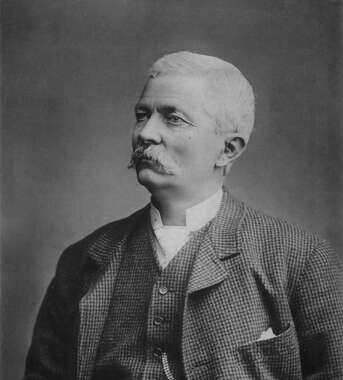
Henry Morton Stanley
Information Theory and Cognitive Science
One useful lens for understanding this system comes from Claude Shannon’s Information Theory, which quantifies the minimum information required for reliable communication. Any capacity beyond that minimum is known as information redundancy — a feature that increases resilience and clarity in transmission. Information Theory was only formalized in 1948, long after Stanley’s encounters in Africa. Had such concepts been available to him, he might have better understood how tonal patterns alone could convey meaning.
Many African languages are tone languages, in which pitch carries significant semantic weight alongside consonants and vowels. Talking drums exploit this feature by reproducing tonal contours of speech. By relying primarily on tone, they draw upon the redundancy built into spoken language to transmit meaning across distance.
This process can introduce ambiguity, which is mitigated through carefully structured formulaic phrases designed for clarity. These compact statements often convey names, events and intentions with precision. Their structure reflects an intuitive understanding of cognitive limits. In some traditions, such phrases typically fall between five and nine syllables — aligning closely with psychologist George Miller’s 1956 observation that human short-term memory reliably processes about seven units of information, plus or minus two.
Technicians of the talking drum were therefore working with principles of information processing and cognition long before these ideas were formally described. Stanley, encountering the system in the 1870s, had no framework through which to interpret its sophistication.
Interested in these sources?
Browse the full reading list in our Bookshop.
Up next:
Part 3 places the talking drum in global context — from communications history to resistance movements — and reframes the “dark continent” metaphor.
Missed Part 1?
Tunde Adegbola is a research scientist, consulting engineer and culture activist. As the executive director of the African Languages Technology Initiative (Alt-i), he leads a team of researchers in appropriating modern information communication technologies (ICTs) for African languages. Tunde’s research interests lie at the intersection of information science, telecommunications and linguistics, including the exploitation of speech surrogacy and other features of African tone languages in speech technologies and modern telecommunications.

Tunde Adegbola