
Leaving It Better Than We Found It: A Road Scholar Staff Beach Cleanup
- Road Scholar employees gathered at Hampton Beach, New Hampshire, to take part in a beach cleanup organized by the Blue Ocean Society.
- Staff members came together from four different states to collect 27.5 pounds of trash, including food containers, wrappers and even a discarded graduation gown!
- Not only was this an opportunity for employees to give back — it also provided a chance for staff to connect and learn something new about the beach ecosystem.
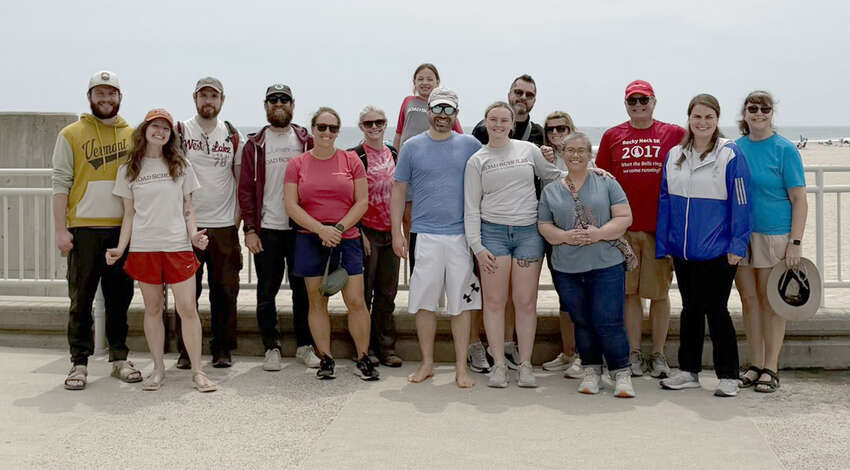
June 6 was a less-than-ideal beach day. With temperatures in the 60s and cloudy skies, it wasn’t difficult to find parking at New Hampshire’s Hampton Beach. But for 15 Road Scholar employees and family members, it was perfect beach cleanup weather! In honor of World Oceans Day, and as part of Road Scholar’s commitment to sustainability, it was time to leave Hampton Beach a little cleaner than we found it.
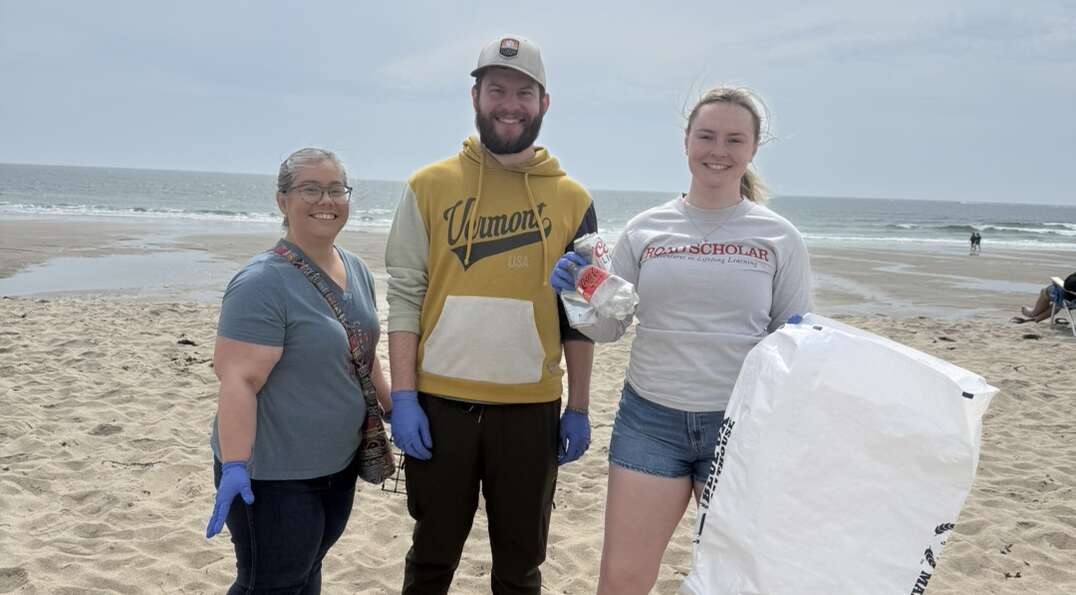
Trading Desks for Garbage Bags
As a remote-first organization, it isn’t often that most Road Scholar employees get to see each other in person. That’s why I was especially looking forward to this event — not only could we do some good, but we could enjoy good company while we were at it. As I gathered with my fellow Road Scholars, we were prepped by the Blue Ocean Society, who was managing this beach cleanup. The Blue Ocean Society is a nonprofit focused on marine conservation in New England, and they made the process of volunteering easy.
As we gathered our garbage bags and gloves, the Blue Ocean Society handed out clipboards. While we picked up trash, we supported their research by recording the different kinds of debris we found along the beach. In the spirit of Road Scholar, we all learned something new from the Blue Ocean Society volunteers. For example, I learned about the Hooksett Disk Spill, which had emptied 4.3 million plastic disks into the New Hampshire coastline after a wastewater treatment facility overflowed due to heavy rains. Due to the currents of the Gulf of Maine, these disks had traveled throughout New England and even as far away as Scotland, England and Norway. The great lengths that this plastic waste could travel put our day’s work into perspective — we could potentially help keep trash from continuing to circle the Earth’s oceans.
Exploring Beach Ecosystems Up Close
But in order to stop that cycle, we first had to find the trash, so off we went! In groups of six, we began collecting and recording the waste we found. For our group, much of the garbage was unidentifiable plastic pieces that had likely broken off of larger containers at some point before washing up on the sand. Even for these seemingly random pieces, the Blue Ocean Society had a system — “Misc. Plastic” was its own category, and we would record fragments based on their size.
As we collected trash, we were able to appreciate the coastal ecosystem that we were working to protect. Our search for litter took us around tidepools, up to the water’s edge and along miles of sandy stretches where we spotted seagulls and plovers.
Our Results
Over the course of just a few hours, our groups collected a total of 2,350 items, including plastic pieces, food containers and even a discarded graduation gown. This equaled 27.5 pounds of trash! (While we kept a close eye out, no one found a Hooksett Disk.)
I thought I had come a long way to get to Hampton Beach from southern Massachusetts, but I was surprised and inspired by the numerous Road Scholars who came from all over New England. We represented four states, with participants traveling from as far away as Vermont and New York. The best part was everyone’s enthusiasm — it was suggested more than once that this become a regular Road Scholar event.
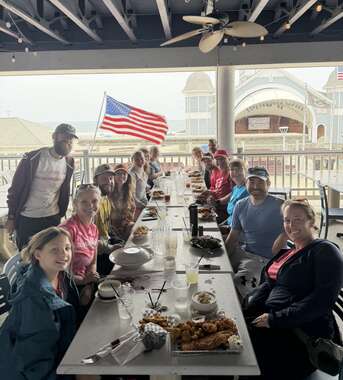
I like to think that, as staff, we all had a taste of the Road Scholar program experience. We made new connections to each other and a new place, while exploring our surroundings and — of course — sampling coastal New Hampshire cuisine at a local restaurant. Lobster rolls ... YUM!
We would like to thank the Blue Ocean Society, whose support, resources and guidance made this day possible.
Lauren Briggs first discovered Road Scholar at the age of ten, when she embarked on a Grandparent Adventure with her grandfather. In 2022, she reconnected with the
organization and began writing for Road Scholar full-time. Lauren is especially passionate about sharing participant stories, including her own Road Scholar experiences in South Dakota and Grand Teton National Park. She lives in Massachusetts and enjoys spending summers exploring New England in her campervan.