The Myth of Theseus and the Minotaur

- The mythical Minotaur dwelt in a labyrinth on the island of Crete, constructed at the direction of King Minos.
- Seeking to end the need for sacrificial Athenians to be fed to the Minotaur, the hero Theseus set out to defeat it.
- Theseus’ triumph ultimately led to tragedy brought on by miscommunication.
- The myth serves as an allegory in several respects and may have roots in real Greek history.
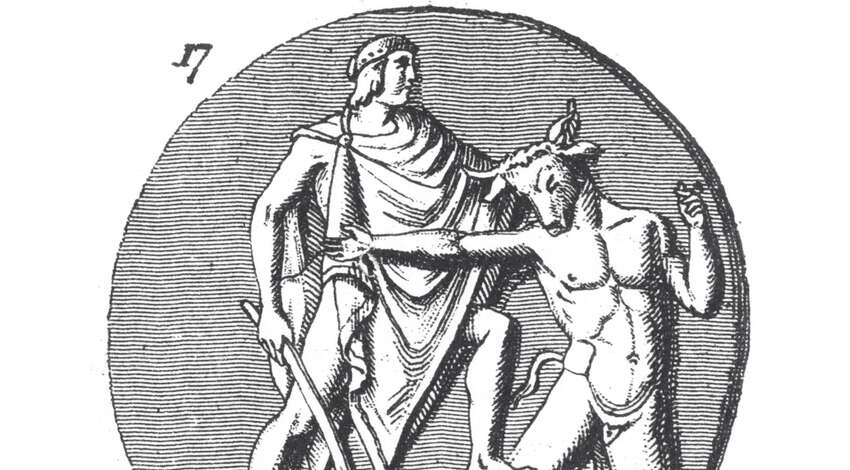
Greek myths are an enthralling combination of fantastical storytelling and morally instructive allegory, often with just enough grounding in real history to make it hard to know where to draw the line between fact and fiction. The myth of the Minotaur is an excellent case in point.
The Minotaur, as you likely know, was a fearsome part-man, part-bull creature that inhabited a labyrinth on the island of Crete. His genesis involved the unwise decision of a king to renege on a deal made with a god.
When King Minos ascended to the throne on the island of Crete, he found himself in competition with his brothers. He appealed to Poseidon, the god of the sea, to send him a snow-white bull as a demonstration that Poseidon favored Minos as king. Poseidon agreed, but sent the bull on the condition that Minos would sacrifice it to him. However, the bull was so beautiful that Minos decided to keep it and sacrifice a different one to the sea god.
Poseidon was not amused. He arranged with Aphrodite to have Minos’ wife fall in love with the white bull, and their union produced a child, the Minotaur. As he grew, the Minotaur became ferocious and developed a problematic diet, i.e., humans. That led King Minos to enlist the services of Daedalus (of winged flight fame) to build a labyrinth so complex that the Minotaur could not escape. Daedalus did, and there the Minotaur lived, subsisting on seven young Athenian men and seven young women each year — a tribute Minos exacted from the Athenians because they had been responsible for the death of his son Androgeus.
The Athenians, understandably, bristled at being a catering service for the Minotaur. Enter Theseus, son of Athens’ King Aegeus. He volunteered to slay the Minotaur and journeyed to Crete to do so. Faced with the logistical problem of entering a labyrinth too complex to ever escape from, Theseus was aided by an unlikely ally — Ariadne, King Minos’ daughter. She fell in love with Theseus and provided him with a ball of thread which he could unwind as he navigated the labyrinth, giving him a trail to follow out. Theseus killed the Minotaur, escaped the labyrinth and headed back to Athens for what would have been a hero’s welcome — had it not been for a tragic communication oversight.
Theseus had promised his father that if he were successful in defeating the Minotaur, he would have the crew of his ship change the sails to white. Were he to be unsuccessful, the sails would remain black, indicating his death. The crew neglected to raise the white sails, however. Seeing the black ones from his lookout, King Aegeus assumed his son had died — and leapt to his own death in the sea below (subsequently named for him, the Aegean).
As with other Greek myths, that of the Minotaur is often interpreted as an allegory. There is the conflict between man as savage and man as reasonable being — of instinct vs. rationality. There is the labyrinth as a metaphor for the complexities of life and the challenges of navigating them. There are the virtues of heroism in Theseus, the pitfalls of hubris in Minos, and the societal values of sacrifice and order inherent in the human offerings made to the Minotaur.
As for whether the myth is rooted in reality, there are tantalizing historical traces that suggest it was not made up entirely out of whole cloth. Bull-jumping was a sport in Minoan culture, in which athletes would leap over bulls — one of several complex interrelationships between humans and bulls that could have prompted the myth.
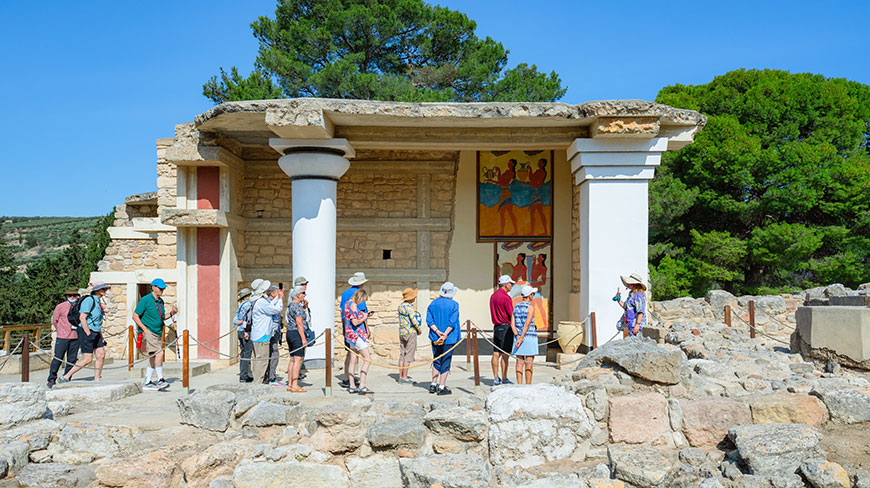
Archaeologically, the ruins of the Palace of Knossos on Crete reveal a sprawling and complex layout akin to a labyrinth. Additionally, a 4,000-year-old circular structure was just discovered on the island in 2024 bearing all the hallmarks of a labyrinth. So, there may be something to it all!
Road Scholars can explore the Knossos Palace on programs including Winter in Greece: The Magical Island of Crete. The Theseum on the Acropolis in Athens is the best-preserved ancient Greek temple in the world and derives its name from sculptures that represent the exploits of Theseus. It can be visited on any Road Scholar program that features Athens on the itinerary, including The Best of Greece: Island Hopping in the Aegean. When Theseus left Crete, he brought Ariadne with him, and they stopped on the island of Naxos, where the god Dionysus visited Theseus in a dream and told him to leave Ariadne behind so she could become Dionysus’ wife. Naxos is a stop on The Greek Isles and Ephesus: A Small Ship Voyage.
Greece is such a delicious blend of human history, legend and natural beauty that it was an easy choice as our Campus of the Year or 2026. Make it your next learning destination!