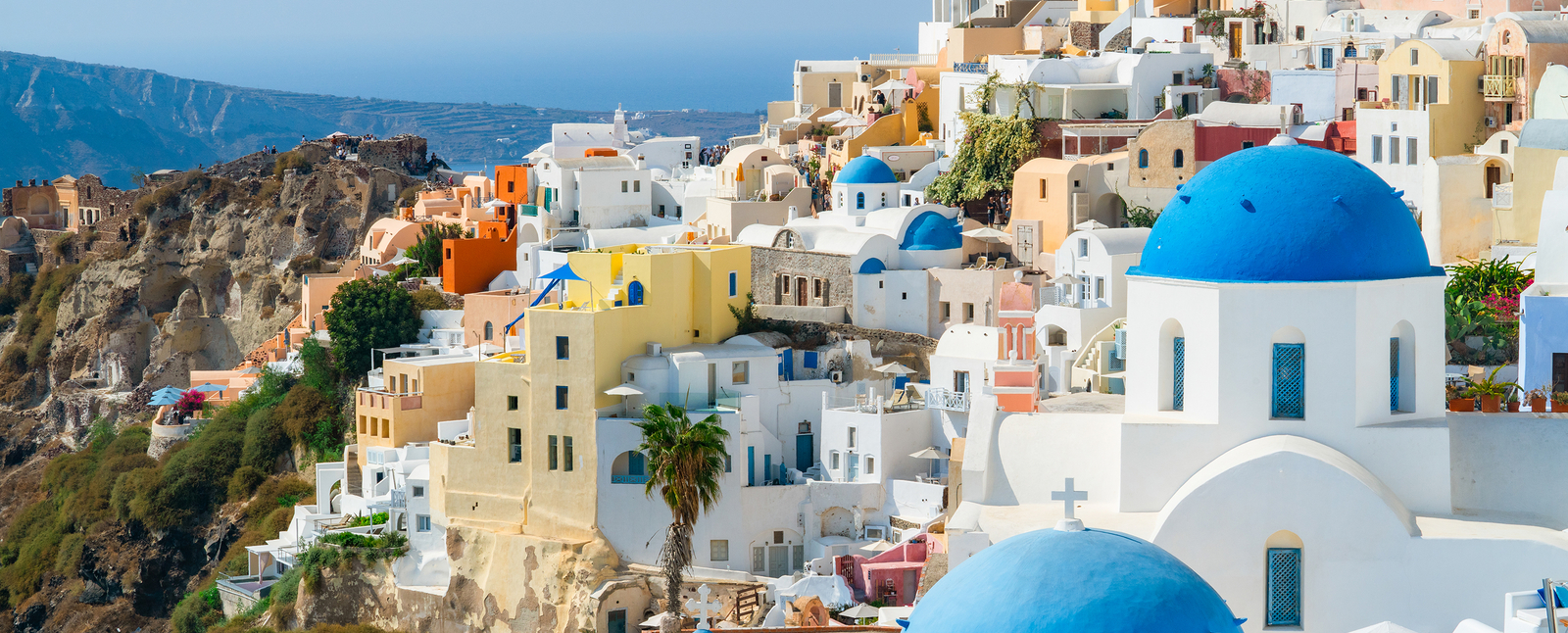
A Group Leader’s Big C: Connection, Continuity and Culture in Greece

- Greece offers more than historic sites, bringing together landscape, daily life and culture in ways that feel immediate and lived in.
- Participants gain a sense of continuity, connecting ancient history with the modern world and their own place in it.
- Food, language and education reveal how traditions carry forward across generations.
- Travel today invites greater openness, helping participants engage more deeply with local customs, perspectives and ways of life.
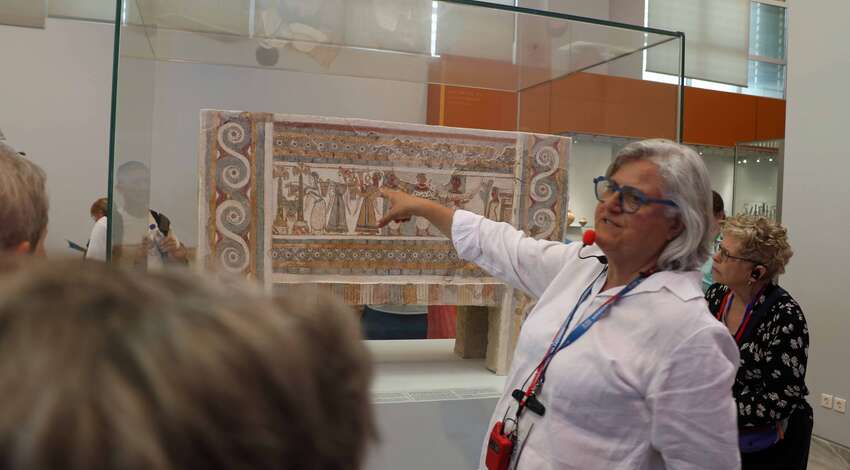
When Group Leader Georgia Papadopoulou talks about Greece, she doesn’t begin with a place so much as a feeling.
“I feel I am 100% myself when I travel,” she says.
For nearly 20 years, Georgia has been leading Road Scholar participants across Greece, from the Acropolis to the islands of the Aegean. Her path to this role wasn’t linear. For 15 years, while raising her son, she stayed close to home, working in education as an editor and academic support.
When she returned to this work in 2006, she found something that brought everything together.
“Exploring and learning at the same time, and sharing this experience with other people,” she says. “That’s the thing I like best.”
It's a philosophy that shapes every program she leads.
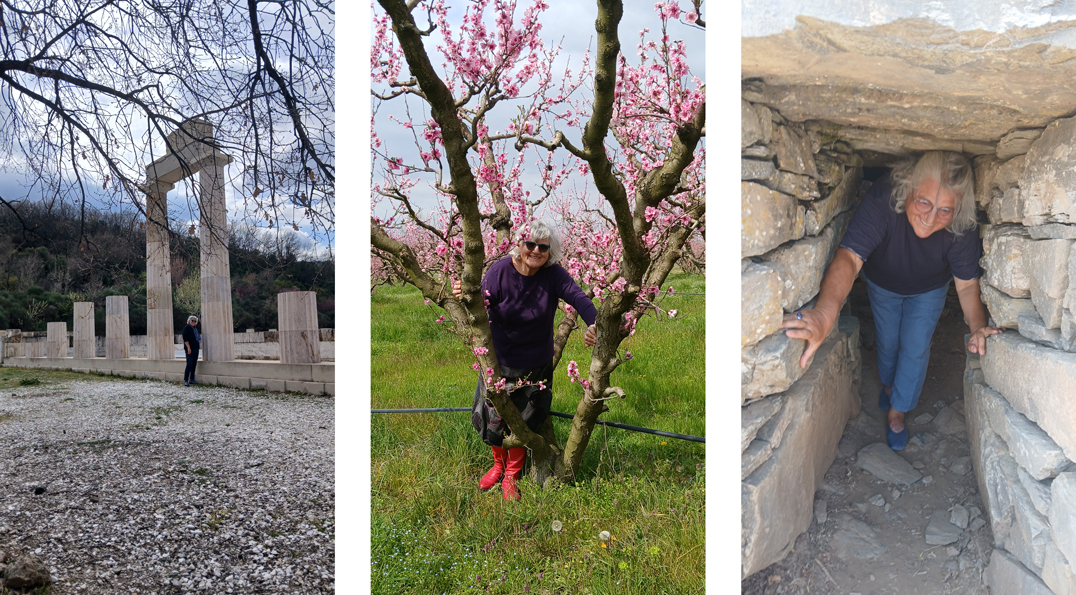
A Landscape That Surprises
When asked what she most looks forward to sharing with her participants, Georgia points first to the landscape — especially on programs that explore the Aegean islands.
She builds in what she calls “wow spots,” carefully chosen viewpoints where the breadth of the landscape reveals itself all at once. In Greece, as you can imagine, there’s always another around the corner.
Participants often arrive expecting history, and of course they find it. But many are surprised by something more immediate — how accessible the natural world feels. The light, the sea, the openness of it all. “Our Road Scholars don’t just look at the landscape,” Georgia says. “They move through it.”
For Georgia, those moments of surprise never get old. “I always have a little ace up my sleeve for the next wow moment,” she says.
Where Past and Present Meet
Greece’s history is a major draw, and Georgia delights in sharing it. At places like the Acropolis, conversations turn to architecture, philosophy and the enduring gravity of the Parthenon. But what she finds most meaningful is what participants notice next.
“Just two steps away, you’re in the heart of the city,” she says. “In this vibrant, modern world.”
That contrast — ancient and modern, side by side — is something she returns to repeatedly. In Greece, the past isn’t set apart from daily life. It exists within it.
You see it in neighborhoods built around archaeological sites, in traditions that continue across generations and in the rhythms of everyday life unfolding near places that have stood for thousands of years.
Georgia’s goal is to help participants connect those layers rather than view them separately.
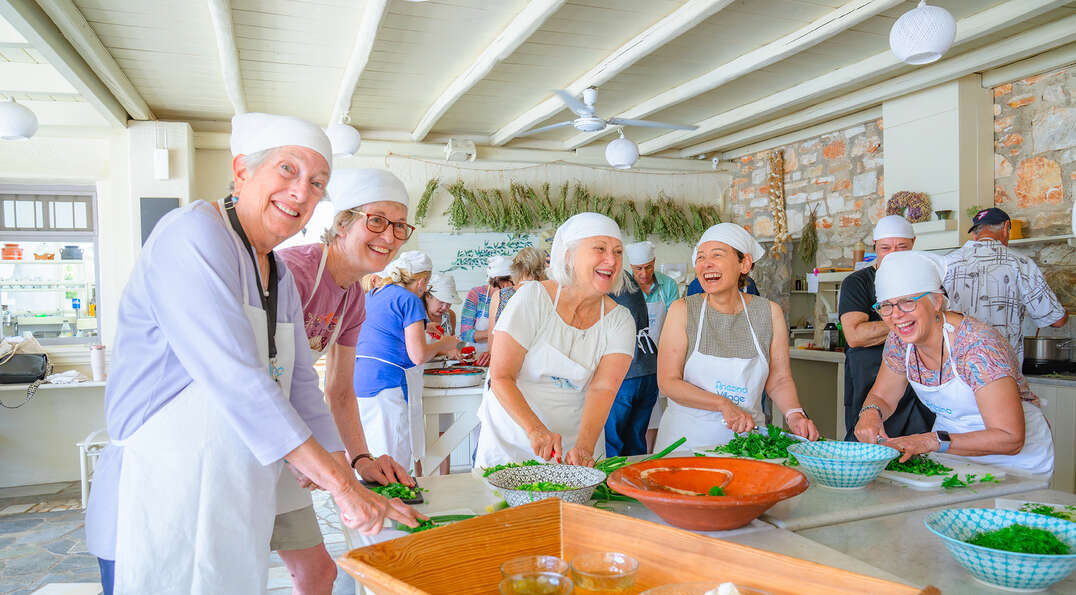
Participants cooking.
The Questions Road Scholars Ask
Over the years, Georgia has noticed certain questions come up again and again.
At archaeological sites and museums, participants often wonder how much of this history is shared by Greeks themselves. Do schoolchildren learn it?
They do — multiple times. Students study ancient, medieval and modern Greek history throughout their education, each time at a deeper level. Literature, mythology, music and culture are all part of that foundation.
Food is another frequent topic of curiosity, especially as culinary experiences have become a more important aspect of experiential exploration.
After a cooking class or a shared meal, participants often ask, “Do you cook like this at home?”
For many, food becomes one of the most tangible connections between past and present. Recipes are passed down, ingredients are tied to place and meals reflect a continuity of culture that feels both personal and shared.
Language brings up similar questions. Standing before ancient inscriptions, participants often ask whether modern Greeks can read them.
“They can read the words,” Georgia explains, “though fully understanding them requires study. Still, the connection is there, and it’s part of a larger story.”
Food. Language. Education. Each offers a different way of tracing what has continued over time.
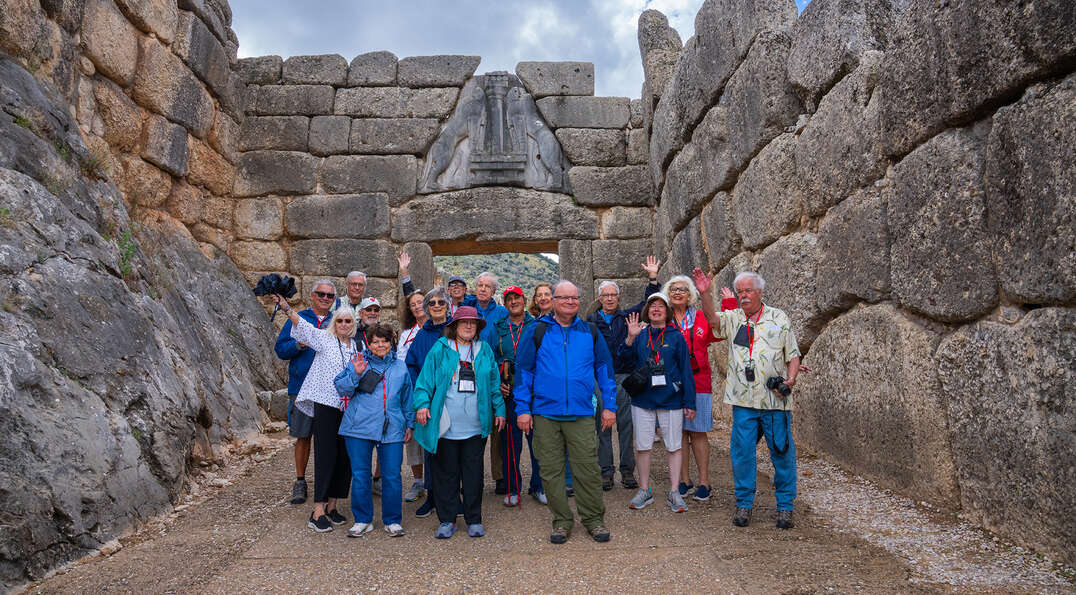
Archaeological Site of Mycenae, Greece
The “Big C”
Ask Georgia what participants carry home with them, and she returns to a single idea.
“Continuity,” she says. “A sense of continuity.”
She calls it the “Big C.”
In Greece, history is not something distant. It’s something you encounter, compare and place alongside your own understanding of the world. Participants begin to build connections across time and geography.
“When this was happening here,” Georgia says, “what was happening in the United States? In India?”
History becomes both vertical and horizontal, she explains, stretching across centuries while linking cultures and places.
In that process, familiar stories often take on new meaning. Mythology, for example, becomes more than a collection of tales. It becomes a way of thinking about human behavior and experience, shaped over time and still relevant today.
How Travel Has Changed
In her years working with participants, Georgia has seen how travel itself has evolved.
Road Scholars always take the time for self-education, but they arrive even more prepared than before, often having done their own research in advance — beyond the booklists and resources recommended by their program. At the same time, the sheer volume of information available today can create confusion as much as clarity.
She recalls a participant who showed her an image of a beautiful site in Greece — one that turned out not to exist at all, but had been generated by AI.
Even so, she sees meaningful changes for the better.
“People travel more,” she says. “They’re exposed to more and more tolerant to differences.”
Today’s participants are often more open to trying new foods, adapting to local customs and approaching unfamiliar experiences with curiosity rather than hesitation.
That openness, she believes, is where the value of exploration lies.
“Travel can broaden the mind,” she says. “And travel can narrow the mind as well. It depends on how you use it.”
Her role is to encourage the former.
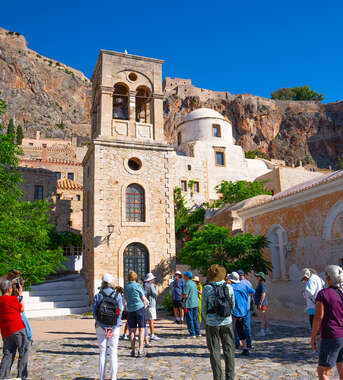
Monemvasia, Greece
At Home in More Than One Place
Georgia was born in Athens, just a short walk from the Acropolis. Today, she lives on the island of Paros, one of the destinations featured on Road Scholar programs.
She describes herself as connected to both, the energy of the city and the quieter rhythms of island life.
But there is another place she feels most at home.
“With my Road Scholar participants,” she says.
It’s in those shared experiences — moments of discovery, conversation and connection — that everything comes together.
At 66, she hopes to continue this work for years to come. What stays with her are the moments that extend beyond the program itself — the delight evident in group photos, the messages participants send afterward, even the pictures of dishes they recreate at home.
These small reminders are indicative of something larger — a sense of continuity, carried forward.
Curious what your own “Big C” moment might look like? Explore our Greece learning adventures and experience the landscapes, traditions and connections that bring the past into the present.