
The Colors of Greece: A Story in Blue and White

- Greece’s blue-and-white palette has no single origin. Its meaning developed through Cycladic architecture, Orthodox faith, independence and daily traditions.
- White limewash reflected the Mediterranean sun, helped disinfect surfaces and became part of maintaining Cycladic homes.
- Greece adopted flags featuring blue, white and the cross during the War of Independence. The cross represents the Greek Orthodox faith.
- Blue also appears in church domes and the mati protective charm, while images of the Aegean and Cycladic villages helped make the colors symbols of Greece worldwide.
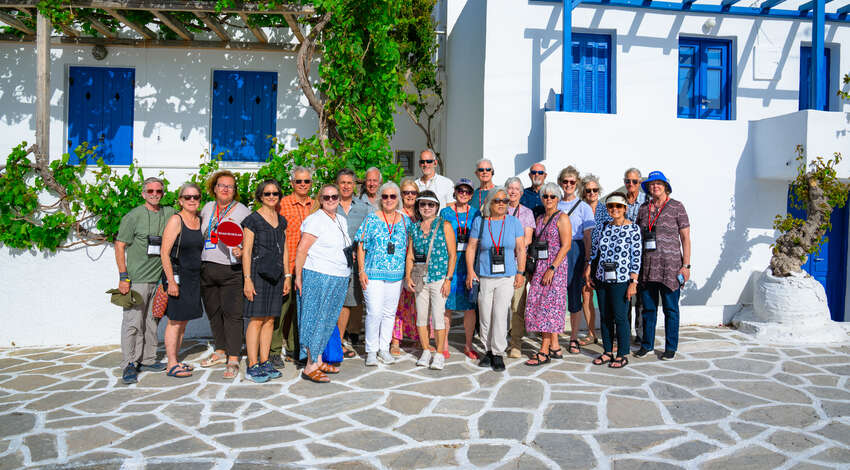
Few color combinations evoke a place as instantly as blue and white evoke Greece. Picture a whitewashed village rising above the Aegean, its blue doors and church domes echoing the sea below. The colors appear on fishing boats, protective charms and the Greek flag itself.
But there’s no single explanation for their significance. Across Greece, blue and white carry layers of meaning shaped by climate, faith, independence and daily life. Their story begins not with symbolism, but with something far more practical.
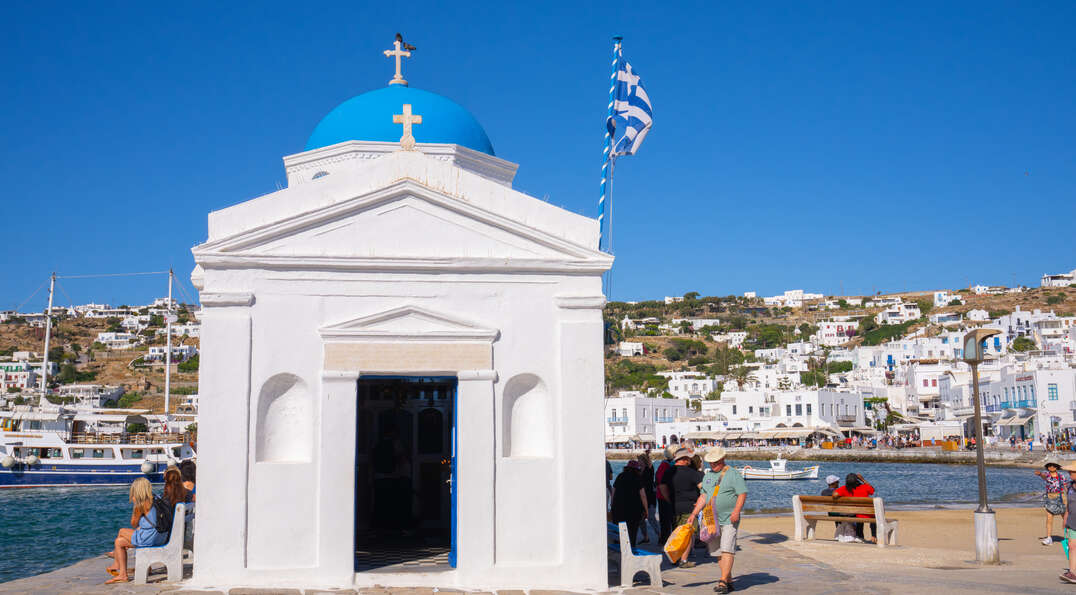
Mykonos, Greece.
Whitewashed by Necessity
The white villages seen in countless photographs are especially characteristic of the Cyclades, the group of islands that includes Santorini, Mykonos, Naxos and Paros. Beneath their postcard beauty lies an architectural style adapted to island life.
Traditional Cycladic homes were built from local stone and coated with limewash. The white surface reflected the strong Mediterranean sun, helping interiors remain cooler during the summer. Lime was also inexpensive, readily available and valued for its disinfecting properties. Families reapplied it regularly, often turning the upkeep of their homes and village streets into a seasonal ritual.
White had an aesthetic connection to the islands as well. The Cyclades are rich in marble, a material that shaped the region’s artistic traditions thousands of years before its whitewashed villages became famous. Early Cycladic sculptors transformed the stone into figures known for their spare, graceful forms — works that later influenced artists including Constantin Brâncuși, Henry Moore and Barbara Hepworth.
In the villages, white walls created a canvas for color. Doors, shutters and railings appeared in blue, green, red and other shades, often depending on which pigments were affordable or available. Blue became especially common, and against the bright walls, its connection to the surrounding sea and sky was hard to miss.

Santorini, Greece.
The Blue and White
Blue and white also tell the story of Greece’s emergence as a modern nation.
During the Greek War of Independence, revolutionaries carried flags in several designs and colors. In 1822, the provisional Greek government established official flags featuring blue, white and the cross. One was a striped flag used at sea — the predecessor of the national flag flown throughout Greece today.
The cross represents the Greek Orthodox faith, which held an important place in Greek identity during the struggle for independence from the Ottoman Empire. The meaning of the flag’s nine stripes is less certain. A popular interpretation connects them to the nine syllables of the revolutionary motto Eleftheria i Thanatos, or “Freedom or Death.” Others have associated them with the nine Muses of Greek mythology.
Neither explanation is established in the original decree, but the first has become part of the flag’s popular story. Greeks often refer to the flag simply as the Galanólefki — “the blue and white.”
The colors themselves are frequently said to represent the blue sea and sky and the white waves surrounding Greece. Whether or not those meanings guided the flag’s original creators, the interpretation feels fitting for a country with thousands of islands and a maritime history reaching back millennia.
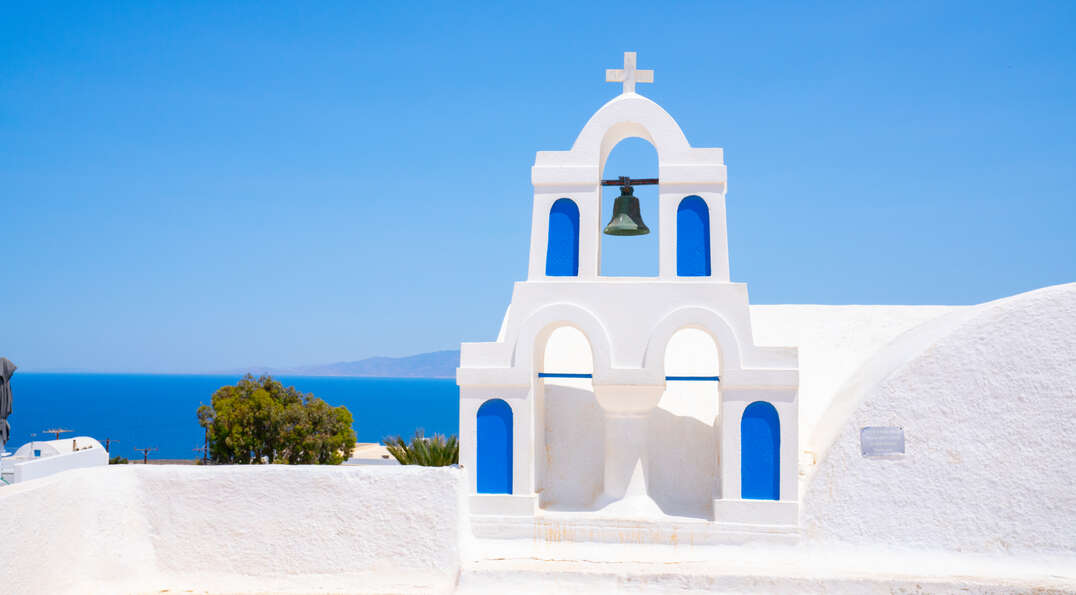
Santorini, Greece.
Blue as a Sign of Faith and Protection
Look beyond the flag and blue appears in another familiar Greek sight: the domes of Orthodox churches rising above island villages.
Not every Greek church has a blue dome. The image is most closely associated with the Cyclades, and especially Santorini. There, the domes create a striking harmony with the Aegean and the open sky. Blue and white connect the church buildings to their surroundings while giving visible form to the role of faith in Greek life.
Blue also appears in the mati, the eye-shaped charm found in homes, jewelry, shops and vehicles throughout Greece. The charm is believed to protect against the “evil eye,” a harmful force traditionally associated with an envious or overly admiring gaze.
Belief in the evil eye is neither exclusively Greek nor purely ancient. Versions appear across the Mediterranean, the Middle East and parts of Asia, and Greek traditions have changed over generations. Still, the blue-and-white mati remains a familiar part of life for many Greeks. Some wear one as an expression of sincere belief, others as a family custom or cultural symbol — and many might recognize a little of all three.
Here, once again, the colors occupy more than one world. They are spiritual and decorative, ancient and modern, deeply meaningful and completely ordinary.
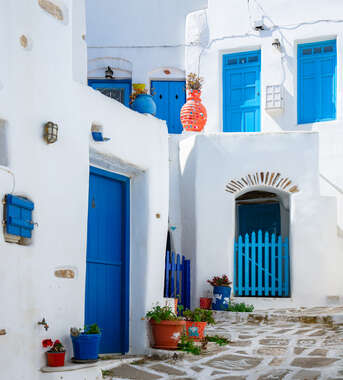
Paros, Greece.
Beneath the Surface
Over time, these separate uses of blue and white began reinforcing one another. The colors of the flag appeared beside whitewashed villages. Blue-domed churches overlooked the sea. Photographs, artwork and travel posters carried the combination far beyond Greece until it became an international symbol of the country itself.
Yet Greece cannot be contained within two colors. Beyond the white villages of the Cyclades are the honey-colored ruins of Athens, the green mountains of Epirus, the red-tiled roofs of Corfu and the stone villages of the Peloponnese. Even on the islands, doors and shutters have never been exclusively blue.
That fuller picture makes the familiar palette more interesting, not less. Blue and white don’t hold one fixed meaning or tell one tidy story. They reflect the way Greek culture itself has developed: through layers of geography, necessity, faith, history and tradition.
As we celebrate Greece as our 2026 Campus of the Year, those colors offer a fitting place to begin learning. At first, we see the Greece we recognize. Then we look more closely — and find centuries of stories hiding in plain sight.
Amy Holt is Communications Manager at Road Scholar, where she writes and edits stories about travel, learning and the people who bring both to life. She holds a master’s degree in English from the University of Maine, previously taught college composition and is the author of “The Herbal Goddess Guide”.