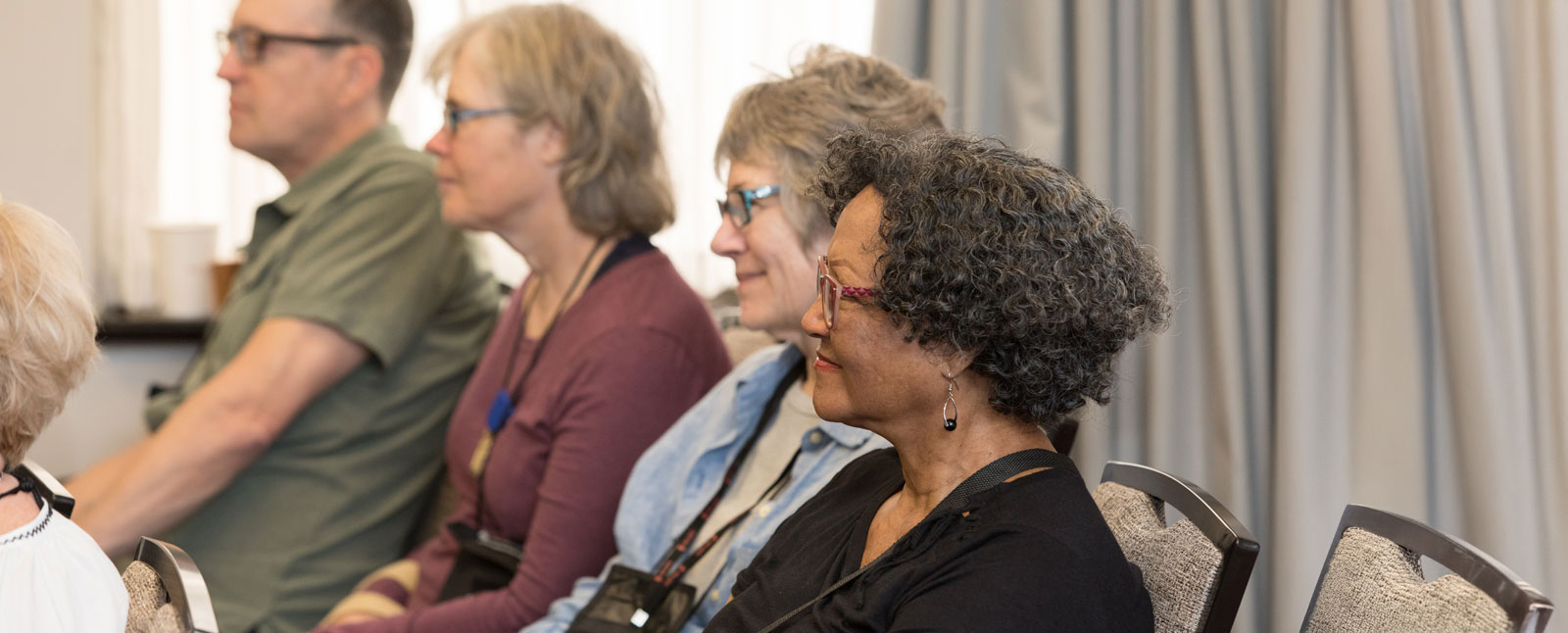
Interesting tidbits from the latest batch of LLI newsletters.
The Academy for Lifelong Learning of Cape Cod, Inc.
at Cape Cod Community College in Massachusetts offered a wide range
of stimulating courses this past fall. Among them was History of
the USMC. Events in the history of the Marine Corps were reviewed
and five major battles were explored in detail. The impact of aviation
on the Corps and the combat actions that made four marines famous were
also discussed. There were guest speakers and films were shown too.
The Academy for Lifelong Learning at Empire State College
in Saratoga Springs, New York offered members the chance to study American
Popular Music and the Times: 1900-1939, this past fall. The cultural
history of this era was detailed with handouts featuring relevant facts
and statistics, as well as photos of architecture, fashion and important
persons. Background information on the popular music of the time was
related to events of the period. Further discussion about composers,
styles of music and Tin Pan Alley songs that captured the mood of the
times, then took place. Finally, out came the song sheets and members
raised their voices in song, love songs, songs of desperation from the
Great Depression, songs of the Dust Bowl period, dance music from the
Big Band Era, and even some silly songs.
The Academy for Lifelong Learning at Kingwood College in
New Caney, Texas recently offered members as part of its Documentary
Film Series, the movie Louisiana Story: This Oscar-nominated,
Pulitzer Prize winning masterpiece was the last film made by Robert
J. Flaherty who is considered the "father of the documentary.”
It is a poetic and visually stunning work. Filmed in the Bayou country
of Louisiana, it follows the advent of an oil rig from the perspective
of a young Cajun boy. Originally released in 1948, the black and white
film has been beautifully restored. There was a short introduction before
and discussion afterwards about several aspects of the film.
The Department of Aging-Services to Seniors came to the Adult
Learning Program at Columbia-Green Community College in New
York this past fall to discuss important senior issues and programs
with the members. Topics covered included transportation, senior centers,
case management, home care services, health insurance counseling, home
delivered meals, and congregate meals. Other services included information
and assistance, caregiver services and legal services.
The Adult Learning Program at the University of Connecticut
in Hartford offered members a session entitled From Wagon Wheels
to Stainless Steel: The Architecture of American Diners. The presenter
talked about the history of diners, their architecture, and their food.
Participants then joined him on a luncheon expedition to a local diner.
The Center for Continuing Adult Learning at Hartwick College
and SUNY Oneonta in New York offered members some interesting
courses this fall. Among them was Revisiting Walden (1854).
Henry David Thoreau (1817-1862) is famed for his nature writing and
social commentary. Are his observations outdated or does he have something
significant to say to us today? Members explored this question in depth.
Members of the Chemeketa Center for Learning in Retirement
in Oregon explored Brazil this past fall. They discussed the
history and geography of the country and enjoyed personal observations
from some members who traveled to the country and/or hosted exchange
students from Brazil.
Members of the Community Academy for Lifelong Learning in State
College, PA offered a nice mix of fall classes. Among them
was Energy: Its Nature and History. This seven-week course
addressed the following questions: What is energy? How many kinds are
there? Why do we need so much? How have we learned to use it? What are
the limits and dangers?
Members of the Institute for Continuing Learning at Young Harris
College in Georgia were treated to a special visitor in the
Introduction to Islam course. A practicing Muslim who sits
on the board of directors of the largest mosque on Georgia, the gentleman
brought to the class his beliefs and insights from the standpoint of
an American citizen who just happens to be one of approximately seven
million people in this country who practice Islam.
Last fall, members of the Institute for Learning in Retirement
at Bluffton University in Ohio took a course entitled From
the New Frontier to the Great Society: The Presidency of Lyndon Baines
Johnson. This course focused on the transition from the Kennedy
administration to the Johnson presidency. The first two weeks focused
on JFK. The remaining six weeks focused on one of the most complex presidents
in American history –a man who led the nation through one of its
most trying, emotional times ever, through a grieving period that still
might not have ended. Johnson had the highest approval rating of any
20th century U.S. president yet, a decade later, was rated one of the
worst.
Members of the Institute for Retirees in Pursuit of Education
at Brooklyn College in New York were challenged this past fall
to study some stimulating topics. Among them was The Statesmanship
of Abraham Lincoln. This course dealt with the statesmanship of
Lincoln, covering his early life, his ascent to power, his mastering
of military, political and constitutional problems during the Civil
War, his foreign policy, his emancipation policies and his ideas of
reconstruction.
The Acadian Experience was the title of a course given at
Lagniappe Studies Unlimited/Osher Lifelong Learning Institute
at Louisiana State University this past fall. In 1604 a group of Frenchmen
left their mother country to establish a colony in North America in
present day Nova Scotia. Over a period of some 180 years a large portion
of their descendants found their way to Louisiana. This is the story
of their lives through the discovery of their ‘Acadie” to
them a virtual paradise on earth, their devastating expulsion from their
lands at the hands of a few Englishmen, of the terrible toll these years
took on themselves and their descendant families, of their suffering
as a result of their Diaspora and their final home in Louisiana. Participants
examined the effects of their nearly two centuries of wandering on their
lives, customs, occupations, language, music, architecture, food and
much more. The course concluded with a look at where Cajunism is today
and what it bodes for the future of their culture.
Members of the Learning Club in Winona, Minnesota
studied the War of 1812 this past fall. The discussion provided
a general overview of the causes, nature, and consequences of the War
in North America.
Members of the Learning Institute at New England College (LINEC)
in Henniker, New Hampshire took part in a stimulating course this past
fall; Are We Critical Thinkers/Careful Observers? Elementary
mathematics and a little curiosity were what was needed for members
to gain a fresh perspective on life. Through discussions, examples,
applications, and even mathematical magic, they found that joy, beauty,
creativity, inspiration and fun can result from exploring patterns,
making decisions, predicting and challenging what they read and hear
every day. Some video presentations were used in conjunction with explanations.
This past fall, members of the Learning in Retirement program
at Furman University in South Carolina took part in Team
Trivia on Tuesdays. Based on the popular board game, Trivial Pursuit,
it was placed by oral participation rather than on the board. They followed
the traditional categories and the atmosphere was competitive.
This fall, members of the Learning in Retirement Program at
Sacred Heart University in Connecticut took some interesting
courses. Corporate America: Health, Safety & the Environment
was one of those courses. A retired Corporate Executive and Professor
told the class how companies deal with these issues, the battles that
occur and how these issues impact on competitiveness and responsibility.
Global issues were discussed, both in fact and fiction, and current
crises such as global warming and auto emissions were also looked at
in depth.
Members of the Learning in Retirement program at Quinebaug
Valley Community College in Connecticut took some interesting
courses this past fall. Among them was this one, Was Alexander All
That Great? Participants spent time developing the history of the
world into which Alexander was born, exploring how he came to power
and his conquests of the Persian Empire. They tried to answer such questions
as: What was Alexander’s motivation? Did Alexander have any kind
of vision of a new world or was he just another in an unending line
of power-hungry conquerors? They also tried to discover some of Alexander’s
lasting contributions, if any.
Finding Media Balance in the Age of Spin was the title of
a forum given at the Lifetime Learning Institute at Northern
Virginia Community College in Annandale. With 24/7 new coverage,
700 channels to choose from, and worldwide access to information at
our fingertips, how do we begin to make sense of it all? Attendees discussed
ways media outlets report the news and the impact this reporting has
on consumers of the information. They viewed examples and engaged in
a lively discussion about the “spin” that is put on the
news we receive and its impact on how we look at the world. They also
discussed some strategies for how to be better media consumers.
Members of the Lyceum at Binghamton University in
New York took a course last fall entitled Scottish Enlightenment.
They studied Edinburgh in the mid-18th century. The Scottish capital
saw the flowering of some of the finest minds of the day, including
economist Adam Smith, philosopher David Hume, biographer James Boswell
and poet Robert Burns. Three Lyceum members also gave brief histories
of the area of Scotland to which they had ties.
Members of the McGill Institute for Learning in Retirement
took some stimulating courses this past spring. Among them was the Evolution
of Cooperation: From Woodrow Wilson to Win/Win to WalMart. What
was promoted, at the time of the formation of the League of Nations,
as a way to prevent World War II, then developed as Game Theory and
the Marshall Plan, has led to new ways of doing business and to resolving
deep-rooted ethnic, community and interpersonal conflicts in a “Flat
World.” We now reward rather than shoot collaborators. Upon registering,
participants will be given a study group outline and a reading list.
The Middlesex Institute for Lifelong Education in
Connecticut took part in an interesting session this past fall led by
a former Secret Service Agent, now a State of Connecticut Representative.
On Assignment was all about his personal observations while
assigned to the White House during the Watergate era as well as his
reflections on the American political scene thereafter.
Members of the Montreat College Center for Adult Lifelong Learning
in North Carolina recently studied Sir Walter Scott. This course
highlighted the historical dimension of Scott’s 27 novels, eight
long narrative poems, his histories, critical editions, researches into
folklore, magic and ancient ballads. Emphasis was placed on the rise
and fall of the House of Stuart, including Mary Queen of Scotts and
Bonnie Prince Charlie.
MSU for Seniors at Minnesota State University in Mankato
offered some interesting courses over this last year. Among them was
Embracing Laughter for Wellness. Authors of A Mirthful Spirit
talked about the benefits of laughter for wellness with tips for maintaining
mirthfulness within oneself at home, on the job, and during times of
distress. The focus of their message was how to intentionally seek out
laughter while minimizing negative humor in everyday life.
Members of the OLLI program at Duke University in
North Carolina were treated to some stimulating courses this past year.
Among them was Western Mystical Masters: Blavatsky & Steiner.
This seminar focused on the works of two great western mystics, Helena
P. Blavatsky and Rudolph Steiner.
Members of the Osher Lifelong Learning Institute at Granite
State College in New Hampshire were offered some stimulating
lectures this past fall. Among them was The Bee Mystery. They
heard the fascinating story of the world and background of honey bees.
They looked at several different questions including, What purpose do
bees serve? How do bees operate as a family unit in their hives? What’s
the overall importance of pollination? Participants then speculated
on the causes and potential impact of the current decline in numbers
– and discussed the potentially serious consequences of losing
bees.
The Osher Lifelong Learning Institute at the University of
N. Florida in Jacksonville offered some stimulating courses
this past fall. In the field of Politics and Religion members studied
Great Decisions in Foreign Policy, 2007; the Journey of Christianity;
Current Events Discussion Group; Islam, It’s Faith, People &
Politics; and the Origin of Good and Evil.
This past fall, members of the Osher Lifelong Learning Institute
at the University of Michigan in Ann Arbor took part in a course
entitled Haiti and Tierra Del Fuego: Poetization of History.
Participants had an opportunity to look into the history of marginalized
people. They studied the works of Alejo Carpentier ad Sylvia Iparraguirre
to better understand the subject.
Members of the Osher Lifelong Learning Institute at Oklahoma
State University recently studied Cross-Cultural Understandings
of “The After-Life.” They explored the values and understandings
people bring into their dialogue with the human and natural environment.
With a basic tenet that we are all creatures who spend a lifetime creating
social meaning for self and other, participants discussed ways to navigate
through their understandings of “The After Life.”
Literature of the Renaissance was the title of a fall course
given at the Osher Lifelong Learning Institute at Yavapai College
in Arizona. Members studied the major works and authors of this period
in European history and also used video, lecture notes and discussion
to undertake a thorough exploration of the topic.
Last fall, the Rose Institute for Life Long Learning in Ohio
offered their members a chance to study the History of Language.
They studied the origins of the English language with emphasis on the
different types of writing and phonetic notation, and the precursors
of our current form of English.
|